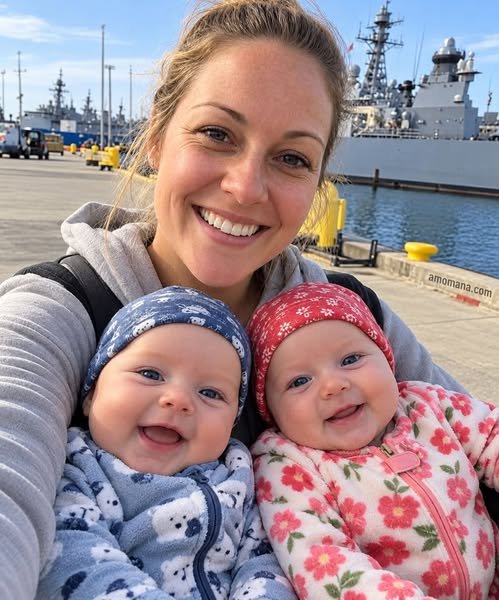
I looked past his shoulder at the tall man in a navy captain’s uniform standing ten feet behind him, a clipboard under his arm and an expression like granite.
“Captain Hollis,” I said pleasantly. “I believe you’ve been waiting to meet my husband.”
Ryan turned. The color left his face in stages.
“Mrs. Brennan,” the captain said, stepping forward. “Thank you for coming in person. Mr. Brennan, I need you to step aside with me, please. Both of you.”
The woman’s smug little smile had vanished. “Ryan, what is he talking about?”
“Nothing,” Ryan said. “It’s nothing.”
“It’s not nothing,” I said, shifting Mia on my hip. “It’s the thing you forgot.”
Here is what Ryan had overlooked.
Six weeks earlier, when the twins were barely a month old, he had called me from the ship at two in the morning, drunk and cheerful. He told me about a “crew party” and let slip that he’d “found a way to make some extra cash” by selling passes to the staff-only deck to passengers. Then he’d laughed and said, “Don’t tell anyone, Claire. It’s practically a tip.”
I hadn’t thought much of it. I was sleep-deprived, holding two babies, and half listening. But I’d saved the voicemail, because I saved every voicemail he left, so the girls would one day hear their father’s voice.
When I replayed it a week later, the details bothered me. Staff-only deck passes. Cash. He mentioned a name, the ship’s pursar.
So I did something Ryan never imagined I would do. I called the cruise line’s ethics hotline. I wasn’t angry, not yet. I was simply a worried wife who thought her husband had said something foolish.
The investigator who called me back was polite and very careful. He asked if I’d be willing to share the voicemail. I did. Within two weeks, the company had pulled security logs, cash records, and passenger complaints. The “extra cash” turned out to be nearly forty thousand dollars over eight months. It also involved falsified access records and, as they later discovered, a passenger whose jewelry had gone missing from a restricted area.
Ryan hadn’t been caught yet. The company had been quietly building a file. And when I mentioned, in a follow-up call, that I planned to meet his ship at the harbor to surprise him, the investigator asked a gentle question.
“Mrs. Brennan, would you be willing to let us know when you arrive?”
I hadn’t intended to expose my husband at a cruise terminal. I had intended to introduce him to his daughters. But the moment I watched him kiss another woman, and heard him say it was how men are, I realized something simple. I didn’t owe him my silence anymore.
So I sent one text, from the terminal bench, while he was still walking toward me.
We’re here. He’s with someone. I think now is fine.
Captain Hollis and two security officers walked Ryan twenty feet away. I couldn’t hear every word, but I didn’t need to. I watched his shoulders drop, then rise again in protest, then drop for good.
The woman, whose name turned out to be Brianna, stood alone with her suitcase. She looked at me, then at the babies.
“I didn’t know he was married,” she said quietly. “He told me he was separated. He said his wife had left.”
“I haven’t left anywhere,” I said. “I’ve been home with these two.”
She went pale. “I’m so sorry. I didn’t know.”
I believed her. Her shame was real, and there was no triumph in it for me. “I know,” I said. “You should know he told me you weren’t the only one.”
Her mouth tightened. Without another word, she picked up her suitcase and walked toward the taxi stand. She did not look back at Ryan.
Captain Hollis returned alone ten minutes later.
“Mr. Brennan has been relieved of duty, effective immediately,” he said. “His crew pass has been revoked, and the company is turning the file over to the authorities. There’s a conversation he’ll need to have with the harbor police.”
Behind him, two officers were walking Ryan toward a side door, his hands in front of him, no cuffs yet, but not free either. He glanced back once. His face was a stranger’s.
“Claire,” he called. “Claire, please. We can talk about this. Think about the girls.”
I looked down at Ava, who was gripping the edge of my collar with one tiny fist, and at Mia, asleep and unbothered.
“I am thinking about the girls,” I said.
He opened his mouth. One of the officers touched his elbow, and he went through the door without finishing the sentence.
Captain Hollis stayed a moment. “For what it’s worth, ma’am, you did the right thing. Most people wouldn’t have.”
“I didn’t do it to hurt him,” I said. “I did it because the girls will ask someday what kind of man their father was. I’d rather tell them the truth than a story.”
The process took eleven months.
Ryan was charged with theft, fraud, and falsifying records. His lawyer pushed for a plea, and after several hearings, he accepted one. He received a sentence of eighteen months, with restitution to the cruise line and the passenger whose jewelry had vanished. His maritime license was revoked for life.
I filed for divorce the week after the harbor. His attorney tried to argue that the adultery was irrelevant to custody, and the judge agreed on that point. But the judge was not blind to the rest. I received primary custody. Ryan received supervised visitation after his release, conditional on counseling and proof of steady work.
The cruise line, to my surprise, sent a letter of apology for the way the matter had unfolded, along with a modest settlement for emotional distress. I put it in a savings account for Ava and Mia, labeled Fresh Start.
I went back to work part-time as a bookkeeper. My mother moved in for six months to help with the babies. My sister brought dinner twice a week. There were mornings I wept over cold coffee, and mornings I laughed at two small faces covered in oatmeal. On the whole, I was tired, and I was free.
Ryan wrote to me once from prison. It was a short letter, two pages in careful handwriting.
Claire,
I’ve had a lot of time to think. I said things at the harbor that I’m ashamed of. I told myself for years that being away made it excusable. It never did. I’m not asking you to forgive me. I just want to say I’m sorry, and that I hope the girls grow up knowing nothing of what I said that day.
If it’s ever possible, I’d like to earn the right to know them.
Ryan
I read it twice, folded it, and put it in a drawer. I did not reply for three months. When I did, my answer was brief. I told him the girls were healthy and happy. I told him that supervised visits would begin after his release, if he completed his counseling. And I told him the truth I’d carried since that morning at the terminal.
You can earn their respect. You can’t earn mine back. But you can be a better man than the one I saw.
On the girls’ third birthday, we had a small party in our backyard. Ava wore a paper crown. Mia insisted on a dinosaur cake. My mother cried over the candles, and my sister filmed everything.
In the middle of the singing, a car pulled into the driveway. A thin, quiet man stepped out, holding a wrapped box. It was Ryan, six weeks out of prison, three months into his counseling, standing at the edge of the lawn as though he wasn’t sure he was allowed.
I walked over. We stood a few feet apart.
“I won’t stay,” he said. “I just wanted to give them this.”
I took the box. Inside was a small wooden boat, carved by hand, with two names painted on the hull in uneven letters: Ava. Mia.
“I made it in the prison workshop,” he said. “It’s not much.”
I held it for a moment. Then I called the girls over. They came running, curious, wearing frosting.
“This is a present from someone who wants to know you,” I said. “His name is Ryan.”
Ava looked at him with the unflinching honesty of three-year-olds. “Are you a pirate?”
For the first time in years, I saw something real in his face. A small laugh, a crack in the armor.
“No,” he said. “Just a man who got lost a long time ago.”
Mia studied the boat, turned it over in her hands, and handed it back. “Float it,” she said.
So the three of them walked to the little plastic wading pool by the fence, and I stood with my mother and my sister and watched my daughters and their father set a wooden boat on the water.
It wasn’t a happy ending. It was something better and quieter: a start.
The boat bobbed, tilted, and then, steadily, floated.