I took a screenshot of the zero balance, then another of the transaction log, and went downstairs.
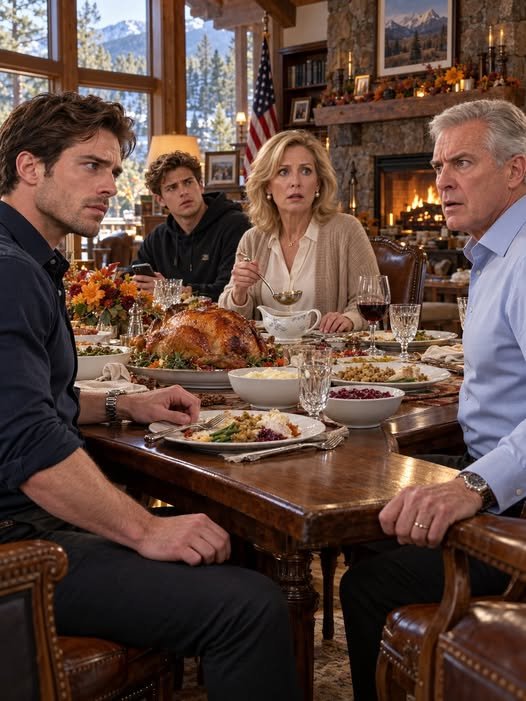
Nobody had moved. The turkey was cold, and Cresa still held the ladle as if she had forgotten it was in her hand.
“Who used the emergency access?” I asked.
Dad set down his fork. “It was family money, Jet.”
“It was my money. The code goes to two phones. Whose?”
“Mine,” Dad said. “And Cresa’s email.”
I looked at my stepmother. She had always been the peacemaker, the one who kept things pleasant. Now her face had gone gray.
“Jet,” she said, very quietly, “I need to tell you something, and I need you to let me finish.”
“The hospital letter came in September,” she said. “I opened it. I know I shouldn’t have, but you’d told us it was your procedure, and I wanted to understand it.”
She pressed her lips together. “It wasn’t your name on the first page. It said Patient: Bod Armmitage. Rheumatology. Aggressive inflammatory arthritis, with joint erosion already present.”
Bod looked up from his phone. It was the first time all night I had seen him afraid.
“What?” he said.
“I didn’t understand it,” Cresa said. “I read the word ‘aggressive’ and the word ‘erosion,’ and I looked up the rest on my phone at two in the morning. The pages said it could cripple a person’s hands. And I…” Her voice cracked. “I panicked. I decided that if my son was sick, he deserved the best birthday of his life, in case…”
“In case what?” Bod whispered.
“In case it was the last one where you could still hold a camera.”
The fire popped behind us. Nobody said anything.
“You didn’t know it was treatable,” I said slowly.
“I didn’t let myself find out. I told myself the diagnosis was a sentence. And your father agreed, because he couldn’t bear it either, and between the two of us we made a terrible decision and called it love.”
Dad stared at the tablecloth. “I said he only gets one birthday a year,” he said. “I wasn’t talking about the party. I was talking about the hands.”
I understood then that the cruelest sentence of the night had been a frightened man’s version of a prayer. It did not make it right, but it changed what it was.
“You should have called me,” I said. “The patient was your son, and the money was meant for him. All you had to do was dial my number.”
“I know.”
“I answered every call for three weeks.”
“I know.” Cresa put the ladle down at last. “I was ashamed to say it out loud. If I said it, it would be real.”
Bod stood up. His chair scraped the floor.
“Eleven months ago,” he said, looking at me, “you took me to a doctor ‘for sponsors.’ It was never for sponsors, was it?”
“No.”
“You’ve been saving for this the whole time.”
“Every bonus. Every tax refund.”
“And I spent it on fireworks.” His voice broke. “I flew in people I barely know so they could film me blowing out candles. How much?”
“Forty-one thousand,” Dad said. “The lodge was twenty-six.”
Bod put both hands over his face. When he lowered them, I saw my little brother, the one I used to carry on my shoulders.
“What does Dr. Ror say about the window?” he asked.
“Two months, maybe. After that, the damage starts to be permanent.”
I called the bank’s fraud line that night from the guest bed. The representative was kind and exact. The emergency provision was meant for situations where the owner could not be reached, and I could prove I had been reachable. If I filed a dispute and a report, they would investigate it as unauthorized access.
I thought about Dad in a deposition and Cresa in a courtroom. Then I thought about Bod’s right hand, closing a little less each month.
At midnight, Bod knocked and came in without waiting.
“Don’t file it yet,” he said. “I need to fix what I can first.”
“You have one week.”
“That’s all I need.”
He used it better than I expected.
He sold the watch, the sneakers, and two of the cameras. He cancelled three brand contracts and told the sponsors why. Then he posted an unedited video of his hands, the swollen knuckles and the finger that had begun to curl, and told the whole story. He did not blame our parents. He said, “I got a birthday party, and my brother got a bill. I’d like to fix that.”
By the end of the week the video had passed three million views. A sports medicine foundation offered a grant. The lodge in Sedona, embarrassed, refunded nineteen thousand dollars of the deposit. Two of the performers sent back their fees.
Dad did the rest. He cashed out a retirement account and wrote me a check at the kitchen table, his pen skipping twice. When he handed it over, his hand shook.
“I read page two of that letter again last night,” he said. “The one that explains the treatment. I should’ve read it first.”
It wasn’t an apology. But it was the first time my father had ever admitted he hadn’t read something.
The surgery took place on the second of January. Dr. Ror’s team repaired the damaged joint in Bod’s right hand, and a rheumatologist started the long, patient course of treatment that would keep the disease quiet.
I sat in the waiting room for four hours with a cold coffee. Cresa sat beside me, folding and unfolding a tissue. Dad stood by the window. Nobody spoke until the surgeon came out.
“We caught it in time,” she said. “He’s going to keep full use of that hand.”
Cresa broke down. Dad turned to the window so we couldn’t see his face.
Bod woke groggy and grinning, with his hand wrapped in white. “Hey,” he said when he saw me. “Did you pay for this?”
“Everybody paid for it.”
“Then I’m paying everybody back,” he said. “Every cent.”
He did. It took two years of small, awkward transfers. Dad drove him to every infusion appointment and sat in the plastic chair without complaint. Cresa learned to ask questions before making decisions, and to pick up the phone when she was frightened.
I never filed the complaint. The bank agreed to close the file once restitution was complete, and I let it go. A report would have punished two scared people for the thing that had already scared them most. That was my choice, and I’m still at peace with it.
The next Thanksgiving, I flew into Flagstaff with a bottle of wine, as I always do. Bod met me at the door. His hand was scarred but steady, and in it he held a dish towel.
“I cooked,” he said.
The turkey was dry. The gravy was lumpy. Nobody mentioned it, and we ate every bite.
Halfway through dinner, Cresa cleared her throat.
“Jet,” she said. “I opened a letter that wasn’t mine, and I made a decision that wasn’t mine to make. I’m sorry for all of it. I’ll be sorry for a long time.”
I looked at her for a while. Then I passed her the gravy.
“Thank you for telling me,” I said. “Next time, call.”
“I will.”
Across the table, my brother flexed his right hand, slowly and fully, and grinned.
For the first time in my life, nobody at that table was performing, and nobody was counting what anyone else owed.