The authorization log listed two names. Railan Armmitage. Cresa Armmitage.
I read them three times, then walked downstairs with my phone in my hand.
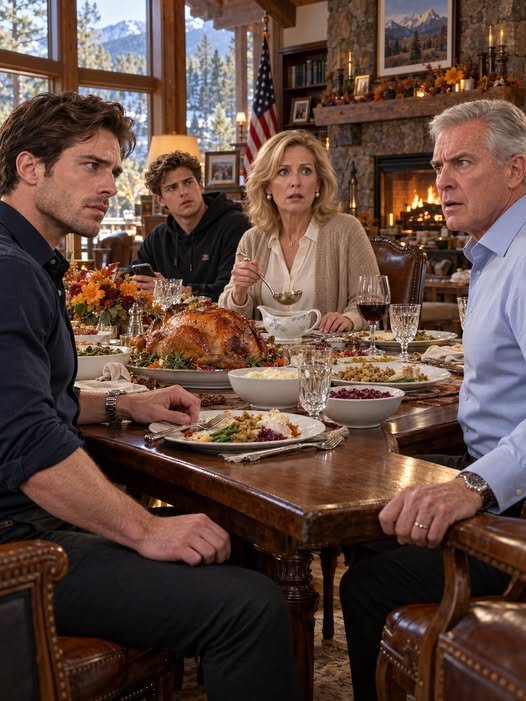
“Who verified the emergency access?” I asked. My voice was level, and I was proud of that.
Dad didn’t pretend. “Cresa got the codes off your old laptop when you visited in spring. We approved it together. Jet, you’ve never been short of money. You were saving for something small.”
“It wasn’t small,” I said. “And it wasn’t mine.”
Cresa put the ladle down. “Then whose?”
I looked at my brother.
“Bod,” I said. “It was yours.”
Nobody moved. The fire popped, and somewhere in the house a clock ticked loudly.
Bod pulled his earbud out slowly. “What?”
“Eleven months ago you fell asleep on my couch and I saw your hands. They were swollen, stiff, and hot to the touch. You’d been blaming old sports injuries.” I kept my eyes on him. “I called Dr. Ror and arranged tests. They found a growth on your pituitary gland. It’s why your joints ache, why your rings stopped fitting, and why you’ve been exhausted for a year. It’s slow, but it doesn’t stop. Surgery now is routine. Wait too long and the damage to your heart, your joints, and your vision can’t be undone.”
“You said it was a minor procedure,” Cresa whispered. “You said it was yours.”
“I said that so you wouldn’t take it over and make it about you.” I let that land. “I should have trusted Bod to handle it like an adult. I didn’t, and that was my mistake. But the money was for him, and you spent it on his birthday.”
Dad’s face had gone the color of the tablecloth. “We didn’t know.”
“You didn’t ask.”
Bod’s voice cracked. “Why didn’t you tell me?”
“Because every time something is wrong with you, Dad lectures and Cresa performs. I wanted you to hear it from a doctor first, with a plan in your hands. I was saving the last of the deposit.” I swallowed. “The appointment letter was supposed to be your first step. They hid it, and they spent your treatment on fireworks.”
My brother stood up. His chair scraped the floor, and for once he looked like someone with no audience.
“Dad,” he said quietly. “Is that true? You knew there was an appointment and you spent the money anyway?”
“You only have one birthday a year,” Dad said, but the line had no strength left. It sounded like something he’d been repeating for so long he no longer heard it.
“I’d have given up the party in a second.” Bod’s eyes were wet. “I didn’t even want the party. Cresa said the sponsors expected it.”
Cresa’s hand flew to her mouth. “Bod, honey, we were trying to…”
“You were trying to look good,” he said. “Like always.”
I had never heard him speak to them like that. I had spent twenty years watching him accept every gift, every excuse, every spotlight they handed him. I’d assumed he enjoyed it. Maybe he had. But he wasn’t stupid, and he wasn’t cruel, and he had never been asked to carry anything heavy.
He was carrying it now.
I left the table and called Dr. Ror from the porch, in the cold, with my breath clouding in front of me. It was a holiday evening, but he picked up on the second ring.
“Jet. What’s happened?”
I told him. He was quiet for a moment, then said, “The surgical slot is still open until the fifteenth of December. If the deposit is guaranteed by then, I can hold it.”
“It’ll be guaranteed,” I said.
Then I called the bank’s fraud line, which never closes. A representative named Denise listened to everything and did not rush me. When I told her the account was in my name alone and the emergency provision was meant for genuine medical emergencies, she said, “Mr. Armmitage, I’m placing a hold on all linked access right now. I’m also opening a dispute. Withdrawals made under a medical-emergency provision, when the account holder was reachable and never consented, don’t meet the terms.”
“Can I get it back?”
“I can’t promise all of it. But the funds moved to a merchant account for a venue and an events company, and I can flag both. Please file a police report tonight. It will strengthen the claim.”
I filed the report from the guest room. Dad stood in the doorway for a long time before he spoke.
“Are you going to have us arrested?”
“I’m going to get my brother’s surgery paid for,” I said. “What happens to you depends on whether you help.”
He sat down on the edge of the bed. For the first time in my life, my father looked small.
“I thought I was being generous,” he said. “To him. To everyone.”
“With my money. With his health.”
He nodded. He didn’t argue, and that was how I knew it was over.
It took eleven days. The venue returned most of its deposit once the dispute landed, and the events company refunded what hadn’t been spent. Dad liquidated an investment account he had kept quietly for years and covered the rest, not offering it as a favor, but handing it over like a debt. Cresa wrote me a letter, which I read once and put in a drawer. Bod sold two watches and a collection of limited-edition sneakers, and posted a video, plain and unscripted, saying he was having surgery and was grateful to his brother. It got more views than anything he’d ever made, and he took it down two days later because he said it had stopped feeling honest.
On December ninth, I sat in a hospital waiting room in Phoenix with a paper cup of terrible coffee. Dr. Ror came out after four hours, still in his cap.
“It went well,” he said. “Clean margins. He’ll be sore, but he’ll recover.”
When I finally saw Bod, he was groggy and pale, a hospital band around his swollen wrist. He looked at me, and his mouth shook.
“You saved up for a year,” he said. “And I never even said thank you.”
“You can say it now.”
“Thank you.”
I took his hand carefully, mindful of the IV. “Next time, tell me when something hurts.”
He laughed, then winced. “Deal.”
Thanksgiving the following year was at my apartment in Denver. It was small, the table barely sat six, and Dad brought wine that he’d chosen himself, without asking what I wanted. Cresa set out napkins and said very little. Bod, thinner and sharper, arrived on time and carried in the potatoes.
Before we ate, Dad cleared his throat.
“I’d like to say something. Jet, you carried this family for a long time, and I let you because it was convenient.” His voice was rough. “I’m sorry. I don’t think I can say it enough, but I’ll try.”
I didn’t forgive him all at once. Forgiveness, I’ve learned, comes in installments, like any debt that’s finally being paid. But I passed him the stuffing, and he took it with both hands.
At the end of the table, Bod lifted his glass and caught my eye.
“To the one who saw it first,” he said.
I raised mine, and for the first time in years, the room felt like it belonged to all of us.