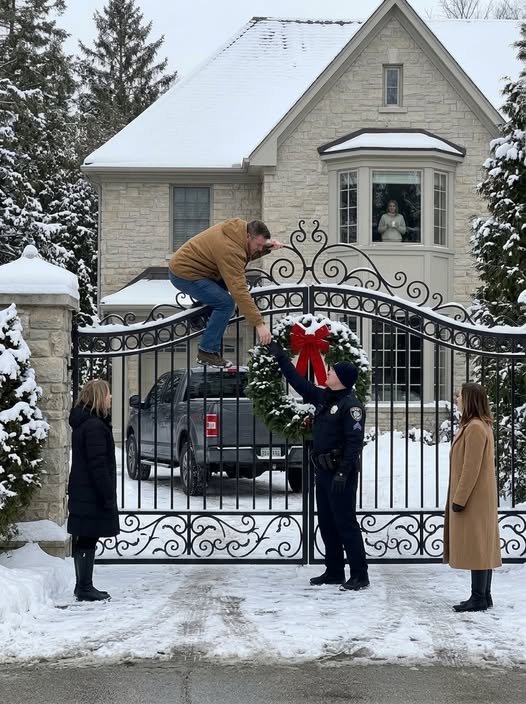
“Let them stay at the gate,” I said into the intercom. “I’ll come out.”
I put on my good wool coat, the navy one Richard bought me the winter before he died, and walked down the long drive. The December air was sharp and bright. Through the iron bars, my three children stood in a row like people waiting outside a closed bank.
Michael had climbed down. His palms were red from the cold metal. Jennifer’s cheeks were flushed. Lisa kept glancing at the camera mounted above the post.
“Mom,” Jennifer said, in the voice she used on customer service lines. “This is ridiculous. We drove four hours.”
“You drove two,” I said. “Michael lives in Boulder.”
Nobody laughed.
“I’m going to say this once, and I’m going to say it kindly,” I said. “I’m not angry. I was. I cried for a week. Then I decided to stop waiting for you to love me the way I needed, and start taking care of myself.”
“You changed the locks on your own children,” Michael said.
“I changed them on everyone. That’s what locks are for.” I folded my hands. “You told me to figure it out myself. So I did.”
Lisa’s voice wobbled. “Mom, we didn’t mean it like that.”
“Lisa, when I was in that hospital bed, scared I was dying, you texted me an emoji.”
She looked at her boots.
“I’m not asking for an apology at a gate,” I said. “I’m asking you to hear what I did. Then you can decide whether you want to be in my life or in my will.”
Jennifer’s eyes snapped up. “Your will?”
“Thomas is waiting in the house. Come in. Slowly. The officer will walk with you.”
Thomas Brennan sat at the end of my dining room table with a leather folder and a pot of coffee he had made himself. I had set out only four chairs. The grandchildren and spouses, I’d arranged, would be welcomed to wait in the sunroom with hot chocolate and a movie. They were not part of this conversation, and I didn’t want them to hear it.
My children sat. Nobody touched the coffee.
“Margaret asked me to explain what has changed,” Thomas said, “and to do it without drama. So I will.”
He opened the folder.
“First, the house. It is now held in a living trust. Margaret is the sole trustee and beneficiary during her lifetime. It cannot be sold, mortgaged, or transferred without her signature, and no one can petition to move her out without a doctor’s certification and her own consent.”
Lisa went pale. Michael’s jaw tightened.
“Second, her investments and savings are held in a separate trust, with a different trustee. Not any of you.”
“Who?” Jennifer demanded.
“A professional fiduciary. An independent firm in Denver.”
“That’s insulting,” Michael said.
“It’s protective,” Thomas said evenly. “Your mother asked for it.”
“Third,” Thomas said, and glanced at me.
I nodded.
“The life insurance policy,” he said, “was never part of the estate. Richard named Margaret as the sole beneficiary. She has since redirected a portion into two charitable gifts, which I’ll describe in a moment. The remainder stays with her.”
“Two gifts?” Lisa whispered.
I took over.
“One goes to a nonprofit in Denver that provides rides and in-home care for seniors who live alone. People who have nobody to call.” My voice shook slightly, then steadied. “I met a woman there last month. Eighty-one. She had been in the hospital for six days and nobody noticed she was gone. I understood her better than I wanted to.”
Jennifer looked away.
“The other,” I said, “is a scholarship in Richard’s name. For nursing students who care for older patients.”
For a moment, nobody spoke. The clock on the mantel ticked. From the sunroom, I could hear the muffled laughter of grandchildren watching a cartoon.
Michael broke first. “So that’s it. You’ve cut us out.”
“No,” I said. “I haven’t.”
Thomas turned a page.
“The will still names all three of you as beneficiaries of the remaining estate,” he said. “In equal shares. But with conditions.”
“Conditions,” Jennifer repeated, like she was tasting something sour.
“Margaret’s request is simple,” Thomas said. “Your inheritance is tied to something she can’t legally force, and wouldn’t want to. It’s tied to showing up.”
He read aloud from the document. “Each beneficiary will receive a full share only if, during the final five years of the settlor’s life, he or she has maintained regular, documented contact and care. Calls, visits, and presence in times of illness. A beneficiary who fails this standard receives a reduced share, to be redirected to the charitable fund.“
Lisa put her hand to her mouth.
“It’s not a punishment,” I said. “It’s a mirror.”
Jennifer was crying now, and not the polished way. “Mom, I know I’ve been terrible. I get so busy that I stop thinking, and then I feel guilty, and then I avoid you because of the guilt. It’s a spiral. I’m so sorry.”
“Jennifer,” I said gently, “I believe you. And I believe you also asked about Richard’s life insurance, three times, in the same month.”
She had no answer.
Michael stared at the table. After a long silence, he said, hoarsely, “I told you to figure it out yourself. I’ve replayed that sentence a hundred times. It’s the worst thing I’ve ever said to anyone.”
“It’s the truest thing you’ve said in a long time,” I said. “That’s why I listened.”
He looked up, startled, with wet eyes.
Lisa spoke last, very quietly. “What do you want from us, Mom? Tell us. Not the lawyer. You.”
I had rehearsed a long answer. I had written it in a notebook at two in the morning. But sitting there, I found it was short.
“I want a phone call on Sundays that isn’t a favor. I want someone to come to the hospital if I’m ever in one. I want to be a person you love, and not a house you’re waiting on.”
Nobody spoke. Then Lisa stood, walked around the table, and knelt beside my chair like she had when she was five.
“I’ll be at the hospital,” she said, crying. “If you ever need it. I’ll be there before the ambulance.”
I put my hand on her hair.
It wasn’t fixed that afternoon. Real repairs never happen that fast.
But they stayed for dinner. The grandchildren joined us, and the house, which had been so quiet for so long, filled with clatter and noise and the smell of roast chicken. Michael carved. Jennifer set the table, forgetting one fork, and then another. Lisa washed dishes beside me, silent and tender.
At the end of the evening, standing in the foyer, Michael hesitated at the front door.
“Mom,” he said. “The gate code. Can I ask what it is now?”
I smiled.
“It’s the date you were born,” I said. “All three of you. In order.”
He looked at me for a long moment. Then he nodded, lifted his hand to his face, and wiped his eyes.
That winter, Jennifer called every Sunday. Michael drove down once a month, bringing groceries I didn’t need and conversation I did. Lisa called on Wednesdays, too, just to say good night.
In March, I got a cold that turned into pneumonia. This time, my phone rang before I’d finished dialing.
Lisa was at my bedside in four hours. Jennifer arrived the next morning with a thermos of soup. Michael slept in the hallway chair, folded like a pretzel, until the nurse made him go home.
On the third night, I woke to find all three of them asleep in my hospital room, one in the chair, one on the window ledge, one with her head resting on the edge of my bed.
I lay awake in the blue light, listening to their breathing.
I had changed the locks. I had changed the code. I had changed the trust, the will, and every piece of paper they once treated as their future.
But the thing I had really changed was whether I was willing to be treated as less than I was.
The gate was still locked. The house was still mine.
And for the first time in years, my children were inside, by invitation, because they had finally chosen to come.