“I’m not the woman you think I am,” Violet said, wrapping both hands around her cup. “But I’m the reason you have a daughter.”
She was seventy-one, small and silver-haired, with the same tiny violet-shaped birthmark behind her ear that I’d seen on Gregory’s chest for twenty years. When she looked at me, her eyes filled.
“Please sit, Samantha. I’ve rehearsed this for two decades, and I still don’t know how to start.”
I sat. My coffee arrived and went cold.
“Gregory is my son,” she said.
I stared at her. “He told me his mother died when he was nineteen.”
“That’s what he believed.” Her voice shook. “Or what I let him believe.”
She told it slowly, looking at the tabletop.
Violet had her son at seventeen, in a small Central Valley town, with a boyfriend who left before the birth and a father who wouldn’t speak of it. She raised Gregory alone for eleven years, cleaning motel rooms at night. When he was eleven, she fell into a drinking spiral so deep she lost custody. A judge placed him with an aunt in San Diego. She was told she could visit when she was sober.
“I got sober at thirty-two,” she said. “By then, the aunt had moved, and nobody would tell me where. I spent years looking. When I finally found him, he was nineteen and furious. He said I’d abandoned him, and he’d made peace with a mother who didn’t exist.” She wiped her eyes. “He told me to stay away. I did. But he got a tattoo that year. I didn’t know until later.”
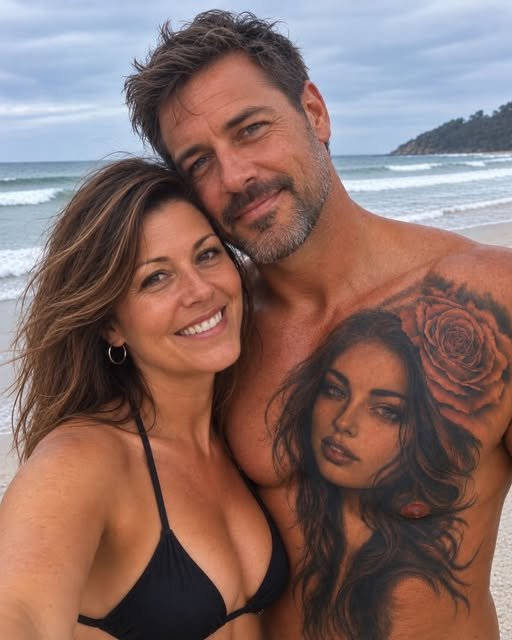
“The woman on his chest,” I whispered. “It’s you.”
“It’s me, young, the way he remembered me before the drinking. With the violet he always said I smelled like.” She laughed softly, wetly. “He told you she was imaginary because he couldn’t stand to say her name.”
My stomach had stopped lurching, but a different dread was forming.
“The photograph,” I said. “The baby. She’s holding Paige’s blanket.”
Violet nodded. “I need to tell you about Paige.”
I gripped the table.
“Eleven years ago,” she said, “I got a phone call from a social worker in Fresno. A young woman had given birth at the county hospital. She was nineteen, homeless, and wanted to place the baby for adoption. She had listed no father, and no family. But she’d named me, by my full name, as the only relative who might take her.”
“Your granddaughter?” I said, and then the words caught. “Paige is…”
“I’m not her grandmother, Samantha. I’m just the person who was called. The young woman, Dana, had once stayed at a shelter where I volunteered. I’d helped her.” Violet pressed her fingers to her mouth. “I couldn’t take a baby. I had no stable home, and no money. But I knew your husband and you had been trying for years. Gregory had written to me, once, when you started treatments. Just a card. He said he’d forgiven me but couldn’t see me.”
“So you called him.”
“I called him. He drove to Fresno in the middle of the night.” Her voice cracked. “He held that baby in the hospital nursery, and he looked at me for the first time in twenty years. He said, ‘Mom, are you sure she’ll be safe with us?’ I said, ‘More than anywhere on earth.’”
I had stopped crying and started listening. It was unexpectedly quiet.
“The adoption through the agency was real,” Violet said. “Everything legal. Gregory told me later you thought it was a closed placement. He and Dana’s social worker agreed to keep the details sealed, to protect Dana. But he asked me to be the quiet link, in case Paige ever needed to know where she came from.”
“Why didn’t he tell me you were his mother?”
“Because I asked him not to.” Her eyes were bright. “I’d destroyed so much. I didn’t want to arrive in your life as the drunk who lost her child. I wanted you to have a clean start. And he agreed, God help him, because he was ashamed too.”
She slid a small brown envelope across the table.
“The photograph on the back says, ‘Forgive me, Violet. She can’t know.’ It was meant to be burned. He never could. ‘She’ is Paige, not you. He was afraid she’d be hurt by the story. And he was afraid you’d be hurt by his silence.”
I turned the photograph over again. Gregory’s handwriting looked stricken.
“He’s been carrying this alone,” I said.
“For eleven years.”
I drove home in the dark with the envelope on the seat beside me. Gregory’s truck was in the driveway. Through the kitchen window I saw him sitting at the table with Paige, helping her with homework. He looked up when I came in. He saw my face.
“Sam,” he said slowly. “What happened?”
I sat down across from him. Paige looked from one of us to the other, then slid off her chair and said, in the careful voice of a ten-year-old who knows when grown-ups need privacy, “I’ll go finish this upstairs.”
When she left, I put the photograph on the table.
He stopped breathing.
“I met Violet,” I said. “She told me everything.”
Gregory put his face in his hands. For a long time he didn’t speak. When he did, his voice was thick.
“I’m sorry. I’m so sorry. I wanted to tell you a hundred times.”
“Why didn’t you?”
“Because every time I tried, I felt like I was about to lose everything. My mother. My daughter. You.” He looked up, eyes red. “I was nineteen and angry, and by the time I wasn’t, I’d built a wall too high to climb down from.”
I reached across the table. He took my hand like a drowning man.
“I was angry,” I admitted. “For about four hours. Then I sat in a diner across from a woman who loved her son so much she handed him a baby and walked away. I don’t think I can stay angry at that.”
We took Paige to meet Violet three weeks later, on a Saturday, at the same diner. I’d told Paige the truth in simple terms: that her birth mother had needed help, that Violet had been the person who made a phone call that brought her to us, and that the woman on her father’s tattoo was her great-aunt in spirit, Violet, his mother.
Paige studied Violet across the booth with her father’s frown.
“You’re the lady on Dad’s chest,” she said.
Violet laughed, startled. “I suppose I am.”
“Dad says you smelled like flowers.”
“Did he?” Violet’s voice caught.
“He says it every year on Mother’s Day. He gets quiet.” Paige tilted her head. “Can I call you Grandma Violet?”
For a long moment Violet couldn’t speak. Then she nodded, tears running down her cheeks. Gregory slid in beside her and put an arm around her shoulders, and she leaned into him like someone who had waited twenty years to set something down.
It wasn’t perfect afterward. Real reunions rarely are.
Violet moved to a small apartment ten minutes from our house. Gregory and she had hard conversations. Some went badly. There were weeks of silence, and a long weekend when he drove to Fresno alone and came back with swollen eyes and no explanation. But slowly, he began to say her name in the house. He put an old photograph of her on the mantel, a young woman laughing, a violet tucked behind her ear.
Dana, Paige’s birth mother, eventually reached out through the agency, wanting only to know that her daughter was loved. Violet helped arrange a letter, then a visit when Paige was thirteen. Dana was twenty-nine by then, a nursing student, shy and grateful. The two of them sat on the porch swing for an hour, saying little. Afterward, Paige told me, “She has my laugh.”
On our twenty-first anniversary, Gregory stood shirtless at the bathroom mirror, tracing the tattoo with two fingers.
“I thought about having it covered,” he said.
“And?”
“I decided against it.” He turned to me. “She isn’t imaginary. She never was. I just needed twenty years to let her be real.”
I put my arms around him, my cheek against the violet inked over his heart.
“Then keep her there,” I said. “Right where she belongs.”
Down the hall, Paige was laughing on the phone with her grandmother. The sound drifted through the house, warm and unguarded and entirely ours.