I heard my husband call me dead weight while his buddies admired the $58,000 truck I’d bought him. “Fifty-four years I’ve carried that woman, boys.” They all laughed. I walked in smiling, set down a plate of brownies and hugged every one of them. Not one of them knew whose name was on that title. The next morning, I made one trip to the dealership. At two he walked his buddies out to see it, in his slippers, and froze…
Homer and I have been married fifty-four years. He ran a road grader for the county for thirty-eight of them, and I did hair. I had a little shop in the front room of our house in Flippin, two chairs and a dryer, and there’s not a woman in that town over sixty whose hair I haven’t set.
“That’s just Trixie’s little hobby,” Homer liked to tell folks at the feed store.
That little hobby paid for our roof, both kids’ braces and the better part of everything else. I put it in a coffee can for years, then in a savings account at the bank on Main Street. I called it my shampoo money.
This year Homer turned seventy-six, and his old pickup had rusted so bad you could see the road through the floorboard. So I drove down to the dealership in Batesville and bought him a brand-new one. Silver, with the heated seats.
Fifty-eight thousand dollars, paid in full. The salesman was a sweet boy named Tucker. I did his grandma’s hair every Friday for twenty years.
“Cash, Miss Beatrice?” Tucker said. “You sure?”
“Forty years of wash-and-sets, honey. I’m sure.”
They took Homer’s old truck in trade for a few hundred dollars. Tucker said they’d likely sell it for scrap. The title came in the mail a week later with my name printed right on it, since it was my money.
Beatrice Joy Hollowell. I put a big red bow on the hood and hid the truck in the garage for his birthday. It fell on a Friday that year.
That morning I set out his pills in his pill organizer, the one with the days of the week on the lids, same as every morning for twenty years. Then I walked him out to the garage with my hands over his eyes. Lord have mercy, you should have seen his face.
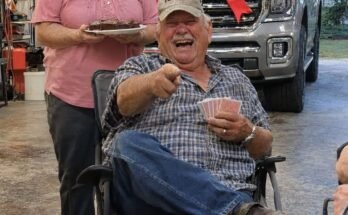
Every Friday night, Homer plays cards with the boys in our garage. Junior, Swede and Rollo. They’ve been coming since Nixon.
That Friday they pulled their lawn chairs in a circle around that new truck like it was a campfire. I baked a pan of brownies and carried them out through the kitchen door. And I stopped on the step, because I heard my name.
“Paid cash for her,” Homer was saying. “Every dime.”
Swede whistled.
“Fifty-four years I’ve carried that woman, boys,” Homer said. “Dead weight. Least I got a truck out of it.”
And they laughed. All of them. Swede laughed so hard he got to coughing. I stood on that step holding a plate of brownies.
Fifty-four years. Dead weight. My face went hot. My hands didn’t shake, though.
Forty years of doing hair’ll do that for you. I took a breath, put on my company smile and walked right in.
“Y’all want brownies?”
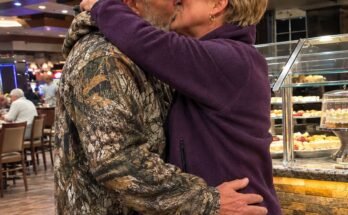
It got real quiet in that garage. I set the plate on the hood of the truck and hugged every one of them, Homer last.
“Happy birthday, honey,” I said in his ear.
“Thank you, Trixie,” he said, like nothing in the world had happened.
Then I went inside and washed every dish in the sink, real slow. I didn’t sleep much. About two in the morning I got up and found the title in the file box, right where I’d put it.
My name. Not his. I sat at the kitchen table a long time with it in my lap. Maybe I was making too much of a joke between old men.
Maybe I ought to let it go, like I always did. Then I heard him say it again in my head. Dead weight.
At eight o’clock I called Tucker.
“Miss Beatrice,” he said, “is something wrong with the truck?”
“Not one thing, honey. I need y’all to buy it back.”
He went quiet. “Ma’am, you’ll lose some money on it. Four thousand, maybe more.”
“That’s fine.”
Then the finance man got on the line. An older fella who’d been in that business a long time.
“Mrs. Hollowell,” he said, “I’ve seen this kind of thing before. You do this, his people will quit speaking to you.”
“His sister, his buddies, the whole bunch. You know how a small town is.”
I knew it. His sister, Leota, has been my best friend since the seventh grade, and she’d take his side. She always has.
I did it anyway. Then I asked Tucker one more thing.
“That old truck of Homer’s. Y’all still have it?”
Tucker laughed. Just once. “It’s out back, Miss Beatrice. Nobody’d take it.”
“I’ll take it,” I said. “And honey, have you got another one of those red bows?”
Homer sleeps late on Saturdays and never goes near that garage before dinner. I drove the new truck to Batesville while he snored, signed the papers and drove home in his old one, rattling the whole way. I parked it in the garage, right where the new one had been.
I tied the red bow on that rusty hood. And I tucked an envelope under the wiper with his name on it in my best handwriting. Then I sat down on the porch swing with my coffee and waited.
At two o’clock, Junior and Swede pulled up right on time. They’d come to see the truck in the daylight. Homer came out the front door in his robe and his house slippers.
“Come on, boys,” he said. “Y’all ain’t seen her in the sun yet.”
He walked them across the yard, proud as a rooster. He grabbed the garage door handle and hauled it up. Then he froze, with his hand still up on that handle.
Nobody said a word. Then Swede reached past him, pulled that envelope off the windshield and read it out loud before Homer could stop him.
“Homer,” it said. “Since I’m dead weight, I figured you’d want the truck you paid for yourself, because the new one went back where my shampoo money came from. The old truck is the last one you paid for yourself.”
Swede lowered the note. Homer still had one hand on the garage door handle, and the other hung beside him like he’d forgotten what it was for. Junior looked from the rusty hood to the silver truck that wasn’t there, then back at the note.
“Is that what she wrote?” Homer asked.
Swede held the paper out toward him. “That’s what it says.”
Homer took it and read the lines again, slower this time. His slippers were dusty from the yard. I could see the red bow drooping over the old hood behind him, one loop caught under the windshield wiper.
I stood from the porch swing and carried my coffee over. I was angry enough to say something I’d regret, so I kept my hands busy around the mug.
Homer looked at me. “You took the new truck back?”
“I did.”
“You sold it?”
“I did that, too.”
Junior shifted in his chair. Swede folded his arms. Neither of them looked at Homer now. I was grateful for that, though I hated needing anybody to witness this.
Homer held the note in one hand and pointed at the old truck with the other. “You brought this thing back?”
“I asked for it. They still had it.”
“You traded this in.”
“I did.”
“So now you’re giving me a rusty truck?”
The words landed harder than I expected. My throat tightened. I’d put the red bow on that truck because I wanted to make him happy. I had loved seeing his face when he first saw the new one. I was still hurt that he’d turned that gift into a joke about me.
“I’m not giving you anything,” I said. “Your truck is right there.”
Homer glanced at Junior and Swede, as if one of them might tell him I was being unreasonable. Neither did.
He shook the note once. “You could’ve talked to me before you went and did all this.”
“I could have,” I said. “I should have asked you what you meant. I didn’t. I heard you, and I made up my mind.”
For a second I wondered if I’d been too quick. Fifty-four years is a long time to put a marriage on the line over a cruel joke. Then I remembered how easy it had been for him to say it while the men laughed, and how small I’d felt standing there with a plate in my hands.
Homer lowered the note. “It was a joke.”
“Then tell me what part was funny.”
He looked toward the garage, not at me. Junior rubbed his thumb along the edge of his lawn chair. Swede’s mouth had gone tight.
“I’ve worked all my life,” Homer said. “The boys know that.”
“I know how much you worked,” I said. “I watched you go out in the county truck for thirty-eight years. I packed your lunch. I waited up when you came home late. I never said your work didn’t matter.”
“I didn’t say yours didn’t matter.”
“You called me dead weight.”
He opened his mouth, then shut it. For a moment his face looked less proud than lost. I knew that look. I’d seen it when the old pickup started making a sound he couldn’t fix and when the doctor’s office called about one of his regular checkups. This time, I didn’t rush to make it easier for him.
Junior finally spoke. “You told us you paid for the truck.”
Homer turned to him. “I said I paid cash for her.”
Swede looked down at the envelope. “That’s not what we understood.”
Homer’s ears reddened. Mine did, too, though I wasn’t the one who’d been caught.
He had wanted his friends to see him as the man who’d bought his wife a new truck. He’d said it as if I were a burden he’d carried for decades, and the truck was the little prize he’d earned for putting up with me. I couldn’t tell whether he’d believed his own story or just wanted to hear the men laugh. Neither answer felt good.
“I paid for it,” I said. “With the money from my shop.”
Junior looked at me. “That money bought the truck?”
“All of it.”
Swede glanced at Homer. “You didn’t tell us that.”
Homer’s jaw worked. “It was our money.”
I knew he’d say that. He’d called my shop a hobby for years, but he had never complained when my savings paid for the roof or the kids’ braces. Hearing him claim it in front of his friends made my face burn all over again.
“It was my savings,” I said. “I earned it doing hair. You knew that.”
He looked at the bow on the truck. I could tell he wanted to say something that would put the whole thing back the way it had been before Swede read my note. He wasn’t going to find the words.
“You made it sound like you bought the truck,” Junior said.
Homer picked at a corner of the note. “I didn’t think they’d take it that way.”
“They laughed,” I said. “You laughed with them.”
That stopped him. Swede looked down at his shoes, and Junior’s chair creaked as he shifted. I didn’t enjoy watching them squirm. But I needed them to hear the truth because they’d heard the lie.
Swede took off his cap and held it in both hands. “I’m sorry, Beatrice. I laughed, and I shouldn’t have.”
“Thank you,” I said. “I heard you.”
Junior nodded, his eyes fixed on the driveway. “I’m sorry, too.”
Homer stared at the note. His thumb rubbed the paper until the fold started to soften. “I was trying to make the boys laugh,” he said.
“Then you used me to do it.”
He looked up. “I know.”
I almost let that be enough. I’ve let too many things slide because saying them aloud seemed harder than swallowing them. But the men were standing there, and Homer had hurt me in front of them. He could apologize in front of them, too.
“Say you’re sorry to me,” I told him.
His face tightened. He looked at Junior, then Swede, then finally me.
“I’m sorry I called you dead weight,” he said. “You earned that money. I shouldn’t have made you sound like you owed me for being married to me.”
It wasn’t pretty, and he didn’t say it easily. But he said it where his friends could hear him.
I set my mug on the porch rail. “Thank you.”
Homer folded the note and tucked it into his shirt pocket. Then he nodded toward the drive. “All right. So call Tucker and get the new one back.”
There it was, plain as day. He’d apologized, but he still expected me to fetch the truck he’d just lost.
“No,” I said. “I sold it back. The money went back into my account, less what I agreed to lose. That’s finished.”
His eyebrows rose. “You lost money on it?”
“I knew I might. I chose to do it anyway.”
He stepped toward the old pickup, then stopped at the red bow. “You really want me driving this?”
“I want you to drive the truck you had before I bought you another one.”
He looked at the hood. A rusted spot showed beneath the bow where the paint had peeled. “The new truck was a gift.”
“It was. Then I heard what you said about me.”
Homer shook his head, and for a second I thought he might argue again. His friends were watching. His hand went to his pocket, where the note was.
“I’m sorry,” he said, quieter.
“I heard you the first time.”
He looked at my face, and I could see him trying to decide whether to ask again. I waited. I was tired of being the one who filled every silence with a way out for him.
He didn’t ask.
Junior stood up and brushed his pants. “I think we ought to leave you two to it.”
Swede gave me a small, ashamed look. “Beatrice, I’m sorry again.”
“I know,” I said. “Go on.”
They walked toward their cars. At the edge of the yard, Junior turned and called, “That bow’s a nice touch.”
It was the first thing that made me smile. “I thought so.”
Homer watched them leave. Then he looked at me, and his face had gone softer around the eyes. “You didn’t have to bring the old one back.”
“Yes, I did.”
He nodded toward the garage. “You could’ve just told me you were mad.”
“I could have.” I picked up my coffee again. “But then you might have thought you could talk me out of it.”
He didn’t answer. He looked at the truck and ran one hand over the old hood, stopping short of the bow.
“I’m sorry I embarrassed you,” he said.
I believed he was sorry. I also knew sorry didn’t make the insult disappear. I wasn’t ready to tell him everything was fine just because he’d finally said the right thing.
“I was proud when I bought you that truck,” I said. “I wanted to see you enjoy it.”
“I did enjoy it.”
“Until you turned around and told your friends I was dead weight.”
He looked down. “I know.”
I felt bad for him then, which annoyed me. That was my habit, trying to carry his feelings on top of my own. I set the mug down on the rail again.
“I’m not asking you to agree with every choice I make,” I said. “I’m asking you not to make me the joke.”
He nodded. “I won’t.”
I let the promise sit there without answering for him. Then I took the envelope from his pocket and slipped it into my apron. I didn’t want it getting lost in the garage.
“Are you keeping the truck?” he asked.
“I bought it back for you.”
He looked at me, surprised.
“I bought it back because it was yours before the new one,” I said. “And because I wanted you to have something to drive. But there isn’t another new truck coming.”
He breathed out through his nose. “I understand.”
That was the most he’d said without turning it into a joke. I reached for the bow and straightened its crooked loop. My fingers remembered tying it on the new truck, and I had to stop for a second before I pulled the ribbon free.
“Leave it,” Homer said.
I looked at him.
“On the old truck,” he said. “It can stay.”
I tied the loose loop back around the windshield wiper. The red looked bright against the rust. Homer stood beside me with his hands in his robe pockets, and neither of us pretended the truck looked better than it did.
The men were gone, but their lawn chairs were still set in a circle. Homer started to move them, then paused and looked at me.
“Want me to put these away?”
“You can,” I said.
He carried them into the garage one at a time. I went back to the porch and took my coffee inside. The dishes from the night before were dry on the rack. I put them away while I listened to him move chairs, one scrape at a time.
When he came in, he stood by the kitchen doorway.
“Would you make brownies again next Friday?” he asked.
“If I feel like it.”
He nodded. “Fair enough.”
The next Friday, I did make them. I put the pan on the counter, where it always cooled, and cut the corners off for myself before bringing any outside. Homer got his own piece, and he thanked me without making a joke about who’d earned it.
His old truck stayed in the garage. The red bow was still tied to the wiper the next morning, drooping over the rusty hood.