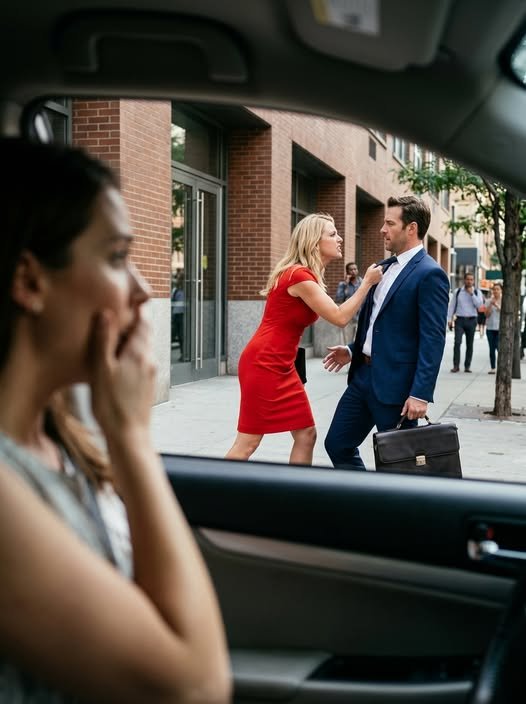
The person standing beside my husband was my father.
I hadn’t spoken to Walter in six years. We had argued at my brother’s wedding, over money, pride and things neither of us could take back. After that I had stopped answering his calls, and eventually he stopped making them. I told myself I had made peace with it.
Now he stood on the steps of that red-brick building with a cane in his right hand. His left arm hung stiffly at his side. He looked thinner and older, his hair completely white. Eliam had a hand under his elbow as they went down the steps one at a time.
I don’t remember getting out of the car. I only remember crossing the street, and Eliam looking up and going pale.
“Nora,” he said. “Nora, wait.”
My father turned, and for a moment nobody spoke.
“You’ve been lying to me for a week,” I said to Eliam, and my voice shook. “You told me you were at the office. I went there. I brought you coffee.“
“I know. I’m sorry. I can explain everything.”
“Then explain.”
He looked at my father, who gave a small, tired nod.
“Three weeks ago, your father called me at work,” Eliam said quietly. “He got my number from your mother’s old address book. He’d had a stroke in the spring, Nora. A mild one, he said, but it affected his left side and his speech. He’s been in rehabilitation ever since. This is the neurological rehab center.”
I looked at the building again, at the sign by the door that I had been too far away to read. I felt the ground tilt.
“A stroke,” I whispered. “In the spring?”
“I didn’t want to tell you,” my father said. His words came slowly, a little slurred at the edges, and each one seemed to cost him effort. “I thought you would feel sorry for me, and I couldn’t stand that. I didn’t want you coming back because you pitied me.”
“So you called my husband instead?”
“I called him because I needed help getting to therapy,” Dad said. “My neighbor had been driving me, but she moved away. I had no one else. Eliam was the only person I could think of who wouldn’t hang up on me.”
Eliam took a breath. “I met him for coffee the next day. He was so ashamed, Nora. And I could see how badly he wanted to see you, even though he couldn’t say it. He made me promise not to tell you yet. He wanted to get stronger first. He wanted to walk into our house on his own feet and say he was sorry properly.”
“And the leave from work?”
“His therapy sessions are at nine every morning, and he can’t drive. I took a week of leave so I could take him.” He rubbed his face. “I should have told you. I knew it the whole time. But I kept thinking, one more day, and then he’ll be ready, and then I can tell her everything. I didn’t realize I was digging a hole. I’m sorry.”
“The medication,” I said. My thoughts were scattered. “You left it at home on purpose?”
“No, that was a real mistake.” He gave a shaky laugh. “I panicked when I realized, and I was going to ask if you could bring it, but then I’d have had to explain why I was somewhere other than the office. When you texted, I froze and lied again. I hated myself for it.”
I turned to my father. I wanted to be angry, and part of me still was. Six years of silence doesn’t dissolve in one morning.
But he was holding a worn paper bag in his good hand, and I saw something sticking out of the top. It was a small wooden bird, half carved.
“What’s that?” I asked.
“Occupational therapy,” he said. “They make us use our hands. This one is for you.” His mouth trembled. “I used to carve you birds when you were little. Do you remember?”
I did. There had been a whole row of them on my windowsill, sparrows and wrens, each one a little lopsided.
My eyes filled before I could stop them.
“I was wrong,” he said. “At the wedding. About all of it. I’ve been wrong for six years, and I was too stubborn to pick up the phone. And then I couldn’t pick it up at all.” His voice cracked. “I’m so sorry, Nora.”
I didn’t decide to hug him. It simply happened. I crossed the last few feet and put my arms around his thin shoulders, and his good hand came up, shaking, to hold the back of my head the way he used to when I was small. We stood there on the steps while Eliam looked away and wiped his eyes.
When I finally pulled back, I turned to my husband. The anger was still there, but it had softened into something more complicated.
“You should have trusted me with this,” I told him. “I spent two days imagining the worst. I thought you were having an affair. I thought you’d lost your job.”
“I know.” He didn’t make excuses. “You’re right, and I’m sorry. I was trying to protect him, and I hurt you instead.”
“No more secrets. Not even kind ones.”
“No more secrets,” he said. “I promise.”
I took his hand. Then I looked at my father. “Where do you live now?”
“A small apartment. Alone.”
“Not anymore,” I said. “Not while you’re recovering. We have the spare room.”
“Nora, I can’t ask that.”
“You didn’t ask. I’m telling you.”
He laughed, and it turned into a sob. “You sound like your mother.”
That evening the three of us ate dinner at our kitchen table. Dad’s hand shook as he lifted his fork, and none of us mentioned it. The medication was still sitting by the coffee maker, and I handed it to Eliam without a word. He took it and gave me a look that said everything.
Later, I set the half-carved bird on my windowsill. It was crooked and unfinished, and it was perfect.
I had followed my husband that morning certain I would find a betrayal. Instead I found my way back to my father. Eliam’s secret had been a mistake, and the truth was something I had never expected to be given again, which was a second chance.