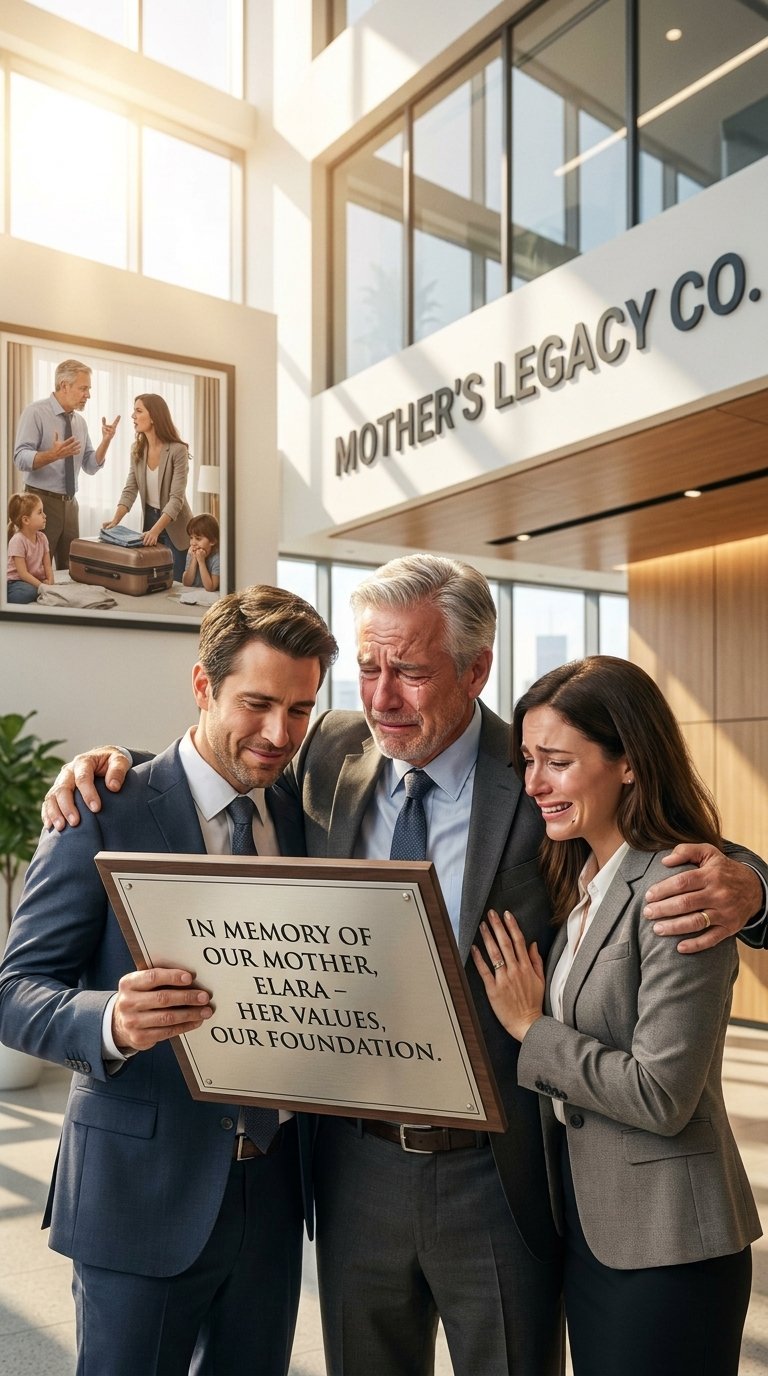
On April 12th, Thomas arrived forty minutes early, wearing a navy suit and carrying a bouquet he had changed his mind about three times.
The address was on the east side of the city, in a neighborhood he had once passed through without a second glance. A converted brick warehouse stood on the corner, its windows glowing gold. A banner covered the front, wrapped in white fabric, tied with a ribbon.
A crowd had already gathered. Families, young couples, a few city officials, local reporters. And a group of about thirty people in matching green aprons, standing in a loose line near the door, looking as nervous as children before a recital.
Naomi saw him first. She crossed the sidewalk in three quick strides and threw her arms around his neck.
“You came.”
“I wouldn’t miss it.”
“You’re early.”
“I’ve been practicing.”
Eli appeared beside her, grinning, taller than Thomas now and wearing a suit that didn’t quite sit right on his shoulders. “You look like you’re about to give a eulogy, Dad.”
“I’m very nervous.”
“Good,” Eli said. “So are we.”
At two o’clock, a small stage at the front of the building filled. Naomi stepped up to the microphone, with Eli beside her. The crowd quieted.
“Thank you all for coming,” she said. “Six years ago, my brother and I made a promise to each other at a kitchen table. We wanted to build something that did more than make money. We wanted to build a place where people who’d been shut out could come back in.”
Eli took over. “Today, we’re opening the first location of a company that trains and hires people coming out of homelessness, addiction recovery, and incarceration. Every employee here earns a living wage, health insurance, and a path to ownership. Thirty of them are standing behind us right now.”
The people in green aprons straightened. A woman near the end wiped her eyes.
“We want to introduce you to someone,” Naomi said. “She isn’t here. But everything we’ve built comes from her.”
Thomas felt his breath catch.
“Our mother, Lillian Whitmore, died when we were nine and twelve. She wasn’t famous. She never ran a business. But she did something every day that we didn’t understand until we were grown.” Naomi’s voice shook. “She set an extra place at the table. She’d say, ‘Somebody always needs a seat.’ And she meant it.”
Eli stepped to the banner and took hold of the ribbon.
“We spent a year trying to decide what to call this place,” he said. “And then we realized we’d known all along.”
Naomi nodded to him. Together, they pulled.
The white fabric fell away.
Across the brick, in warm hand-painted letters two stories tall, it read:
LILLIAN’S TABLE
Somebody always needs a seat.
The crowd erupted. People clapped, cheered, wiped their faces. Thomas didn’t hear any of it.
He was standing very still, with the bouquet hanging from one hand, and he was crying openly, and he did not care who saw.
When the noise settled, Naomi spoke again, more quietly now.
“Dad, can you come up here?”
He walked to the stage on legs that didn’t feel like his own. Eli took his arm to steady him.
“We have something to tell you,” Naomi said, and now she was crying too. “There’s a reason we didn’t tell you about this until now. We wanted you to know that you’re the one who made it possible.”
“Me?” His voice cracked. “I wasn’t even there. I was working all the time. I barely…”
“Dad.” She took his hands. “Do you remember the day you packed Victoria’s suitcases?”
He nodded, unable to speak.
“I was standing on the landing. I watched you. I was twelve, and I’d already decided you were going to send us away. Everyone I knew had gotten sent away, or left. I thought that’s what grown-ups did when things got hard.” She swallowed. “And you walked right past her and chose us.”
“I didn’t do anything special.”
“You did everything,” Eli said, his own voice thick. “You taught us that when someone’s hard to love, you don’t send them away. You sit down on the floor and build a cardboard castle.”
Thomas covered his mouth.
“Mom set the extra place,” Naomi said. “But you were the one who pulled out the chair for Walter on Thanksgiving. You were the one who burned the cinnamon rolls. We built this company on her values, Dad. But you showed us they were real.”
Then Naomi did something Thomas hadn’t expected. She turned to the line of green-aproned employees, and a gray-haired man stepped forward, leaning on a cane.
“Walter,” Thomas whispered.
“Hello, Mr. Whitmore.”
“How…”
“Your son found me again about four years ago,” Walter said, with a crooked smile. “I was sleeping in a car. He said, ‘Remember Thanksgiving? We’re hiring.’ I’ve been our head cook ever since.” His eyes were bright. “Sir, I’ve never forgotten that chair.”
The crowd murmured. Thomas pressed both hands to his face.
One by one, others came forward. A young woman who had spent two years in county jail and now managed the front counter. A recovering addict who baked the bread. A mother of three who had lived in a shelter eighteen months ago and had just signed the lease on her first apartment.
“Your children gave me a seat,” each of them said, in different words.
And behind each of them, Thomas heard the same echo, the same quiet voice from a kitchen long ago.
Somebody always needs a seat.
Afterward, when the crowd had thinned and the staff was serving the first lunch, Thomas sat alone at a long wooden table by the window. Sunlight poured through the glass. The room smelled like bread and coffee and, faintly, impossibly, cinnamon.
Naomi set down a plate in front of him. Two cinnamon rolls, golden and slightly uneven.
“Mom’s recipe,” she said. “I made them myself.”
He took a bite. His eyes closed.
“They’re not burned,” he said.
“I’ve had practice.”
Eli slid into the chair across from him. Naomi took the one beside him. For a moment, the three of them sat in silence, looking at the room they had made.
“There’s one more thing,” Eli said. He nodded toward the end of the table. A single empty chair stood there, set with a plate and a folded napkin. A small card read:
Reserved for Lillian.
“We’ll always keep one open,” Naomi said softly. “For her. And for whoever walks in next.”
Thomas reached across the table and took each of their hands.
“Your mother would have been so proud of you,” he said. “And so angry at me for crying in public.”
“She’d have handed you a napkin,” said Eli.
“And a roll,” said Naomi.
He laughed, wet and astonished, and for the first time in twenty years, the weight he had carried since the funeral felt lighter.
Lillian’s Table has eleven locations now, in nine cities. More than four hundred people have been hired through its training program, and nearly all of them are still employed, still housed, still learning. Naomi runs operations. Eli runs the training academy. Thomas, now seventy-one, comes in every Tuesday and Thursday to wash dishes in the back, because he insists on starting at the bottom.
On the wall by the first location’s front door, framed in simple wood, hang two things. A child’s crayon drawing of four stick figures under a yellow sun. And beneath it, in his daughter’s handwriting:
Because a father chose us.