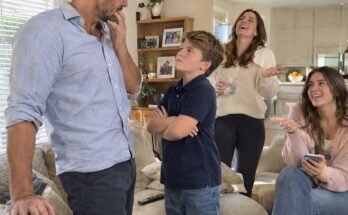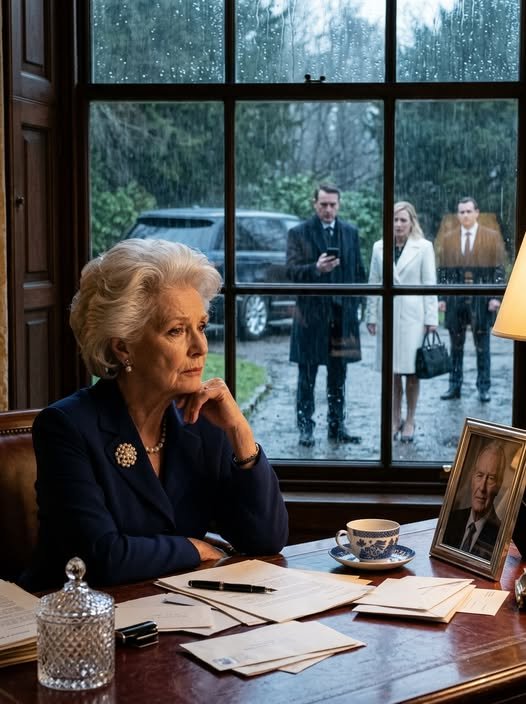
The third person was my granddaughter, Lily.
She stood beside the car in her school coat with her backpack hanging off one shoulder, looking at my front door as though she wasn’t sure it would open. Genevieve was already marching up the walk. Benjamin trailed behind her, phone still in hand, scrolling through declined notifications as if one of them might change its mind.
I let them knock twice before I opened the door.
“Mother,” Genevieve said, and her voice was sugar over gravel. “There seems to be a terrible mix-up at the bank. Every card has been declined. The mortgage draft bounced this morning. Benjamin’s business account is frozen.”
“It isn’t a mix-up,” I said. “Good morning, Lily. Come in out of the rain, sweetheart.”
Lily slipped past her mother and wrapped her arms around my waist. I felt her small shoulders shaking.
“Grandma, I’m sorry about last night,” she whispered. “I wanted to come get you. Mom said you were tired.”
“I wasn’t tired, darling.” I kissed the top of her head. “Go sit in the kitchen. There’s lemon cake on the counter.”
She went, glancing back once. Genevieve’s smile never moved, but her eyes followed her daughter’s retreat like a gate swinging shut.
“Benjamin,” I said, “would you like to tell me what you came to say?”
My son had always had Thomas’s shoulders and, I used to believe, Thomas’s heart. Standing in my hallway, he looked like a boy who had broken a window and was hoping someone else would confess.
“Mom, I think we got our wires crossed. Genevieve was stressed about the dinner. The text wasn’t supposed to go like that.”
“You wrote it. I read it forty times. ‘My wife doesn’t want you there.’ Which part crossed?”
Genevieve stepped forward. “You are seventy-seven years old. You can’t just pull the rug out from under a family. We have commitments. The preschool deposit, the country club, the mortgage on the townhouse…”
“A townhouse I was told was ‘for you too, Mom,'” I said. “Yet I wasn’t welcome at its first dinner.”
Neither of them answered.
I walked to the desk, took out the folder marked BENJAMIN, and laid it open on the hall table between us.
“Fifteen years,” I said. “Tuition. Insurance. Dues. Emergency transfers that became monthly bills. Last year alone, ninety-three thousand six hundred dollars. I never asked for a thank-you. I never asked for a ledger. All I ever asked was to be a part of the family I was paying for.”
“We never asked you to,” Genevieve said.
The words fell flat in the hallway.
“No,” I said quietly. “You didn’t. And that is exactly the point. You never asked. You simply assumed. When I stopped being useful, I stopped being invited.”
Benjamin’s face crumpled. “Mom, please. We’ll lose the house.”
“You’ll lose the house I helped you buy, with money I didn’t owe you. That is a hard lesson. It is not a cruel one.”
“You’re punishing us,” Genevieve snapped.
“No, dear. I’m done subsidizing you. There’s a difference, and one day you’ll understand it.”
From the kitchen doorway, a small voice said, “Mom, stop.”
We all turned. Lily stood with a fork in her hand and frosting on her thumb. She was nine years old, and she looked straight at her mother.
“I heard you on the phone last week,” she said. “You told Aunt Marguerite that Grandma was ‘an ATM with a pulse.’ And you said you didn’t want her at the dinner because she’d ’embarrass you’ in front of Daddy’s boss.”
Silence.
Genevieve’s face drained of color. “Lily, that’s not what…”
“It is, Mom. I was in the hall. I heard every word.”
Benjamin turned slowly toward his wife. “You said that?”
“It was a private conversation! I was venting!”
“About my mother?” His voice cracked. “The woman who paid for our wedding?”
I watched my son finally see what I had watched for years. It wasn’t triumph I felt. It was grief, wide and quiet, like a field after a flood.
“Benjamin,” I said, “I think the two of you have a conversation to have. Not here.”
“Mom, wait.” He caught my hand. His fingers were cold. “I let her talk about you like that. I let her say things and I laughed along because it was easier. I’m so ashamed.”
“I know you are.”
“Can you forgive me?”
I looked at my son’s face, the same face that had once fallen asleep on Thomas’s chest on this very sofa.
“I love you,” I said. “That has never been in question. But forgiveness isn’t a transaction, and I won’t buy it back with a bank account. If you want me in your life, you’ll have to show it in ways that cost you something.”
He nodded, tears running freely now.
Genevieve took Lily’s hand. “We’re leaving.”
“Lily can stay,” I said. “If she’d like to. I’ll drive her home tonight.”
Lily looked at her mother. For a long moment no one spoke. Then she let go and walked back to my side.
Genevieve stared at her daughter, then at me. Something shifted in her face, something that wasn’t quite anger and wasn’t quite shame. She turned and walked out into the rain without another word.
Benjamin lingered in the doorway. “Mom, I’ll fix this. I swear.”
“Then start by fixing yourself.”
The next six months were hard on all of us.
Benjamin sold the townhouse and moved his family into a small rental near the school. He took a second job on weekends. Genevieve went to her sister’s for two months, and when she came back, she was quieter and thinner and went to counseling with Benjamin every Thursday. I didn’t ask whether it was working. It was not my place.
Lily came every Saturday. We baked, did puzzles, and read Thomas’s old paperbacks on the porch. One afternoon she looked up from her book and said, “Grandma, you’re not mad at us anymore, are you?”
“I was never mad at you, sweetheart. I was only tired of being invisible.”
In May, a card arrived in the mail. The handwriting was Genevieve’s, careful and slow.
Eleanor, I have no right to ask, but I wanted you to know that I am sorry. Not for the money. For the way I treated you. You raised a good man, and I almost took him from you. If you ever want to see us, we’ll be there. If you don’t, I understand.
I held that card for a long time.
On Mother’s Day, they came to my door with a lemon cake Genevieve had baked herself. It was lopsided and slightly burned on one edge. Benjamin carried a small box. Inside were the pearl earrings, which I had left on the kitchen table and which Lily had quietly mailed to her father in a sock.
“They belong to you,” he said.
“They belong to your father’s memory,” I said. “But thank you.”
We ate the cake at the kitchen table. It was terrible. I ate two slices.
I do not pay their mortgage. I do not cover their dues. But I sit at their table now every second Sunday, in a navy dress I no longer smooth with nervous hands, and when Genevieve passes me the potatoes, she looks me in the eye.
Some doors are meant to be closed. Others are only meant to be closed long enough for the people on the other side to learn how to knock.