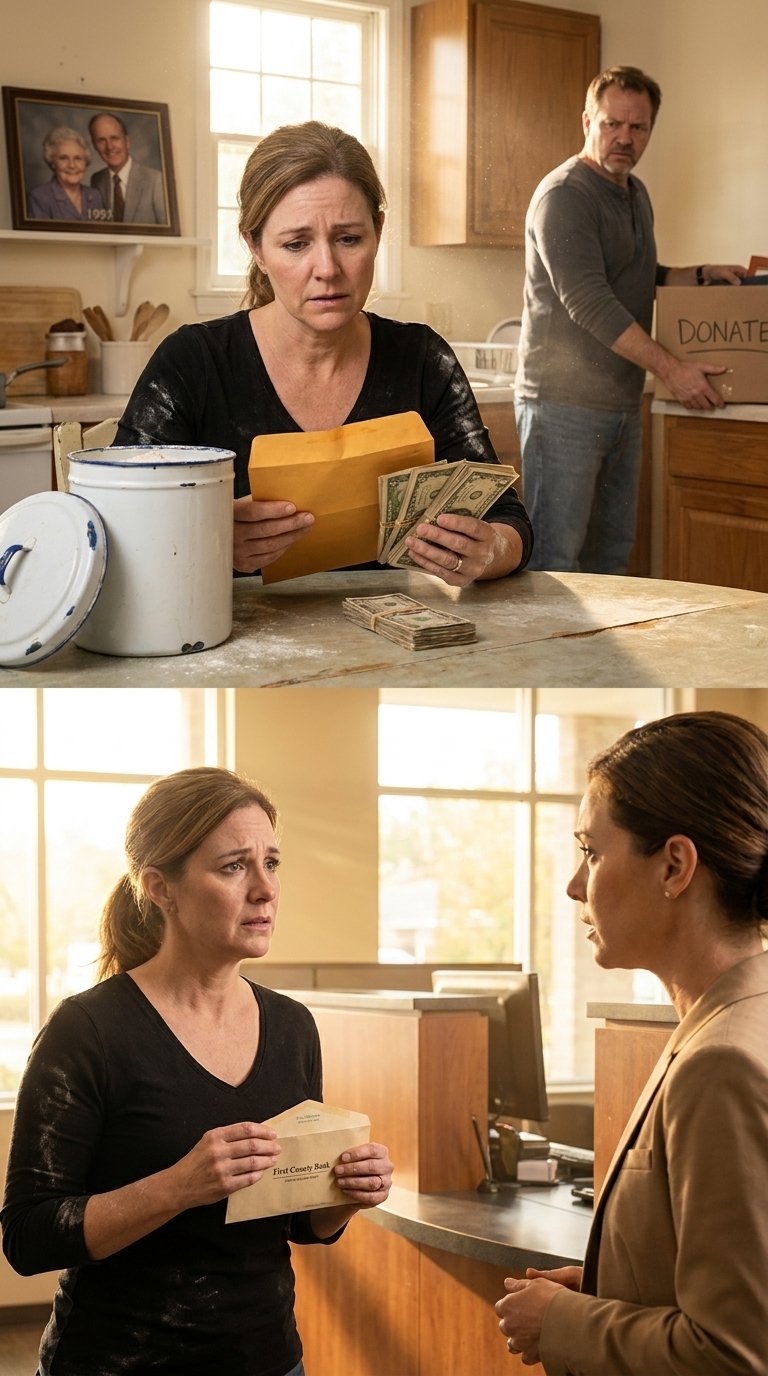
The branch manager was a gray-haired woman named Mrs. Delacroix, with reading glasses on a beaded chain. She took one look at the flour on my sleeves and the tin under my arm, and her face softened.
“Linda Pruitt,” she said. “Your mother said you’d come. Please, come back to my office.”
Russell had followed me in his truck. He pushed through the glass doors as Mrs. Delacroix was closing her office door, red in the face and out of breath.
“Linda, don’t sign a thing. Mama wasn’t right in the head at the end.”
“She was right enough to buy a stamp and find this bank,” I said. “Sit down, Russell, or wait in the lobby.”
He sat. He stared at his knees.
Mrs. Delacroix slid a folder across her desk. “Your mother came in last spring. She opened a safe deposit box in your name and asked me to hold one more document until you arrived. She said you’d bring the third page.”
I peeled back the browned tape with my thumbnail. The paper was soft as cloth. It was Mama’s slanted handwriting, the same hand that signed every report card I ever brought home.
Linda,
If you’re reading this at the bank, you did as I asked. I always said you were the one who listened.
Here is what I should have told you forty-one years ago.
The trucking company paid a settlement of sixty-two thousand dollars for your accident. The court put it in a trust until you turned twenty-one, and because you were a minor, Wayne signed as trustee. I signed too. I never read the papers. I trusted him.
Wayne told us the hospital ate it all. That was a lie. The insurance had already paid your bills. Wayne used your money to cover gambling debts he had hidden from me and to buy a share in his brother’s hardware store. By the time I found the bank statements, nearly all of it was gone.
I confronted him. He cried and swore he’d make it right. And God forgive me, Linda, I let him stay. I was fifty and scared of being alone with two children, and I chose my own comfort over yours.
So I started saving. A few dollars from every grocery trip. Birthday money from Aunt Faye. Egg money. Forty-one years of it. It was never enough to feel right, but it was something. The tin was never about flour. I slapped your hand that day because I was terrified you’d find it before I had the courage to tell you.
Russell knows. He found the old statements after Wayne died. He wanted me to say nothing, and he wanted part of what was left. I told him no. He has been angry with me since, and I don’t blame him for that. But he was wrong to ask.
The cash in the tin is yours. The key to the box is in Mrs. Delacroix’s drawer. Inside is everything else I could do.
I love you. I just didn’t know how to be brave.
Mama
I read it twice. Then I laid it on the desk and looked at my brother.
Russell would not meet my eyes. “She made me promise,” he said at last. “Wayne was dead by then. I figured, what good would it do?”
“What good?” My voice came out quiet, and that frightened me more than shouting would have. “I limped for a year, Russell. I turned down the nursing program because I thought we were poor. I stocked shelves at the very Piggly Wiggly where that truck hit me.”
“I was nineteen when it happened. I didn’t know.”
“You were forty-six when Wayne died. You knew exactly what you were doing. You wanted the money.”
He didn’t argue. That was the worst part.
The vault was cool and silent. Mrs. Delacroix left me alone with the box, and Russell stayed upstairs, which I took as a small mercy.
Inside was a manila envelope and a velvet pouch.
The envelope held the original trust papers, stamped and signed, along with copies of bank statements in Wayne’s handwriting, the withdrawals circled in Mama’s red pen. Clipped to them was a letter from a lawyer dated eight months earlier. Mama had gone to see him. She had asked whether anything could be recovered.
He told her no. Too many years had passed, and Wayne had died with nothing to his name.
Across the bottom of the letter, in Mama’s hand: I couldn’t get it back, Linda. So I decided to give it to you myself.
Beneath the letter lay a savings passbook. Eleven months of deposits, every one made from her widow’s pension, small and faithful. The balance was $23,410. Beside it was a note: For the nursing program you never got to finish.
I opened the velvet pouch last. Inside was a photograph of me at six years old, standing on a kitchen stool with flour to my elbows and a gap-toothed grin. On the back, in Mama’s writing: Biscuits with Linda. Best day of the year.
I sat on the floor of that vault with the picture against my chest and cried until I had nothing left. Not only for the money, but for a mother who had spent four decades carrying something that was never hers to carry alone.
When I came upstairs, Russell was standing at the lobby window with his hands in his pockets. He looked smaller than I remembered.
“I’m not going to ask you for anything,” he said. “I want you to know that. I was ashamed. Not just of the money. Of staying quiet.”
“Why did you?”
He rubbed his jaw. “Because Wayne raised me too. He taught me to fish. I couldn’t stand the idea that the same man did that to you. It was easier to pretend it never happened.”
I didn’t forgive him that day. I’d rather be honest about it. Forgiveness doesn’t arrive on the schedule of a funeral.
But I said, “Come help me carry the tin to the car.”
He did.
I used the money the way Mama would have wanted. I enrolled in the nursing program at the community college that fall, at fifty-eight years old, the oldest in my class by thirty years. The twenty-three thousand covered every semester. I wore flowered scrubs I bought myself, and I graduated with honors, and in the second row of the auditorium sat Russell in a borrowed tie, clapping harder than anyone.
He had called me in the spring after the funeral. He wasn’t asking for anything. He’d sold the camper and started seeing a counselor. He wanted to put a thousand dollars toward my books.
I said yes to the thousand. I said we could talk about the rest over biscuits.
We made them in Mama’s kitchen the week before the house sold. I stood on a stool, because the shelf was still too high, and took down the flour tin. This time it held actual flour, a fresh bag I’d bought that morning.
Russell watched me cut in the butter. “Mama used to slap my hand too, you know,” he said.
“I remember.”
“I think she slapped her own harder.”
I looked at that white enamel tin with its blue chips, and for the first time it was only a tin.
“Hand me the rolling pin,” I said. “And wash your hands. We’re using all of it.”