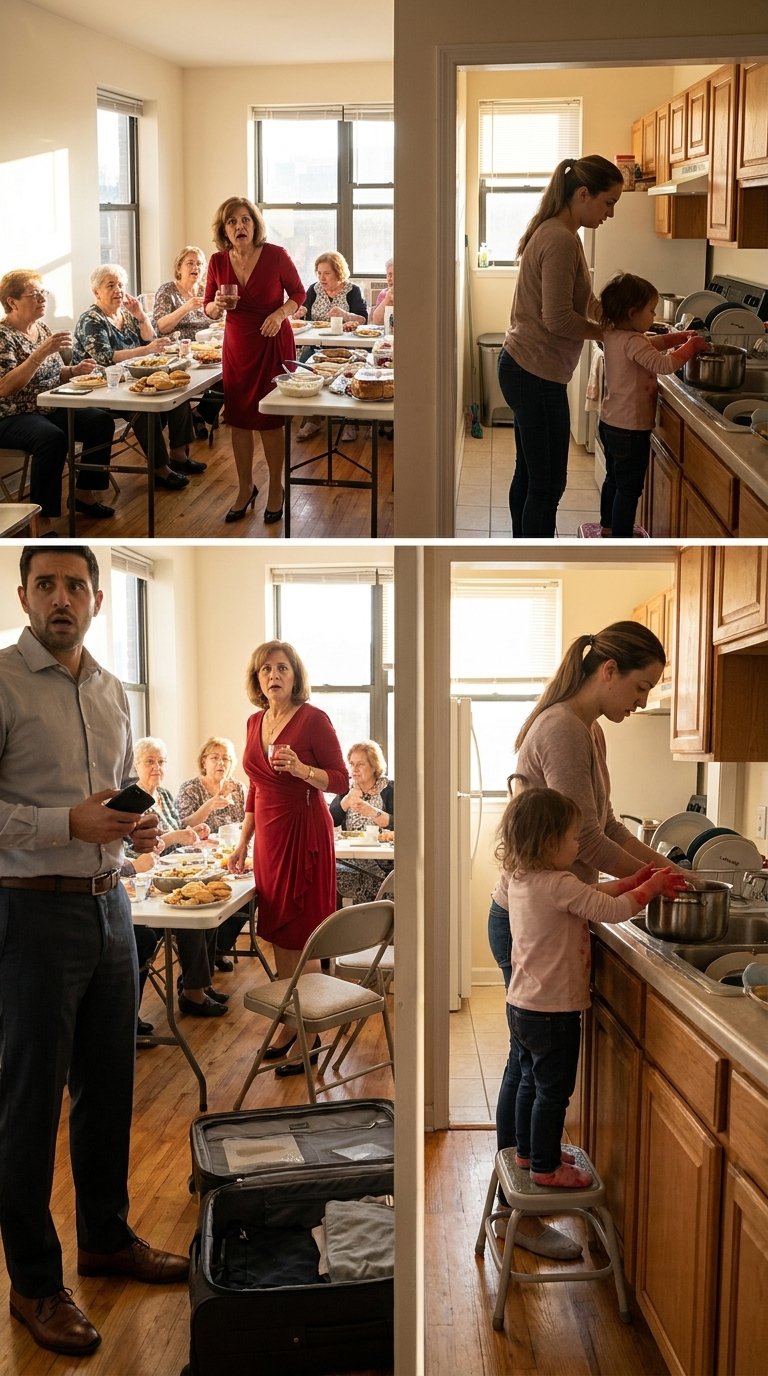
I knelt in front of the stool. “Olivia, put it down, sweetheart.”
“But Grandma said…”
“I know what Grandma said. Put it down. Daddy’s here.”
She set the dish in the sink with a care that broke my heart. I lifted her off the stool and turned her hands over. The skin was scalded pink, the fingertips wrinkled white, and across two knuckles ran a row of small, angry blisters.
“Zayden,” my mother said, rising from her chair, her voice sweet and brittle. “You’re home early. We were just having a little gathering. The girl insisted on helping.”
I didn’t answer her. I looked at Jessica, who had backed against the counter with the bandaged hand held behind her, as if hiding it could still fix everything.
“Jess,” I said quietly. “Show me your wrist.”
“It’s nothing. I burned it on the pan. Please, not in front of everyone.”
“Show me.”
She held it out. The blister had broken, and the skin around it was raw.
I took out my phone, and my hand was steady, which surprised me. I had expected to shake.
“Zayden, what are you doing?” my mother demanded.
“Calling 911.”
“For what? Over a few dishes?” She laughed, and nobody joined her. “Don’t be dramatic.”
The dispatcher answered. “911, what is your emergency?”
“My name is Zayden Ferris. I’m at 2214 Camelback Court, apartment 6B. I have a five-year-old with scald burns on both hands and my wife has an open burn on her wrist. They need medical evaluation. I also need an officer here, because I believe this is child endangerment and domestic abuse.”
Behind me, a chair scraped. One of the guests whispered, “Carmen, you said the child was playing.”
I hung up and spoke to the room, evenly. “Ladies, I’m going to ask you to leave. Quietly, please. The police and paramedics will want to speak with some of you.”
Not one of them argued. They gathered purses and shawls and filed past my mother without meeting her eyes. One of them, a gray-haired woman in a blue cardigan, paused at the door and looked at Olivia, and her face crumpled.
“I’m so sorry, honey,” she said. “We didn’t know.”
The paramedics arrived in six minutes. They cooled Olivia’s hands with saline and wrapped them in loose gauze. One of them, a young woman named Reyes, crouched at her level.
“Can you tell me how this happened, sweetie?”
Olivia looked at me, then at the floor. “Grandma said the water has to be hot so the grease comes off. If it’s not hot, I have to do it again.”
Reyes glanced up at her partner, and the look they exchanged told me everything I needed to know about how the report would read.
When the officer came, a patient, broad-shouldered man named Alvarez, I told him what I’d seen and heard. My mother, from the couch, called it a misunderstanding, a cultural difference, an overreaction by a son who’d been brainwashed by his wife.
Then Olivia tugged my sleeve.
“Daddy,” she whispered. “Can I tell you something?”
“Of course.”
“Grandma has a drawer. The one in her room. It has a lock.”
I knelt closer. “What’s in the drawer, baby?”
“Mommy’s phone. And her passport. And the papers Mommy cries about.” She hesitated. “Grandma said if Mommy told you, she’d send us away and you’d never see me again.”
My mother stood up so fast the cushion fell. “That child is lying. She’s been coached.”
“Ma’am, please sit down,” Officer Alvarez said.
“That’s my property. You have no right…”
“Mother,” I said. I hadn’t raised my voice once, and I didn’t now. “Give me the key.”
She stared at me. In thirty-four years I had never spoken to her that way. I watched her calculate whether I meant it.
“Now,” I said.
Her hand went to the gold chain around her neck. A small brass key hung beside her cross. She did not unclasp it. Officer Alvarez gently stepped forward, and after a long, terrible moment, she took it off and dropped it into his palm.
The drawer was in the bottom of an old dresser in the guest room, the room my mother had claimed a year ago. Alvarez opened it with me standing beside him.
Inside, laid out neatly, were Jessica’s phone, her passport, her driver’s license, and her birth certificate. Beneath them was a thin folder.
I opened it. It held copies of Jessica’s immigration paperwork, her visa renewal still pending, and a handwritten list in my mother’s looping script, dated and detailed. Dates. Times. Didn’t finish dishes. Spoke back. Used too much soap. Next to some entries were small notations: no dinner, kitchen floor overnight.
And at the bottom, a letter addressed to the immigration office, unsigned, drafted for my mother’s signature. It accused Jessica of fraud. It claimed our marriage was a sham.
My knees nearly gave out.
“She was going to report you,” I said aloud, stunned. “She was keeping your papers so you couldn’t leave, and she was going to report you if you ever told me.”
Jessica had come to the doorway. She was crying silently.
“I tried to tell you,” she said. “I tried so many times. But she was always in the room, or she’d already told you I was tired, or sensitive. And then she took my phone, and I had nobody to call.” She wiped her eyes with her good hand. “I thought you wouldn’t believe me. She’s your mother.”
“I should have seen it,” I said. “I saw you lose weight. I saw Olivia go quiet. I chose not to look.”
“Zayden…”
“No. Let me say it.” I took her unburned hand carefully. “I’m sorry. I’ll say it a thousand times if I have to. I’m so sorry.”
My mother was arrested that evening. The charges were child endangerment, false imprisonment for the confiscated documents, and assault. The detective who took Jessica’s statement said a pattern like this, documented in my mother’s own handwriting, would be hard to defend.
A court-appointed attorney eventually negotiated a plea. My mother received two years of supervised probation, mandatory counseling, and a permanent restraining order keeping her away from Jessica and Olivia. She was ordered to return to Baltimore, where my aunt agreed to take her in. When she left the courtroom, she looked at me once, and I understood she had expected me to defend her.
I couldn’t. I did write her a letter a year later, short and plain, telling her I hoped she was getting help. She never answered.
Jessica’s visa was approved in the spring. We found a counselor, a calm woman named Dr. Patel, who worked with Olivia through drawing and play until my daughter stopped flinching at footsteps. Jessica went back to school part time, for the nursing degree she’d put aside when we married. I cut my hours and learned to cook, badly, then less badly.
The scars on Olivia’s hands faded to faint pink lines, and then to nothing.
On the first anniversary of that day, I came home early again, deliberately this time. I opened the door to the smell of burned pancakes.
Olivia ran down the hallway and threw herself into my arms. Behind her, Jessica stood in the kitchen doorway, laughing, with flour on her cheek.
“We made dinner for you,” Olivia announced. “Mommy said I could do the stirring.”
“Did anyone make you?”
She looked at me, confused. “No, Daddy. I wanted to.”
I carried her into the kitchen. The three of us ate burned pancakes at the table, laughing, nobody washing anything until the meal was done. Afterward, Olivia climbed onto her stool and helped me with the dishes, and the water was only ever lukewarm.
“Daddy,” she said, drying a plate, “is Grandma ever coming back?”
I thought about how to answer honestly.
“Not to live here, sweetheart,” I said. “But you’ll never have to be afraid in your own home again. That’s my promise.”
She nodded gravely, the way she does, and handed me the plate.
“Okay,” she said. “Then I’ll finish.”