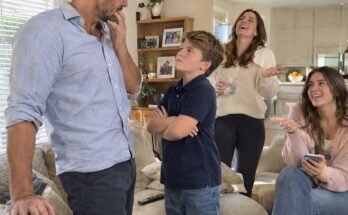
His reply came immediately: Dad, what does that mean? Are you at the airport?
I put the phone face down on Eleanor’s kitchen island and made a fresh pot of coffee. The house was quiet in the good way, the way it hadn’t been in three years. Outside, snow was coming down over the neighborhood in slow, fat flakes.
I did not answer.
On December twenty-fourth, the phone buzzed eleven times before noon. I let it. At two o’clock, I put on my good sweater, the green one Eleanor had picked out, and drove to the Hendricks Senior Center, where I had signed up a week earlier to help serve Christmas Eve lunch. Nobody there asked me to bring a card. A woman named Dolores handed me an apron and a ladle and said, “Raymond, you’re on gravy.”
I was good at gravy. I hadn’t known that.
The calls that mattered began at four o’clock on Christmas Day.
I was in my armchair with a plate of leftover turkey from the senior center, the Christmas village glowing on the mantel, when the phone lit up. Not Preston this time. Marissa.
I answered on the fifth ring.
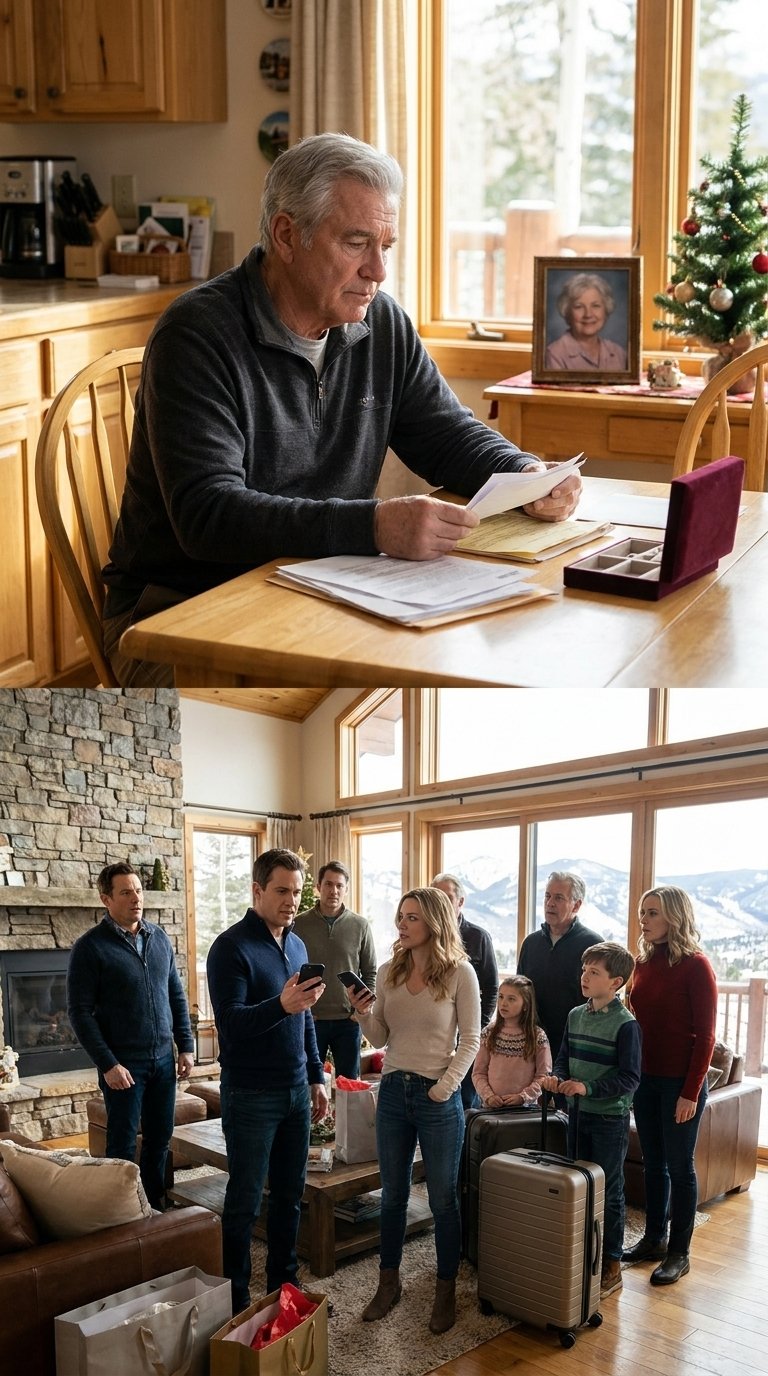
“Raymond.” Her voice was thin and tight, the polished tone gone. “We have a serious problem. The lodge says the card was declined. The remaining balance is twenty-two thousand dollars, and they’re threatening to take the reservation back. My parents are standing in the lobby with their luggage.”
“That sounds stressful.”
“Stressful? Raymond, there are eleven people here!”
“Eleven in a six-bedroom lodge,” I said. “I read the itinerary very carefully.”
She went quiet. I could hear a man in the background asking someone about the front desk.
“Preston said you were being dramatic,” she said finally. “That you’d come around.”
“Preston was wrong about a number of things.”
“Fix it. Please. We’ll talk about the rest when we get home.”
“There is nothing to fix, Marissa. I’m not on that card anymore, and neither is he. Your reservation was never mine to pay for. It was a gift I never offered.”
She started to say something sharp, then stopped. When she spoke again, it was lower, almost frightened. “He told me you knew. He said you’d agreed.”
“I did not.”
The line clicked and went dead.
Preston called at 4:40. I let it ring out. He called again at 4:45, and again at 5:10. At 5:30, a text arrived, long and ragged, the kind written by thumbs that were shaking.
Dad, please. They’re going to cancel the whole stay. Marissa’s father is furious. He thinks I lied to him. I need you to pick up. I’ll explain everything. I swear.
I read it once. Then I made a decision I had never made in thirty-six years of being his father. I turned the phone on silent and finished my dinner.
At nine o’clock, I called him back.
He answered on the first ring. “Dad. Thank God.”
“I’ll give you ten minutes,” I said. “You can use them however you like.”
I won’t pretend it was a tidy conversation. He began with excuses, the way he always did. Marissa had pushed him. The debts had piled up. The company he’d invested in had folded, and he hadn’t known how to tell me. The trip was supposed to keep everybody calm. He’d meant to repay me. Eventually.
I listened without interrupting. When he ran out of breath, I said, “Preston, I read the email chain.”
Silence.
“All of it. Including the part about getting me out of the house by spring. Including the part about the motel.”
“Dad, that was Marissa…”
“It was your name on the replies. ‘Already handled.’ ‘Easier to talk into simplifying.'” My voice stayed level. “Is that how you think of me? A problem to be handled?”
I heard him breathing. When he spoke again, his voice had cracked. “No. I don’t know. I stopped looking at you as a person a long time ago. You were the one who always came through. And I got used to it.”
“I know you did.”
“I took Mom’s necklace, Dad.”
I closed my eyes. “I know that too.”
“I pawned it in September. I was going to buy it back. I had three months to redeem it, and then I couldn’t, because of the trip, and…” He was crying openly now. “I’m so ashamed. I can’t even say how ashamed.”
I thought of Eleanor, and of the blue velvet box, and of Emma’s eighteenth birthday, still seven years off.
“Where is it?”
“Brightwell Pawn, on Lorain Avenue. The ticket’s in my desk. I can send you a photo of it.”
“Do that.”
He did, within a minute. I looked at the number, the date, the amount: $2,800.
“Preston,” I said, “here is what’s going to happen. I will redeem that necklace myself, tomorrow morning. You will not be reimbursing me, because I don’t want your money. I want you to understand what you took.”
“I do.”
“You don’t yet. But you will.”
Julian Vance had told me the truth on the first day: I could press charges for the theft, the unauthorized withdrawal, and the card, and a court would likely side with me. I thought about that for a week.
In the end, I chose something else.
On the twenty-eighth, Preston and Marissa drove home from Colorado in a rented car, because the airline had stranded them once the lodge cancelled. Marissa’s parents had refused to speak to her. Two of her sisters had flown home separately. Their holiday photographs, the ones she’d been so careful about, were never posted.
They arrived at my door on the twenty-ninth at ten in the morning, unshaven and hollow-eyed, both of them in the same coats they’d worn on the plane. Marissa held a folded sheet of paper. Preston held nothing.
“Come in,” I said. “Wipe your feet.”
I poured coffee for all of us, in the mugs from the cupboard, not Eleanor’s blue one. I kept that one for myself.
Marissa went first, her chin trembling. “Raymond, I owe you an apology. What I wrote about you was cruel. I told myself it was just planning, just logistics, but it was contempt. I was embarrassed by where you came from, and I was a fool to be. You gave my husband everything.”
“Thank you,” I said.
“I’d like to repay the Telluride deposit, as much as I can, over time. I wrote it out.” She slid the paper across.
I looked at it. It was a careful payment schedule, three hundred dollars a month, signed at the bottom. It wouldn’t clear the debt in fifteen years. But it was honest.
“I’ll accept it,” I said, “on one condition. Preston signs it too.”
He did, with a hand that shook.
Then I opened a folder of my own. Inside was a document Julian had drafted: the trust, the revised will, the new power of attorney. I set it on the table so they could see their names were not on it.
“I’m not leaving you out of my life,” I said. “I’m leaving you out of my money until you’ve earned a way back in. The house is mine. It will stay mine. When I die, a portion goes to Emma’s education, a portion to the senior center, and the rest we’ll discuss if you rebuild my trust.”
Preston bowed his head. “That’s fair.”
“It isn’t about fair. It’s about honest.”
The spring was slow.
Preston took a second job at a hardware store near his apartment and, at his own insistence, started meeting with a financial counselor on Tuesdays. Marissa went back to her old job in medical billing. They sold the second car. They moved to a smaller apartment, and Emma, my granddaughter, started coming to my house on Saturdays, her backpack bursting with books.
In June, Preston showed up unannounced with a blue velvet box in his hands.
“I know you already got it back,” he said. “I wanted to bring it to you myself.”
“I did get it back. And you can keep that one.” I nodded at the box. “I’ll hold on to the original for Emma. That one’s for you to give her yourself, someday.”
He looked puzzled, so I took the necklace from my pocket, the real one, polished and bright, and held it up to the light.
“Eleanor wanted this to go to a girl who’d be loved enough to deserve it,” I said. “I think you’re finally becoming a father she’d be proud of. Slowly. But I see it.”
He pressed his hand to his mouth.
That December, nine days before Christmas, a white envelope sat on my kitchen island again. This time, I opened it with some caution.
It was a card. Inside, in Preston’s rough handwriting: Dad, we’d be honored if you’d come to our table. There’s a seat. It’s by the window. It isn’t a motel. Love, P.
I laughed out loud, alone in my kitchen, until I had to wipe my eyes.
I went. I wore the old flannel shirt. Nobody took a photograph of me, and nobody asked me to leave early. Emma sat in my lap and told me about her science fair, and Marissa passed me the potatoes and, for once, looked me in the eye.
When I got home that night, I stood in front of Eleanor’s village on the mantel and straightened a tiny glowing church that had slipped crooked.
“They’re learning, El,” I said. “Slowly. But they’re learning.”
I turned out the lights, poured the last of the coffee into her blue mug, and sat in the warm dark for a long time, finally and fully at home.