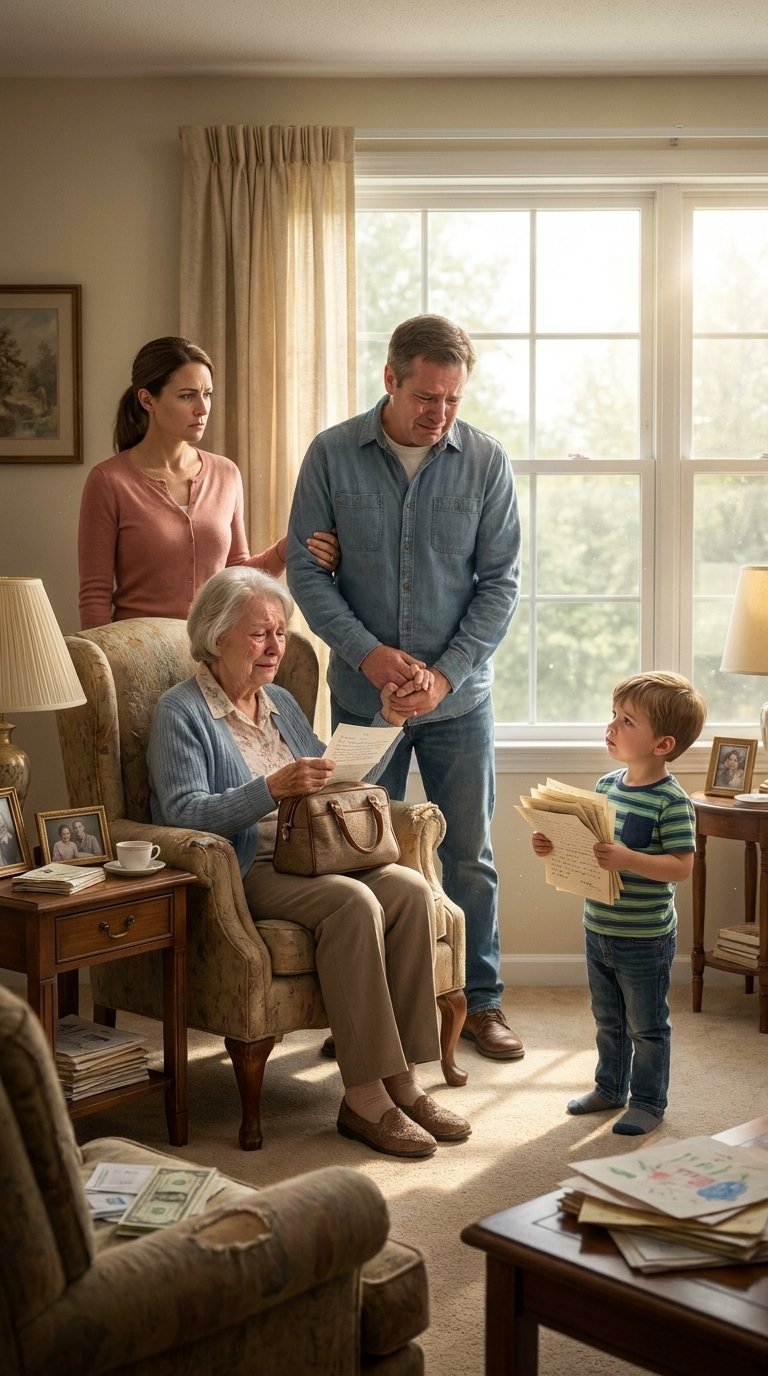
Helen’s new apartment was one bedroom, painted a pale cream, with a small window that looked out over a parking lot. It was clean and quiet. It was also, for the first time in her life, very lonely.
She stretched her pension carefully. Without the savings she had poured into her family’s household, there was little left. She ate soup most nights and kept the heat low. She told David on the phone that she was doing wonderfully, that the neighbors were friendly, that she’d joined a knitting circle. Some of it was true.
He called on Sundays at first. Then every other Sunday.
Back at the house, life went on. Without Helen cooking, the kitchen became a mess of takeout containers. Without her laundry routine, the baskets piled up. Without the soft background of her humming, the house was oddly silent. Vanessa had the space she’d wanted. She found that she didn’t feel any freer.
It was Ethan who first noticed what was missing.
He was sixteen now, taller and quieter, and he’d started to feel an uncomfortable weight he couldn’t name. One afternoon in October, he was helping David clear out the garage when he found Helen’s old sewing chest, the one she’d left behind because it was too heavy to carry. He lifted the lid, hoping to find a spool of thread for Lily’s torn backpack.
Instead, he found a bundle of envelopes tied with a blue ribbon.
On top was a note in his grandmother’s careful, looping handwriting: To my family, if you ever need to understand.
Ethan sat down on an overturned bucket and began to read.
The letters were written over many months, each one addressed to his late grandfather, Frank. Dear Frank, the first one began. The children are in the house now, and it feels full again. I know you would be proud…
Later letters told a different story, quietly and without complaint.
Dear Frank, I paid the electric bill today. It was $312. I took it from the retirement account. David doesn’t know how much they cost, and I don’t want him to worry.
Dear Frank, I sold your pocket watch. I’m sorry. Vanessa’s car broke down and they had no way to get to work. I told them I found the money in a coffee can. I think you’d have laughed at that.
Dear Frank, the account is nearly empty. Forty years of your hard work and my careful saving, and now it’s almost gone. But Lily laughed so hard at dinner tonight that milk came out her nose. I wouldn’t trade that sound for a thousand dollars.
Ethan’s hands began to shake.
Dear Frank, I heard Vanessa tell David that I take up too much space. I suppose she’s right. I’ve spent my whole life trying to make room for others and I never noticed how much room I was taking. I will go. I won’t tell the children why. I would rather they think I wanted my independence than know how badly it hurt. A mother’s love shouldn’t come with a bill.
The last letter was dated the night before she left.
Dear Frank, tomorrow I leave the house. I’ll miss the blue pencil marks the most. Please look after our boy. He is a good man. He is only lost. And please look after my grandchildren, because they are the best thing I ever did.
Ethan couldn’t finish. Tears were running down his face, dripping onto the paper. He folded the letters carefully, stood up, and walked into the house.
He found his parents in the kitchen and laid the bundle on the table.
“Read these,” he said in a voice he barely recognized. “Read every one.”
David read first. Halfway through, his face crumpled. He pressed a hand over his mouth and sank into a chair. Vanessa took the letters from him and began to read, slowly, and by the time she reached the one that mentioned her own words, she was crying so hard she had to set the page down.
“I said that,” she whispered. “I said that, and she heard me.”
“She paid for everything,” David said hoarsely. “The bills. The groceries. The car. Mom spent her whole retirement on us, and I never once asked where the money was coming from. I never wanted to know.”
Nobody spoke for a long time. Then Ethan said quietly, “She wasn’t taking up too much space. We were taking everything she had.”
That night, none of them could sleep. The next morning, all four of them, David, Vanessa, Ethan, and Lily, drove across town, and David knocked on the apartment door with a shaking hand.
Helen opened it in her faded blue cardigan, surprised. “Well, this is a nice…”
Before she could finish, Vanessa stepped forward and dropped to her knees on the hallway carpet.
“Helen, I’m so sorry. I’m so, so sorry. I was cruel and selfish and I didn’t see what you were giving up. You saved us. You gave us everything, and I made you feel unwelcome in your own home. Please forgive me.”
Helen’s hand flew to her chest. “Oh, honey. Get up, get up. You were under so much pressure. It’s all right.”
“It’s not all right,” David said, tears streaming. “Mom, we found your letters.”
Helen went very still. For a moment she looked like a woman who had been caught in the middle of an enormous secret. Then her shoulders sagged, and the strong face she had worn for years finally softened.
Lily threw her arms around Helen’s waist. “Grandma, come home! Please! We miss you!”
Helen looked at her son. He was crying openly, the little boy she had once rocked to sleep.
“Mom, I can’t undo what I let happen,” he said. “But I can promise you this: from now on, you will never pay for another thing. Not one bill. Not one meal. We take care of you now.”
The Ending
David took a second job. Vanessa picked up extra shifts and enrolled in a certification program. Ethan started working weekends at a hardware store and handed over his first paycheck to his grandmother, who tried to refuse it and was overruled by four stubborn people at once.
Within a year, they had saved enough to rent a small house just ten minutes from Helen’s apartment. They didn’t ask her to move in. They had learned that love isn’t about squeezing someone into your space. It’s about making room for them in your life.
Every Sunday, Helen came for dinner, and this time the cooking was shared. Vanessa learned to make chicken and dumplings from her mother-in-law’s own hands, and Helen learned, much to her delight, how to use a slow cooker. Lily slept at Helen’s apartment every other Friday, and the two of them stitched tiny quilts for the neighborhood shelter.
Two years later, after the family had rebuilt its finances, David did something he’d been planning in secret. With help from Ethan and a few of his old construction friends, he tracked down the new owners of the yellow brick house, who had no plans to stay, and bought it back, paying every penny himself.
On the day they moved in, they invited Helen over for lunch. When she stepped into the kitchen, she stopped.
The blue pencil marks were still there on the doorframe. And beside David’s, in fresh blue pencil, someone had added new ones: Ethan, age 16. Lily, age 9.
“Mom,” David said gently. “Welcome home. This time it’s yours, and we’re the guests.”
Helen pressed both hands to her mouth. At the back of the room, Vanessa wiped her eyes and nodded.
Helen’s bedroom was the largest in the house, the one with the morning light, and no one ever said she took up too much space again.
She still writes letters to Frank sometimes. They are different now. They begin the same way, Dear Frank, but they end differently.
Dear Frank, our boy came home. And so did we.
The lesson: The people who sacrifice the most for us rarely say so out loud. Look closely, ask questions, and say thank you before you have to read it in a letter. Love isn’t measured by the space it takes up. It is measured by the room it makes for everyone else.
❤️ If this story touched you, share it, and call your mother, grandmother, or anyone who has quietly given up something for you.