“Sit down,” Gabriel said again, gently, and opened the passenger door of his SUV. “Please. I’ve waited twenty years to say this, and I don’t want you to hear it standing on the curb.”
I sat. The dinner I’d cooked rested in my lap, forgotten, the foil still warm against my hands.
“Gabriel isn’t my full name,” he began. “It’s the name your mother gave me at the hospital. My last name is Whitfield, because that’s the name of the family that took me in when I was three days old.”
I stared at him.
“Your mother was nineteen when I was born,” he said. “She wasn’t married, and her parents wouldn’t let her keep me. They arranged a private adoption and told her it was over. She was never allowed to hold me. She only saw me through a nursery window for a few minutes.”
My mouth had gone dry. “You’re saying…”
“I’m saying she was my mother.” His voice broke. “And you’re my little sister. Half-sister, if anyone’s counting. I’ve never counted.”
I wanted to say it couldn’t be true. But I thought of Mom’s face when she’d carried that pie across the yard, and of the way she’d snapped at me. She hadn’t been angry because I was selfish. She’d been angry because I had called her son a stranger.
“My adoptive family wasn’t cruel,” Gabriel went on, “but I was never really theirs. When I was seventeen, my adoptive father died and the family fell apart. There were debts, and a stepbrother who wanted me gone. They put me out the week I turned eighteen. I found my adoption papers in a box before I left. Your mother’s name was on them, and the town where she lived.”
“So you came here,” I whispered.
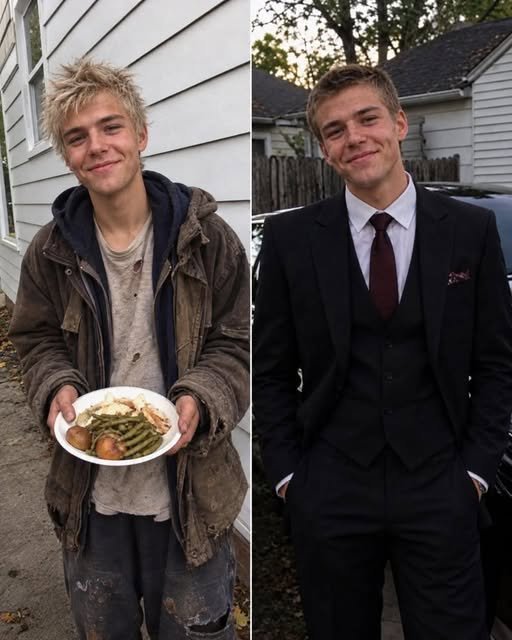
“I came to look at her house from a distance. That’s all I intended. I just wanted to see what she looked like. But I had nowhere to sleep, so I ended up behind the dump. Three days later she walked out with a plate of food. She looked at me for a long time, and then she dropped the plate.”
I laughed, a small wet sound. “She never told me that part.”
“She recognized me instantly. She said I had her father’s chin.” He wiped his eyes. “She sat down in the dirt and held my face and cried. Then she made me promise not to tell you.”
“Why?” My voice cracked. “Why would she keep that from me? I was eight. I was so cruel to you.”
“You were a child who’d just lost her father,” he said. “She was terrified. She’d been forced to give one child away, and she thought you’d feel she was giving you away, too, if she shared her love with me. She was afraid you’d think there wasn’t enough of her to go around. And she was ashamed. Her parents had spent her whole life telling her that what happened to her was a disgrace. She was still carrying that.”
I thought of every meal. The apple pie. The nights I’d gone to bed hungry, resentful, sure she loved a stranger more than me.
“She was feeding her son,” I said.
“She was trying to make up for eighteen years in the only way she could.” He smiled sadly. “She wouldn’t let me take more. She said you needed her more than I did, and she was right. I understood. I had a roof of cardboard and a mother who loved me. It was more than I’d had before.”
“But you left the dump,” I said. “Mom never mentioned it.”
“After three years. She helped me get a job at a lumberyard. I slept in a rented room, then a small apartment. I took night classes in construction management. Eventually I started my own company.” He gestured at the SUV. “It did well. But every Sunday for seventeen years, I came to your mother’s kitchen door and she fed me. We’d sit and talk for hours. You were always away at school or work, and she’d be so proud when she talked about you.”
My chest ached. “I never knew.”
“She never wanted you to. Not out of shame, in the end, but because by then it was too complicated. You’d built a life far away. She was afraid that telling you would feel like a debt, or a burden. And she kept hoping you’d come home on your own.”
I looked down at my hands. “Why weren’t you at the hospital? I looked for you.”
“I was there.” He met my eyes. “I’d been sleeping in the waiting room for three days. When you arrived, your mother asked me to step out. She wanted a few minutes alone with you. She wanted to ask you to look after me, because she’d lost the courage to tell you the truth herself. She was dying, and still afraid.”
“She asked me not to abandon you,” I said slowly. “And I thought…”
“You thought she was asking you to look after a stranger.” He nodded. “That was all she could manage.”
The silence in the car felt like a held breath.
“There’s one more thing,” he said. He reached into his coat and took out an envelope. “Your tuition. The scholarship you thought came from a community fund.”
I couldn’t speak.
“It was me. Your mother found the fund’s name and let me use it. She didn’t want you to feel indebted to me. I was twenty-four and barely scraping by, but I wanted to give you the chance she’d never had.”
I pressed my hand to my mouth. All those years, I had assumed I’d earned everything alone.
“Gabriel,” I said, and my voice shattered. “I’m so sorry. I was awful to you. I turned you away every time you tried to be my friend.”
“You were eight.” He took both my hands, just as he had at the funeral. “I never held it against you. I only wanted to be your brother. That’s all I ever wanted.”
I didn’t plan to hug him. I simply leaned forward, and he caught me, and we sat in the dark car, both of us crying for the woman who had loved us in secret and in fear.
After a while, I laughed through my tears and lifted the dish.
“I brought dinner,” I said. “It’s her recipe. Apple pie for dessert.”
He stared at it, then burst out laughing, and so did I.
We ate on the curb of the old house, brother and sister at last, watching the lights come on across the street. And for the first time in twenty years, I didn’t feel alone.