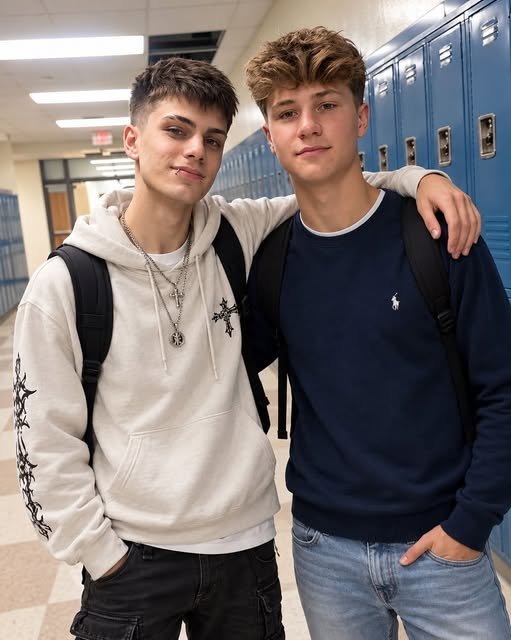
Nathan stood in the doorway with his backpack hanging off one shoulder. His jacket was streaked with dust, and his knuckles were scraped raw.
“Where is Cole?” Denise was on her feet before I could speak.
“He’s in the car,” Nathan said. “He’s okay. Please don’t yell yet. Just let me explain.”
“Car?” I said. “What car?”
“Mrs. Hallworth’s.” He swallowed. “Our neighbor from two streets over. She’s driving us home. She’s outside.”
Denise pushed past him and ran down the front steps. Through the window I watched her yank open the passenger door of an old green sedan and pull a skinny, sheepish Cole into her arms. A white-haired woman stood by the driver’s side, hands folded, waiting patiently.
I turned back to my son. “Start talking.”
He sank into a kitchen chair. “You’re going to be angry, and you have the right to be. But we weren’t doing anything bad. I swear.”
“Eight weekends, Nathan. You lied to me eight weekends in a row.”
“I know.” His voice wobbled. “Mom, do you remember Mr. Ellison? The old man who used to live in the blue house on Maple, who sat on his porch and waved at everyone?”
I did. He’d lived alone for as long as I could remember. “He died in the spring.”
“In June,” Nathan said. “His nephew sold the house in July to a developer. Nobody wanted to live there, and they were going to tear it down. But before that, the house just sat empty with everything still inside. Furniture, books, all his things.”
Denise and Cole came in. Cole wouldn’t look at his mother.
“Go on,” I said.
“August, we were walking by after the movies,” Nathan said. “The back door was open. The lock was broken. We went in, just to look, and…” He glanced at Cole. “Mom, there were boxes everywhere. Photo albums. Letters. A whole wall of shelves with these tiny wooden birdhouses he’d carved. Hundreds of them. And the developers had started putting everything in a dumpster.”
My stomach turned. “You were trespassing.”
“Yes,” Cole said quietly. “We were. We know.”
“But we couldn’t just leave it,” Nathan continued. “He had a whole life in that house. His wife’s letters from the war years, his sketchbooks, his birdhouses. We started carrying boxes out. We hid them in Cole’s grandfather’s old garage, the one nobody uses. Every weekend we went back, sorted what we could, and saved what mattered.”
“That’s why you were exhausted,” I said slowly. “That’s why you showered the second you walked in.”
“The house was filthy,” he admitted. “And we were up all night. We told you we were at each other’s places because we knew you’d say no.”
“Of course I’d say no!” Denise cried. “You broke into a house!”
“We know,” Cole said again. His eyes were wet. “We were wrong to lie. But Mrs. Hallworth was wrong too, if you think about it, for letting everything go.”
Everyone turned to the doorway. The old woman had stepped inside, leaning on a cane.
“Forgive the intrusion,” she said. “I’m Margaret Hallworth. Frank Ellison was my friend for fifty years. May I explain what these boys did?”
I nodded, unable to speak.
She lowered herself carefully into a chair. “Frank had no children. His nephew wanted the house emptied quickly, and the cleanup crew was told to throw everything out. I was in the hospital with a broken hip. I couldn’t stop them.” Her voice shook. “Last night I finally came home, and I saw your sons carrying a box down the alley at two in the morning. I nearly called the police.”
“What stopped you?” I asked.
“The box was labeled.” She almost smiled. “In their handwriting. It said, Frank’s sketchbooks, handle with care. Then I followed them to that garage. I saw what they had built.”
Nathan looked up. “We made a catalog. Every box has a list. We were going to find his family, or somebody who’d want it all.”
“There was no family,” Mrs. Hallworth said. “But there was me. I’ve been looking for Frank’s letters for months, and your sons have kept every one.”
Denise sank onto a chair, one hand over her mouth.
“They saved forty-one boxes,” Mrs. Hallworth continued. “Eleven hundred photographs. Two hundred and six birdhouses. Frank’s wife’s wartime letters, which he read every Sunday. And the sketchbooks, which are extraordinary.” She turned to the boys. “Tonight we found the last box, the one under the stairs. It held the deed to his property, his will, and a letter.”
“A letter?” I asked.
She took an envelope from her handbag. “Frank wrote it two years before he died. It says that if anyone ever saved his things, they should keep his workshop tools. And his savings, which his nephew never knew about, should go to the person who carried on the work.”
The kitchen went still.
“Savings?” Cole whispered.
“Eighty-three thousand dollars, held with an attorney in town,” she said. “Frank wanted it used for a scholarship in woodworking and art, at your high school. He named no one, only that the person who found his work should oversee it.” She looked at the boys with an expression I will remember for the rest of my life. “He would have chosen you.”
Nathan blinked fast. “Mom, we didn’t do it for money. We didn’t even know.”
“I know you didn’t,” I said. My throat was thick. “That’s what makes it true.”
I looked at Denise. She was crying. So was I.
“You were still wrong to lie,” Denise said, but her voice had no steel left. “And you will both apologize to every person who lay awake tonight.”
“We will,” Cole said.
“And you will pay back that nephew’s developer for the broken lock, whether it was you or not,” I added.
“Yes, ma’am,” Nathan said.
I pulled my son into a fierce hug, smelling dust and old paper on his jacket. “Never again. You tell me where you are. Even if you think I’ll say no.”
“Never again,” he whispered.
Three weeks later, the town held a small ceremony at the high school. The Frank Ellison Memorial Scholarship was announced, with a display of two hundred and six birdhouses in the front hall. Mrs. Hallworth cut the ribbon. Nathan and Cole, wearing borrowed ties, stood on either side of her.
The developer, once he learned the story, donated the old workshop’s tools and changed the demolition plans so that the porch could be preserved.
That night Nathan came home and set one birdhouse on our kitchen windowsill. It was small, blue, carved with a tiny door.
“Mrs. Hallworth gave me this one,” he said. “She said Frank made it for a boy who’d never stopped waving back.”
I looked at it, and then at him, my sixteen-year-old, who had lied to me and loved a stranger’s memory enough to rescue it.
“Eight weekends,” I said, shaking my head. “I’m still grounded-angry.”
“I know,” he said, grinning. “Worth it?”
I kissed the top of his head.
“Ask me again in a month.”