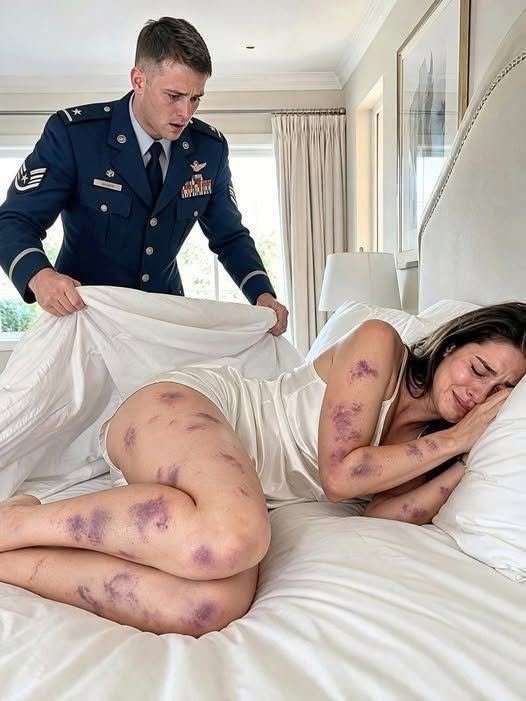
I didn’t storm into the garden. Every instinct in my body demanded it, but I had spent years in uniform learning that anger without a plan only gets people hurt, and Elena had been hurt enough.
I sat beside her and asked one thing: “Will you tell me everything? Only what you can bear to.”
It took two hours. Ricardo had gambled away almost everything he owned within a year of my leaving. When he came to Victoria for help, she didn’t scold him. She looked at my accounts instead. My army pay, my investments, the house I had bought with my savings, and the business Elena and I had built from nothing were all within their reach.
At first they pushed Elena with words. Victoria told her I had signed power-of-attorney papers before leaving, which was a lie. When Elena refused to sign over our property, the words became shoves, then grabs, then worse. Ricardo did the bruising. Victoria watched, and told Elena that no one would believe a lonely wife over a respected mother. They took her phone, then monitored her calls, and threatened that if she told me during our video chats, they would make sure I was dishonorably discharged for “family scandal.” She was terrified I would be distracted in the field and get hurt. So she stayed silent for six months.
“I wanted you to come home alive,” she whispered. “That was all I wanted.”
I held her until she fell asleep. Then I sat in the dark with the old phone and went through everything again, photographing each message, transfer record, and document. Elena, I learned, had been braver than she knew. She had quietly kept the phone hidden inside a flour tin in the pantry and had saved copies of what she could.
At dawn, I didn’t wake my mother or brother. I drove Elena to a hospital two towns away, where a doctor documented every injury with photographs and a written report. A nurse quietly gave Elena the number for a domestic violence advocate, and Elena finally cried in relief at being believed.
From the hospital parking lot I called the base legal assistance office, then a civilian attorney named Marisol Vega, a former prosecutor who specialized in financial exploitation. By noon, we were in her office. She read through the evidence for an hour without speaking, and then she said, “This is the cleanest case of forgery and coercion I’ve seen in years. Your brother made one mistake: he kept records.”
Over the next five days, everything happened quietly. Marisol filed for an emergency freeze on every transfer. A forensic document examiner confirmed that my signature on the property papers was forged, the pen pressure and letter formation all wrong. A notary who had stamped several of the documents admitted, when confronted, that Ricardo had paid her to stamp them without me present. The bank’s own audit trail showed Victoria had personally authorized three of the transfers from my account, using details only a family member would know.
Meanwhile, I behaved normally. I laughed at Ricardo’s jokes at dinner. I let Victoria believe Elena’s silence meant she had given up. It was the hardest acting I have ever done, and every night I lay awake beside my wife, who slept with her back to me and then, on the third night, turned over and rested her head on my shoulder.
On the sixth day, I invited them to a “welcome home” lunch at the house, the house they believed was theirs. Victoria wore her new jewelry. Ricardo wore my watch.
Halfway through the meal, the doorbell rang. Marisol stood on the porch with two detectives and a uniformed officer.
“Mrs. Victoria Alvarez? Mr. Ricardo Alvarez?” the lead detective said. “We have warrants regarding forgery, fraud, elder-and-spousal financial exploitation, and assault.”
Victoria’s glass slipped from her fingers. “This is absurd. Daniel, tell them this is a misunderstanding.”
I stood slowly. “I know exactly what it is, Mother.”
Ricardo bolted for the back door, but two more officers were waiting there. When they cuffed him, he spat that Elena was a liar. Then the detective read aloud the medical report, and Ricardo went silent. The photographs were already in evidence, and the pawn shop receipts proving he had sold my grandfather’s medals for gambling money were in the file as well.
Victoria tried a different approach. She turned to me with tears on her face and said, “I raised you. Everything I did was for this family.”
“You did it to your family,” I said. “Elena is my family. You stopped being that the day you put your hands on her.”
The case moved faster than I expected. Faced with the forensic evidence, the notary’s testimony, and the medical records, Ricardo accepted a plea deal rather than risk trial. He received eight years for forgery, fraud, and assault. Victoria, as the planner who authorized the transfers and enabled the abuse, received five. The court also ordered full restitution, and every stolen asset was legally returned. The house, my investments, and our small business were ours again, with a court order voiding every forged document.
The recovery of money was the easy part. Healing was slower.
Elena began therapy twice a week, and I went with her to every session she wanted me to attend. For months she flinched when I moved too quickly or came up behind her in the kitchen, and every time, I stopped, stepped back, and waited until she was ready. I never once asked her to be fine.
One evening, nearly a year later, we sat on the porch watching the sunset. She slipped her hand into mine without being asked, and held on.
“I thought you’d never look at me the same way,” she said quietly. “After everything.”
“I look at you and see the strongest person I’ve ever known,” I told her. “You protected me from the other side of the world, with nothing but silence and courage.”
She smiled, a real smile, the first I had seen in a long time.
The medal I brought home from deployment sits in a drawer now. The thing I’m proudest of is hanging on our wall: a framed photograph of Elena the day her restitution hearing ended, standing on the courthouse steps, chin up, free.
I came home expecting to be welcomed. Instead I learned what real strength looks like. It isn’t in medals or uniforms. It’s in a woman who endured the unthinkable and still chose, in the end, to reach for my hand.