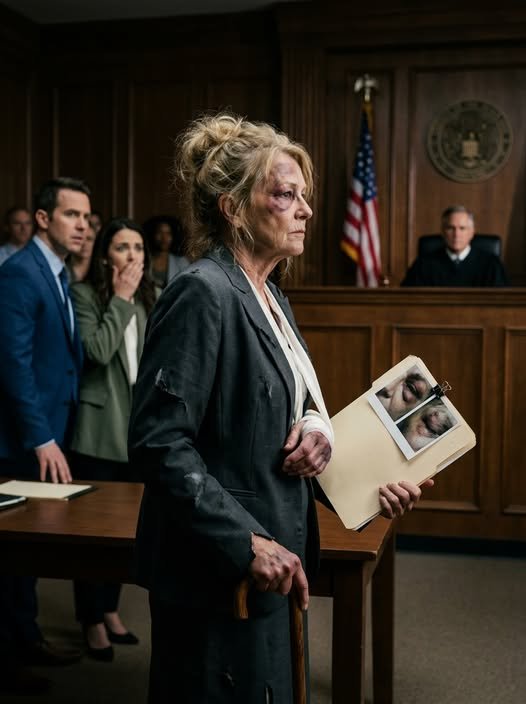
Judge Mercer read in silence for eleven minutes. The only sounds in the courtroom were the turning of pages and Vanessa’s shallow, rapid breathing.
He started with the medical records. Dr. Patricia Hallworth, my physician of nineteen years, had documented the wrist sprain, the laceration, and the shoulder contusions, noting in her own hand that the injuries were “inconsistent with a fall and consistent with forceful grasping and impact.” Behind it was a cognitive evaluation dated nine days before the hearing, administered by an independent neuropsychologist. I had asked for it myself. The score was in the superior range, and the final line read, No evidence of cognitive impairment.
Then he reached the messages.
Stop making this difficult. Sent at 12:17 a.m., the night I stood in the rain. Beneath it, a thread between Daniel and Vanessa that I had never meant to see, recovered from the family tablet that still synced to my account. In it, Vanessa wrote: Just keep logging the “episodes.” Judge will see a pattern. Daniel replied: Once she’s under guardianship, we move the accounts. She won’t fight it.
The judge lowered the page and looked over his glasses at my son.
“Mr. Vance, is this your phone number?”
“Your Honor, those are taken out of context…”
“I asked whether it is your number.”
Daniel’s lawyer touched his sleeve. “My client would like a moment.”
“Your client has had a moment,” Judge Mercer said. “He’s had several weeks.”
He kept going. The photographs of the locksmith’s invoice, dated three weeks earlier, with Daniel’s signature. A copy of the investment authorization Vanessa had tried to force me to sign, my wrist visibly red in a photo taken by the neighbor, Mrs. Okafor, who had heard the shouting and recorded the date in a notebook. A bank statement showing a transfer request of $212,000 filed the day after the guardianship petition.
“Counsel,” the judge said, “did you review these materials before filing?”
Daniel’s attorney had gone pale. “Your Honor, I relied on my client’s representations.”
“I see.”
Judge Mercer closed the file and folded his hands. When he spoke, his voice was quiet, which made it worse.
“I have sat on this bench for twenty-two years. I have seen genuine guardianship cases, where families agonize over how to protect someone they love. This is not one of them. This is a petition built on fabricated incidents, supported by photographs of injuries that the petitioners themselves appear to have caused. The petition is denied with prejudice.”
Vanessa began to cry. Daniel stared at the table.
“Furthermore,” the judge went on, “I am referring this matter to the district attorney for review of assault, elder abuse, financial exploitation, and filing a false petition. I am also ordering that the locks be restored and Mrs. Vance’s full access to her home be returned today. Bailiff, please ensure Mr. and Mrs. Vance do not leave the courthouse before they are served.”
Daniel found his voice then. “Mom. Mom, please. We were trying to help. You were struggling. You have to tell them.”
I stood slowly, leaning on the cane, and I let myself look at him fully for the first time that day. He was forty-four years old. I remembered him at six, asleep on his father’s shoulder after a Fourth of July parade, sticky with watermelon.
“I did tell them, Daniel,” I said. “I told them the truth. That’s all I’ve ever asked of anyone.”
“I’m your son.”
“You were,” I said gently. “Until you decided I was an asset.”
The aftermath moved the way these things do, quickly in some ways and with agonizing slowness in others. The district attorney’s office opened a formal investigation within a week. Mrs. Okafor testified about what she had heard, and the locksmith confirmed who had hired him. The tablet messages were authenticated by a forensic examiner. Vanessa, facing the strongest evidence against her, took a plea deal and received two years in a state facility, along with a restraining order and a restitution order. Daniel pleaded to filing a false petition and financial exploitation. He was sentenced to three years, with five more suspended and a lifetime ban from any control over my finances.
I did not attend the sentencing with satisfaction. I went because I believed in showing up for the record, the way I had for thirty-six years.
That night I drove home alone. The locks had been replaced, and a new key sat in my palm. The porch light was on. Mrs. Okafor had left a casserole on the step with a note: Welcome home, General.
I laughed out loud for the first time in months.
Inside, Robert’s study was exactly as I’d left it, his reading glasses still on the desk, his old Army coffee mug beside them. I sat in his chair and let myself cry, quietly, for the husband I missed and the son I had lost long before any courtroom.
Healing took time. My wrist needed physical therapy, and the scar over my eyebrow faded to a thin white line. But my life widened again. I resumed my volunteer work with veterans, and I joined the board of a legal aid clinic that helps older adults facing guardianship fraud. Over a hundred people have come through that program since, many of them told, just as I was, that they were too frail to speak for themselves.
Last spring I was asked to address a room of two hundred seniors and their families. I stood at the podium without a cane.
“They will tell you that you are confused,” I said. “They will tell you that you are fragile. Keep records. Tell a neighbor. Call a lawyer. Do not stay silent to keep the peace.”
The applause lasted a long time.
Afterward, a woman in her eighties pressed my hand and whispered, “You gave me courage.”
“You already had it,” I told her. “Sometimes you just need someone to remind you.”
I still have the navy coat. It hangs by the door, and I touch it sometimes on my way out.
Daniel believed he walked into that courtroom to take control of my life.
He was right about one thing. He did leave with a lesson in command.