I was still standing beside my car when I heard footsteps on the gravel behind me.
Alicia’s sister, Hannah, was twenty-six, with the same dark eyes and the same crooked half-smile. She wore a black coat and carried a shoebox tied with a white ribbon, held against her chest like something that might spill.
“Lucas,” she said. “Can I talk to you?”
I nodded. I didn’t trust my voice.
“She asked me to give you this only after she was gone.” She pressed the box into my hands. “She made me promise. She said you’d try to refuse it, and I wasn’t allowed to let you.”
“Hannah, I can’t take anything. I only married her because…”
“Because she asked. I know.” Her voice wobbled. “Open it at home. Not here. Please.”
She squeezed my arm, turned, and walked back toward the cemetery, where the last of the mourners were drifting away under a gray sky.
I drove home with the box on the passenger seat, seatbelt across it, like a child. My apartment was exactly as I’d left it: a stack of medical journals, a cold mug of coffee, a single plate in the sink. I set the box on the kitchen table and sat across from it for almost an hour.
Finally I untied the ribbon.
On top lay an envelope with my name in Alicia’s looping handwriting, and beneath it, folded tissue paper. I opened the envelope first.
Doctor Lucas,
If you’re reading this, I’ve won the argument about the box, and I’m probably telling Hannah “I told you so” from somewhere with better snacks.
First, you don’t owe me anything. Not grief, not guilt. I know you married me because I begged, and because you’re the kind of person who can’t say no to a dying girl. That is exactly why I picked you.
Second, I wasn’t entirely honest. Let me explain.
I turned the page.
When I first got sick, I made a list. I was fifteen. I wrote it on the back of a pharmacy receipt: things I wanted to do before I died. Most were silly. See snow. Eat dessert for dinner. Make a nurse laugh so hard she snorts.
I did most of them. But one thing stayed on the list for three years, and I never crossed it off.
“Be somebody’s person.”
I don’t mean boyfriend. I mean the one who gets called when something goes wrong and when something goes right. I never got to be that. I was always the patient, the burden, the one people were careful around.
Then you walked in with your serious face, and you treated me like I was a whole person. You asked what I thought. You laughed at my stories even when you were pretending not to. You never once looked at me like I was already gone.
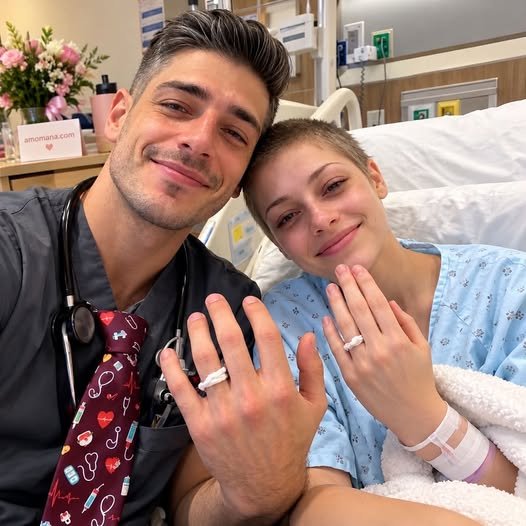
The wedding wasn’t a wish to be married. It was a wish to be chosen. And you chose me, in a hospital room, with a bandage ring. I got to be somebody’s person for two days. It was the best thing that ever happened to me.
Thank you.
I put the letter down. I put my forehead on the table. For a long while I didn’t do anything at all.
When I could, I lifted the tissue paper.
Inside was the bandage ring, the one the nurse had braided. It had been carefully cleaned and pressed flat, and sealed in a small glass frame. Under it, in the box, was a leather-bound notebook, and a thick envelope stamped with the name of a bank.
I opened the notebook. The first page said, in capital letters: THE LIST.
Alicia had copied out every item, in order, with check marks beside the ones she’d finished. Dozens of lines. Near the bottom, the last entries were in a different, shakier hand.
Get married. ✓
Make Lucas smile with teeth. ✓ (Day 2. He tried to hide it. Failed.)
Help someone else finish a list.
That last one had no check mark. Beneath it she had written a note.
Lucas, that’s yours. If you want it.
The envelope held a savings passbook. I stared at the number twice before it made sense.
Alicia’s parents had died when she was twelve. She’d lived with Hannah ever since, and a small life insurance payout had been set aside for her. The hospital bills had eaten most of it, but not all. After treatment, she and Hannah had quietly decided to keep what remained for something specific.
There was a note clipped to the passbook, in Hannah’s handwriting this time.
Lucas, this isn’t a gift. Alicia wanted it to be a seed. She wanted it used to help other patients who run out of time to finish their lists. She said you’d know how.
It’s not much. About eleven thousand dollars. But she asked me to tell you: “Doctors fix bodies. Somebody has to fix the rest.”
I read that line a dozen times.
Three days later, I went to see the head nurse on Alicia’s floor, a woman named Gloria who’d been there thirty years. I laid the notebook on her desk and told her what was in the box.
Gloria read the list in silence. When she finished, she took off her glasses and wiped her eyes with the back of her wrist.
“She never told us about this,” she said. “She made a game of everything. We thought she was just being brave.”
“I think she was doing both.”
“What do you want to do with it?”
I had spent three days thinking. “A fund,” I said. “Small. For patients with a short prognosis. Not for medical bills. For the list. A plane ticket. A concert. A wedding. A visit with an estranged sister. Whatever they need to cross off before the end.”
Gloria looked at me for a long moment. Then she opened a drawer, pulled out a blank folder, and wrote on the tab in thick black marker: ALICIA’S LIST.
“I’ll get the social worker,” she said. “And the chaplain. And half the nurses on this floor, because they’ll want in.”
The first patient we helped was a retired bus driver named Mr. Delaney, eighty-one, with four weeks left. His list had one item: See the ocean one more time. The hospital arranged a transport van, a nurse volunteered her weekend, and I went along to carry the oxygen. He sat on a beach chair at the edge of the water in a wool blanket, and said nothing for forty minutes. On the drive back, he said quietly, “I feel finished. In a good way.”
The second was a nineteen-year-old girl who wanted to hear her little brother play in his school band. We moved the concert into her hospital room.
The third wanted to ask forgiveness from a father who hadn’t spoken to her in eleven years. The father came. I wasn’t in the room, but the nurse told me the door stayed closed for two hours, and when it opened, both of them were red-eyed and holding hands.
By the end of the first year, the fund had helped twenty-three people. Donations came in from nurses, from families, from strangers who heard the story. The hospital added a line to its budget. Hannah joined the board and, on the first anniversary, stood in front of a small crowd in the hospital lobby and said, “My sister would have hated all this attention.”
Everyone laughed. Then she added, “She would have loved every second.”
I never remarried, though that wasn’t a vow. I simply stopped measuring my life against what I’d lost and started measuring it against what I could pass on.
On the second anniversary of the wedding, I drove to the cemetery with a coffee and a paper bag of pastries, her favorite, because she’d said dessert for breakfast was the only reasonable way to live.
I sat by her stone. The bandage ring in its glass frame was in my coat pocket. I took it out and held it in the sunlight.
“Twenty-three people the first year,” I said. “Forty-one the second. Mr. Delaney’s daughter sent a photo of him at the ocean. He’s smiling in it. With teeth.”
The wind moved through the trees.
“I wore a tie instead of a stethoscope, once,” I said. “It was the best day of my life, and I never told you. So I’m telling you now.”
I set the frame on the grass beside the pastries and smiled. It was a real one, wide and unguarded and a little bit wet.
“You were right,” I said. “Smiling is free.”