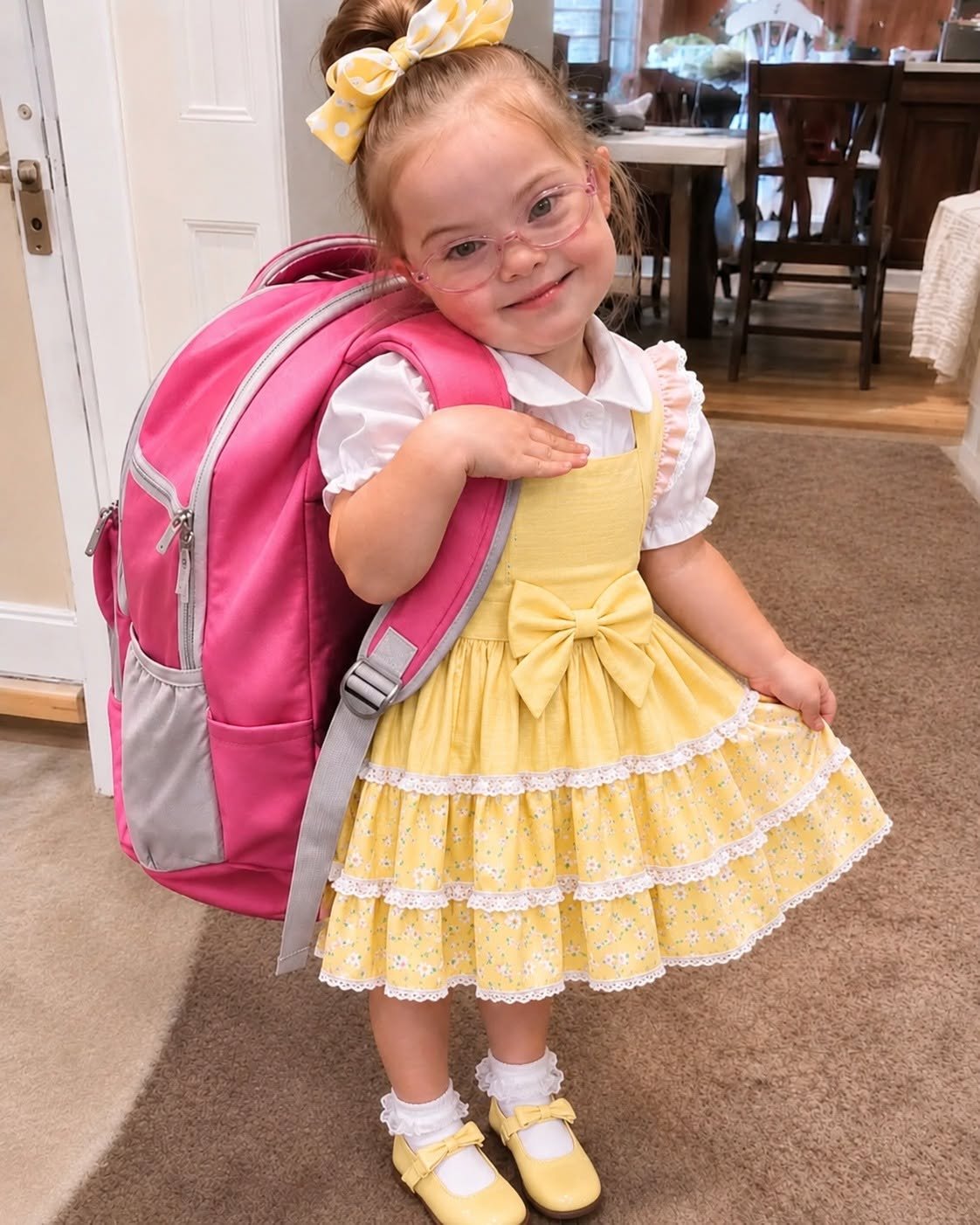
Part 1 – The Butterfly She Never Received
My daughter was so excited about her first school festival — but an hour after I dropped her off, the principal called, saying she was begging for me. When I arrived, she told me her new teacher had refused to paint her face like the other girls because “makeup won’t make girls like me pretty.”
My 6-year-old daughter, Victoria, has Down syndrome. Sending her to first grade was one of the hardest decisions I’d ever made.
I worried about everything. Would the other children make fun of her? Would she understand if someone was cruel? Would she tell me if something happened?
But Victoria wanted to go to school more than anything. And for the first two weeks, she was happier than I’d ever seen her.
Every afternoon, she’d run into my arms, talking about her new friends and showing me the drawings she’d made.
Then came her first school festival.
I kissed her forehead and dropped her off. Everything seemed perfectly normal.
But just an hour later, my phone rang. It was the principal.
“Mrs. Parker, Victoria has been crying for twenty minutes. She keeps asking us to call you. Could you come pick her up?”
“Is she hurt? What happened?”
“She’s safe, but she’s very upset.”
I was already grabbing my car keys.
When I arrived, Victoria was waiting in the school hallway. Children with painted faces were running around, laughing, while a young teacher was busy painting butterflies on another little girl’s cheeks.
Victoria spotted me and ran straight into my arms.
“Mommy, I want to go home.”
“Sweetheart, what happened?”
She pointed toward the teacher, who had her back to us and was too far away to hear.
“She said makeup is for pretty girls. And it won’t help me because I’m not pretty.”
I knelt beside her.
“Mommy, am I not pretty? Will I never be pretty? Please don’t lie to me.”
I wiped her tears and kissed her forehead.
“Victoria, you are beautiful, sweetheart. Don’t ever let anyone tell you otherwise.”
“But Mommy, she’s a teacher. Teachers don’t lie.”
I looked over at the woman. She was still smiling, painting another child’s face, completely unaware that I was standing there.
And then an idea came to me.
“Baby, go back to the principal’s office, okay? Tell her Mommy will be there in five minutes. I just need to take care of something.”
“Are we going home?”
“We’re going to the movies, sweetheart. And afterward, we’ll get your favorite ice cream. I promise.”
Victoria gave me one last hug and hurried back down the hallway. I watched until she disappeared into the principal’s office.
Then I turned toward the teacher.
She had never met me before. She didn’t know I was Victoria’s mother. And I intended to keep it that way.
Because no child deserved to be treated the way she’d treated my daughter and she will remember this lesson — so I went directly toward her table as she finished painting another girl.
“Those butterflies are beautiful,” I said.
The teacher looked up and smiled.
“Thank you! The children have been absolutely obsessed with them this morning.”
Her name tag read MISS BENNETT.
She appeared to be in her late twenties, with neatly arranged brown hair and a pale blue cardigan. A collection of colorful brushes lay beside her, along with a small mirror decorated with silver stars.
Under different circumstances, I might have trusted her immediately.
“Do all the children get one?” I asked.
“Of course.”
“Every child?”
Something in my voice must have caught her attention.
She put down her brush.
“Well, depending on whether they can sit still. We have to be practical.”
“I understand. What about children with Down syndrome?”
Her smile became uncertain.
“We try to accommodate everyone.”
“That’s wonderful. Because I saw a little girl crying in the hallway. She seemed to think she wasn’t allowed to have her face painted.”
Miss Bennett glanced toward the principal’s office.
“Oh. Victoria.”
The casual way she said my daughter’s name made my chest tighten.
“Was there a problem?”
“She’s a sensitive little thing. Sometimes children with special needs misunderstand what adults are trying to tell them.”
“What did you tell her?”
The teacher picked up a cloth and began wiping her brushes.
“I simply tried to manage her expectations.”
“About a butterfly?”
“About appearance.”
For several seconds, I could hear nothing but the music playing from the festival speakers.
“She’s six years old,” I said quietly.
Miss Bennett sighed.
“I know that.”
“And what expectations concerning her appearance could possibly require managing?”
She looked at me more carefully.
“Are you a parent here?”
“Yes.”
“Well, then I’m sure you understand that children sometimes need to be prepared for the real world.”
I took a slow breath.
“The real world?”
“Children can be unkind. I don’t think encouraging unrealistic ideas about beauty helps anyone.”
There it was.
Not a misunderstanding.
Not an accidental remark.
A belief.
I reached into my purse and took out my phone.
On the screen was a photograph of Victoria taken that morning. She was wearing a yellow dress, white sneakers, and two little butterfly clips in her hair.
I turned the screen toward Miss Bennett.
“This is my daughter.”
The teacher’s face changed.
“Mrs. Parker?”
“Yes.”
“I didn’t realize—”
“Would you have answered differently if you had?”
She opened her mouth, then closed it.
A volunteer approached the table with more paper towels. I waited until she had walked away before continuing.
“I’m not going to embarrass you in front of these children,” I said. “But I need you to understand something. My daughter came here believing today would be one of the best days of her life. She left your table asking whether she would ever be pretty.”
“I’m sorry she got upset.”
“That’s not the same as being sorry for what you said.”
Miss Bennett looked down.
I wanted her to understand. I wanted her to hear Victoria’s trembling voice and see the way she had searched my face for reassurance.
But I knew anger alone wouldn’t accomplish that.
“I want to discuss this with the principal,” I told her. “Privately, and properly.”
I walked away before my emotions could overtake me.
Principal Margaret Ellis was waiting inside her office. Victoria sat beside her desk, holding a stuffed rabbit from the school’s reading corner.
“Mommy!”
She immediately reached for my hand.
“Ready for our movie?”
She nodded.
Before leaving, I asked Mrs. Ellis for a meeting on Monday.
Her expression became serious when I explained what Miss Bennett had told me.
“I’ll document this today,” she promised. “You have my word that we’ll look into it.”
I wanted to believe her.
But promises felt terribly small beside the pain in my daughter’s eyes.
Outside, Victoria watched several children walk past with butterflies painted across their cheeks.
“Mommy?”
“Yes, baby?”
“Can we buy butterfly paint?”
“Absolutely.”
“Even if I’m not pretty?”
I stopped walking.
I bent down until our eyes were level.
“You don’t have to earn a butterfly by looking a certain way. You get to have one because you want one. Just like everybody else.”
She thought about that.
“Can mine be purple?”
“Purple it is.”
We went to the movies. We ate strawberry ice cream afterward. I bought a small face-painting kit, and that evening, I painted a purple butterfly on her cheek.
It was crooked.
One wing was considerably larger than the other.
Victoria loved it.
She ran into the bathroom, climbed onto her little stool, and smiled at herself.
“Look, Mommy! It landed on me!”
For the first time that day, I laughed.
My husband, Daniel, returned home shortly after six. Victoria hurried to show him her butterfly.
He smiled, kissed her forehead, and declared it the finest butterfly he had ever seen.
Later, after she fell asleep, I told him everything.
Daniel listened without interrupting.
When I finished, he sat silently at our kitchen table.
“She asked you whether she’d ever be pretty?”
I nodded.
He rubbed his eyes.
“She’s six, Emily.”
“I know.”
“Six.”
His voice broke.
Daniel had been the first person to hold Victoria after she was born. He used to carry her around our living room for hours, singing songs he barely remembered from childhood.
He had never looked at our daughter and seen anything missing.
Neither had I.
“We could move her to another school,” he suggested.
“I’ve thought about that.”
“But?”
“Victoria loves her friends. She loves her classroom. Why should she have to leave because an adult failed her?”
Daniel nodded slowly.
“Then we make sure they take responsibility.”
On Sunday afternoon, Victoria spread her crayons across the dining table.
She drew a school building, a yellow sun, and several children holding hands.
One child had a purple butterfly.
“Who’s that?” I asked.
“Me.”
“And this one?”
“Lily.”
Lily was the little girl who sat beside Victoria during reading time. According to Victoria, they were best friends because they both liked strawberries and disliked green beans.
“And who’s the grown-up?”
Victoria stopped coloring.
“Miss Bennett.”
I noticed that she had drawn the teacher standing far away from the children.
“Why is she over there?”
Victoria lifted one shoulder.
“She doesn’t like my group.”
I looked at her.
“What group, sweetheart?”
“The window group.”
I had never heard of a window group.
“Who sits there?”
“Me. Noah. Samuel. And sometimes Rosie.”
“Why?”
“Because we need help.”
She returned to coloring.
I remembered Noah from orientation. He wore hearing aids. Samuel needed additional support with reading, and Rosie sometimes used a walking aid.
Perhaps it was simply a small instructional group.
But something about Victoria’s tone troubled me.
“Do you play with the other children?”
“Sometimes.”
“Do you sit with Lily?”
“Not when Miss Bennett says window group.”
Before I could ask another question, my phone rang.
The number was unfamiliar.
“Hello?”
“Mrs. Parker?”
“Speaking.”
“My name is Rebecca Walsh. My daughter, Lily, is in Victoria’s class.”
I straightened.
“Of course. Victoria talks about her all the time.”
“I’m sorry to call you at home. I got your number from the parent contact list.”
“Is something wrong?”
There was a pause.
“I heard about what happened at the festival.”
I glanced toward Victoria.
“Yes.”
“Lily told me something yesterday. I wasn’t sure whether I should believe her, but after hearing about Victoria, I think you need to know.”
My fingers tightened around the phone.
“What did she say?”
“Apparently, Miss Bennett has been telling certain children that they shouldn’t expect to participate in everything the other children do.”
“The window group?”
Rebecca went silent.
Then she whispered, “Victoria told you about that?”
“Just now.”
“Emily, there’s something else.”
I walked into the kitchen.
“Lily brought home a piece of paper on Friday. She said Miss Bennett dropped it near her desk. I thought it was some kind of classroom schedule.”
“What was on it?”
“I’ll send you a photograph.”
A moment later, my phone vibrated.
The photograph showed a printed classroom planning sheet with several handwritten notes.
Near the bottom was a section titled FESTIVAL PARTICIPATION.
Four names had been written underneath.
Victoria Parker.
Noah Mitchell.
Samuel Reed.
Rose Carter.
Beside them, someone had written:
Alternative activity. Avoid main display. Parent collection if distressed.
My stomach turned.
Victoria hadn’t been excluded because the face-painting table was crowded.
Someone had apparently planned a separate festival experience for four children before the event even began.
Then I noticed another detail.
At the bottom of the page, beneath Miss Bennett’s initials, was a second signature.
It belonged to Principal Margaret Ellis.
Part 2 – The Children by the Window
I stared at the photograph until the letters blurred.
Principal Ellis had promised to investigate what happened.
Yet her signature appeared on the very document suggesting that Victoria and three other children had been separated from their classmates.
“Emily?” Rebecca said through the phone.
“I’m here.”
“Do you see it?”
“Yes.”
“I didn’t want to make assumptions. Maybe there’s an explanation.”
“I hope there is.”
But as I looked through the doorway at Victoria, happily coloring her purple butterfly, I couldn’t imagine an explanation that would make everything acceptable.
Daniel studied the photograph that evening.
“Don’t confront anyone based on this alone,” he said. “We need to know what was actually approved.”
He was right.
The document suggested something troubling, but it didn’t tell us the entire story.
On Monday morning, my mother came to stay with Victoria while Daniel and I attended our meeting.
Victoria protested when she learned she wouldn’t be going to school immediately.
“But Lily needs me!”
“Grandma’s going to make pancakes,” Daniel told her.
This helped considerably.
At school, Principal Ellis welcomed us into her office. Miss Bennett sat beside her, along with a woman introduced as Janet Morris, the school’s student support coordinator.
I placed a printed copy of Rebecca’s photograph on the desk.
“Before we discuss the festival, could you explain this?”
Mrs. Ellis picked it up.
Her eyebrows drew together.
“Where did you get this?”
“Another parent provided it.”
She examined the paper closely.
“I signed the original accommodation plan.”
“Then you approved this?”
“Not exactly.”
She opened a folder and removed several pages.
“The plan was intended to provide quieter activities for children who might become overwhelmed by the festival. Participation was supposed to be optional.”
She put the original document beside ours.
The four names were identical.
The handwritten instructions were not.
On her copy, the note read:
Offer quiet activity as needed. Support full participation according to individual preference.
Miss Bennett shifted in her chair.
“Clara?” Mrs. Ellis asked.
Miss Bennett folded her hands.
“I thought separating them would prevent difficulties.”
“Did you add these instructions after I signed the document?”
“Yes.”
The principal’s expression changed.
“You were not authorized to do that.”
“I was trying to make the festival manageable.”
Daniel leaned forward.
“Manageable for whom?”
Miss Bennett didn’t answer.
I took a breath.
“Victoria had been talking about face painting for an entire week. Did you know that?”
“Yes.”
“Then why wouldn’t you let her participate?”
“There were several children waiting. I thought she might move suddenly or become upset.”
“Did you give her a chance?”
Silence.
“And did you tell her makeup wouldn’t make girls like her pretty?”
Miss Bennett’s eyes filled with tears.
“I said something I shouldn’t have.”
“That isn’t what I asked.”
“Yes.”
The word seemed to settle over the room.
For days, I had been replaying Victoria’s account, wondering whether there was some misunderstanding that might make the situation less painful.
Now there was none.
“Why?” I asked.
Miss Bennett looked toward the window.
“I don’t know.”
I shook my head.
“Please don’t give me an answer you think will end this conversation.”
She swallowed.
“I grew up believing children should be taught to accept their limitations. I thought I was being realistic.”
Janet Morris spoke.
“Providing support is not the same as deciding what a child deserves to experience.”
Miss Bennett nodded.
Mrs. Ellis explained that the school would conduct a formal review. In the meantime, another teacher would supervise Victoria’s class while Miss Bennett was temporarily reassigned away from classroom duties.
She also promised to review the experiences of the other children mentioned in the document.
“Mrs. Parker,” she said, “I should have recognized that something was wrong on Saturday.”
“You called me to collect Victoria instead of finding out why she was crying.”
The principal lowered her eyes.
“You’re right.”
It was the first uncomplicated acknowledgment I had received.
I appreciated it.
But there was much more to understand.
After the meeting, Daniel drove me home.
Neither of us spoke for several minutes.
Finally, he said, “Do you think she’ll be okay?”
“Victoria?”
He nodded.
“I don’t know.”
Children were resilient, people liked to say.
But children also remembered.
A single sentence spoken by a trusted adult could follow someone for years.
That evening, I contacted the other families.
Noah’s mother, Angela, told me that her son had been encouraged to watch a festival performance from a separate room because the music might be too loud.
“Nobody asked whether he wanted to stay,” she said.
Samuel’s father learned that his son had been given coloring worksheets instead of participating in the storytelling activity.
Rosie’s parents had been told their daughter chose not to join a game.
Rosie insisted she’d never been invited.
Individually, each incident might have been dismissed as a small mistake.
Together, they revealed a pattern.
We arranged to meet on Wednesday at Rebecca’s house.
She served coffee while our children played in the garden.
Victoria and Lily immediately began building an imaginary butterfly hospital beneath a tree.
Noah joined them with a plastic magnifying glass.
Samuel carried a notebook, declaring himself responsible for appointments.
Rosie sat on the garden bench and instructed everyone where to collect imaginary medicine.
Watching them, I felt an unexpected ache.
They were solving problems, negotiating roles, laughing, and making room for one another without an adult telling them how to do it.
Inside, we agreed that we didn’t want our children turned into subjects of gossip.
We wanted meaningful changes.
Rebecca suggested requesting an independent review of the school’s inclusion practices.
Angela wanted better communication.
Samuel’s father wanted classroom observations.
And I wanted Victoria to return to school without wondering whether she belonged there.
When the meeting ended, Lily pulled her mother aside.
“Can Victoria sleep at our house someday?”
Rebecca smiled.
“We’ll talk about it.”
“Because we’re sisters.”
Victoria nodded enthusiastically.
“Butterfly sisters!”
For the first time since Saturday, I felt something resembling hope.
The following morning, Victoria returned to school.
Her temporary teacher, Mrs. Audrey Dawson, greeted her at the classroom door.
“Victoria! I’ve been told you’re an excellent artist.”
Victoria beamed.
“I draw butterflies.”
“Then I think we’re going to get along beautifully.”
I watched her enter the classroom.
For a moment, she hesitated near her old place by the window.
Mrs. Dawson noticed.
“You can sit beside Lily if you’d like.”
Victoria’s face brightened.
She hurried across the room.
I nearly cried.
It was such a simple thing.
A chair.
A choice.
A friend.
Yet it meant everything.
That afternoon, Victoria came home carrying a drawing of two girls holding hands beneath an enormous butterfly.
“Mrs. Dawson said I could put it on the wall!”
“That’s wonderful.”
“Everybody saw it.”
She sounded astonished.
I wondered how many times her work had quietly been set aside.
Over the next few days, she became more cheerful.
But an unexpected habit emerged.
Before choosing her clothes, she asked whether they made her look pretty.
Before leaving the house, she asked whether her hair was right.
When Daniel took a photograph of her, she requested to see it immediately.
The questions were innocent enough.
Their frequency worried me.
One evening, I found her standing before the bathroom mirror, trying to stretch the corners of her eyes upward with her fingers.
“Sweetheart?”
She quickly lowered her hands.
“What are you doing?”
“Trying something.”
“What?”
“Looking like Lily.”
I sat beside her on the bathroom floor.
“You don’t need to look like Lily.”
She stared at her slippers.
“Miss Bennett likes Lily.”
My heart sank.
I wanted to offer a perfect explanation. One that would undo every painful thought.
Instead, I told her the truth.
“Sometimes grown-ups make mistakes because they haven’t learned enough about other people. That doesn’t mean there’s anything wrong with you.”
“Can teachers learn?”
“Of course.”
“Even Miss Bennett?”
“Yes.”
Victoria considered that.
Then she asked, “Can I teach her?”
I hugged her.
“You don’t have to, sweetheart. That’s the adults’ responsibility.”
But her question remained with me.
On Friday, Principal Ellis asked me to return to school.
The formal review had uncovered additional concerns about classroom participation.
Several parents had reported similar experiences.
The principal promised corrective measures, staff training, and improved oversight.
Then she handed me an envelope.
“Miss Bennett asked me to give you this. You don’t have to read it.”
I turned it over.
My name was written carefully across the front.
“Has she written to the other families?”
“Yes.”
I waited until I was home before opening it.
The letter began with an acknowledgment of what she had said and done.
There were no excuses in the first paragraphs.
She apologized for excluding Victoria and for making assumptions about what she could handle.
Then the tone changed.
There is something about my childhood that I have never discussed with anyone at this school.
I am not telling you this because I expect forgiveness. But I think I owe you an honest explanation of where my thinking came from.
When I was growing up, I had an older sister.
Her name was Eleanor.
She had Down syndrome.
I slowly lowered the letter.
The woman who had told my daughter that girls like her could never become pretty had grown up with a sister who had the same condition.
But the next sentence was even more unexpected.
I have not spoken to Eleanor in almost eight years.
Part 3 – The Sister She Left Behind
For several minutes, I simply sat at the kitchen table.
Miss Bennett’s letter lay open beneath my hands.
I thought about the photograph of Victoria on my phone. I thought about the teacher’s expression when I had asked whether every child deserved a butterfly.
And I wondered what kind of childhood could lead someone to carry such beliefs into adulthood.
I continued reading.
Clara Bennett had grown up in a small town several hours away. Her father worked long shifts at a manufacturing plant. Her mother stayed home with Clara and Eleanor.
Eleanor was four years older.
She loved music, gardening, bright clothes, and anything decorated with flowers.
Their mother loved both daughters, but she was often worried about the way people treated Eleanor.
Whenever Eleanor expressed an ambitious dream, her mother encouraged something smaller.
When Eleanor wanted to join a dance class, their mother suggested she watch dance programs at home.
When she wanted to attend a school dance, their mother worried that nobody would ask her to dance.
When Eleanor asked to wear lipstick to a family celebration, their grandmother told her that makeup wouldn’t make her look like other girls.
At that sentence, I stopped reading.
The words were painfully familiar.
Clara had been a child when she first heard them.
She had absorbed the belief that protecting someone meant keeping them away from situations where they might be disappointed.
Eventually, she began repeating the same messages.
Years later, when Eleanor announced that she wanted to live more independently, Clara argued with her.
Eleanor had been accepted into a supported living program that would allow her to share an apartment, receive assistance when necessary, and work part-time.
Clara insisted it was unrealistic.
Eleanor disagreed.
Their relationship deteriorated.
Finally, Eleanor moved into the program.
Clara rarely visited.
After a disagreement at a family gathering, they stopped speaking almost entirely.
I convinced myself I knew what was best for my sister, Clara wrote.
I never stopped to consider whether she knew what was best for herself.
The final paragraph was brief.
Victoria deserved joy that morning. I took some of that joy away from her. I cannot undo what I said, but I accept responsibility for it. I am sorry.
I folded the letter.
Knowing Clara’s history didn’t erase what she had done.
It didn’t make Victoria’s tears less real.
But it helped me understand that the words spoken at the festival hadn’t appeared out of nowhere.
They had been passed from one generation to another.
Fear disguised as protection.
Limitations disguised as kindness.
And somewhere along the way, a woman who had once loved her sister had begun believing that exclusion was a form of care.
Daniel read the letter that evening.
“Do you want to respond?”
“Not yet.”
“That’s fair.”
I appreciated that he didn’t encourage me to forgive her before I was ready.
A few days later, I met with Janet Morris to discuss Victoria’s adjustment.
She suggested some age-appropriate ways to help Victoria rebuild her confidence and offered to connect us with the school counselor.
“She’s already made progress,” Janet said. “But it’s important that she hears consistent messages from the adults around her.”
We agreed.
At home, Daniel and I began making a conscious effort to praise Victoria for more than her appearance.
Her patience.
Her creativity.
Her determination.
Her kindness.
When she helped her grandmother carry napkins to the dinner table, we noticed.
When she practiced writing her name until she got every letter in the right order, we celebrated.
When she felt disappointed about something, we encouraged her to explain why.
We didn’t want beauty to become another standard she felt obligated to meet.
She was allowed to enjoy pretty things.
She was also allowed to be messy, stubborn, funny, tired, impatient, brave, or ordinary.
Just like anyone else.
One afternoon, Rebecca called.
“I found something interesting,” she said.
“What?”
“Remember Eleanor Bennett?”
I had told Rebecca only that Clara had mentioned a sister, without sharing the private details of her letter.
“Yes?”
“There’s an artist with that name who sells handmade jewelry at the community craft market. She’s also helped organize accessible art workshops.”
“Are you sure it’s her?”
“No. But there’s a public interview from the local community center.”
Rebecca sent me the link.
I opened it after dinner.
A woman wearing a bright green scarf sat beside a display of handmade earrings and painted wooden ornaments.
Her smile was warm and confident.
She introduced herself as Eleanor Bennett.
She spoke about her work at a garden shop, her artistic hobbies, and the apartment she shared with a friend.
She also talked about growing up surrounded by people who frequently underestimated her.
“I like getting help when I ask for it,” she said during the interview. “But I don’t like people answering questions for me.”
I watched the entire video.
Then I watched it again.
Eleanor wasn’t someone else’s cautionary tale.
She had her own life.
Her own opinions.
Her own achievements and frustrations.
She was everything Clara’s old assumptions had failed to recognize.
I considered contacting her.
But I decided against it.
Eleanor owed me nothing. Her relationship with her sister was private. I had no right to pull her into our school’s investigation simply because their lives intersected in an unexpected way.
Instead, I wrote a short reply to Clara.
I acknowledged her apology.
I explained that understanding her history did not excuse her conduct.
And I told her that if she truly wanted to reconsider the beliefs she’d inherited, she might begin by listening to the people whose lives those beliefs had affected.
I left the rest to her.
Meanwhile, the school continued its review.
Mrs. Ellis arranged an evening meeting for parents to discuss inclusion, without identifying individual children or disclosing private personnel matters.
Daniel and I attended.
Several parents spoke about their concerns.
Others admitted that they had never considered how seemingly minor decisions could isolate children.
One father asked why special accommodations were necessary at all.
Janet explained the difference between providing access and giving unfair advantages.
The discussion remained respectful.
Not everyone agreed on every detail, but people listened.
Near the end, Mrs. Ellis announced that the school would review classroom practices, improve staff education, and make future festival activities accessible by design.
She also proposed holding a spring arts celebration.
This time, children would help choose the activities.
Parents could volunteer, and students would be invited to share their work.
Victoria was delighted when she heard.
“Can I draw butterflies?”
“You certainly can.”
“Can everybody draw them?”
“Everybody who wants to.”
She smiled.
“Good.”
A week later, she returned home with a classroom assignment.
The children had been asked to draw something that made them happy.
Victoria drew a rainbow, a purple butterfly, and four figures.
I recognized myself and Daniel.
The third figure was Lily.
The fourth was a woman standing beside a paint table.
“Who’s that?”
“Miss Bennett.”
I felt uneasy.
“Why did you draw her?”
Victoria kept coloring.
“Because she didn’t get a butterfly either.”
I looked at her.
“Baby, Miss Bennett is a grown-up. She can paint her own butterfly.”
“I know.”
Victoria selected a purple crayon.
“But maybe nobody gave her one.”
I didn’t know what to say.
My daughter wasn’t responsible for healing someone who had hurt her.
Yet her generosity reminded me that accountability and compassion didn’t have to oppose each other.
Two weeks later, I received another letter.
Clara explained that she had started working with a professional mentor and had enrolled in additional training on inclusive education.
She understood that these actions wouldn’t automatically restore her position.
Then she mentioned Eleanor.
I called my sister.
She didn’t answer at first.
When she eventually returned my call, she told me she would listen only if I was prepared to listen to her.
We talked for almost an hour.
For the first time in years, I didn’t try to correct her.
I put the letter away.
Perhaps Clara was beginning to change.
Only time would reveal whether that change was meaningful.
On Saturday morning, Victoria and I visited the community craft market.
She had saved a few dollars from helping Daniel organize his gardening tools and wanted to buy something for her grandmother.
We wandered between tables filled with pottery, knitted scarves, candles, and wooden decorations.
Then Victoria stopped.
“Mommy! Look!”
Ahead of us was a table covered in painted butterflies.
Behind it sat a woman wearing a bright green scarf.
I recognized her immediately.
Eleanor Bennett.
Victoria hurried toward the display.
“Did you make these?”
Eleanor smiled.
“Every single one.”
“Even the purple ones?”
“Especially the purple ones. They’re my favorite.”
“Mine too!”
I approached more slowly.
Eleanor looked at Victoria’s butterfly hair clips.
“You’ve got excellent butterfly taste.”
Victoria giggled.
She selected a small wooden ornament.
“Can Grandma have this one?”
Eleanor carefully wrapped it in tissue paper.
As Victoria counted her money, I noticed a photograph standing beside the cash box.
It showed two young girls wearing matching yellow dresses.
One was Eleanor.
The other was Clara.
“That’s my sister,” Eleanor said when she caught me looking.
I hesitated.
Then I introduced myself.
“I’m Emily Parker. This is Victoria.”
Eleanor’s expression became thoughtful.
“Victoria Parker?”
“Yes.”
She looked at my daughter.
Then she looked back at me.
“My sister told me about you.”
I didn’t know how much Clara had shared.
Eleanor reached beneath the table and took out a small envelope.
“I was hoping I might get a chance to meet you.”
Inside was a painted butterfly with two purple wings.
On the back, Eleanor had written five words.
You were always enough, Victoria.
Part 4 – Learning to Listen
I held the wooden butterfly carefully.
Victoria leaned against my arm.
“What does it say, Mommy?”
I read the inscription aloud.
She looked up at Eleanor.
“Enough for what?”
Eleanor smiled.
“For being you.”
Victoria appeared satisfied with that answer.
She placed the ornament beside her grandmother’s purchase, then began asking Eleanor how she painted the tiny dots along the wings.
Their conversation flowed effortlessly.
I watched Eleanor demonstrate how to hold a brush and explain that mistakes could sometimes become part of a design.
“If you make a dot too big,” she said, “you can turn it into a flower.”
Victoria listened with complete concentration.
Before we left, Eleanor asked whether I would be comfortable speaking privately for a moment.
A neighboring vendor watched her table while we stood nearby.
“Clara told me she hurt Victoria,” Eleanor said.
“She did.”
“She used to say things like that to me.”
Her directness surprised me.
“I’m sorry.”
Eleanor shrugged.
“I’ve got a good life now. But it took me a long time to stop hearing her voice whenever I wanted to try something new.”
I glanced toward Victoria.
That was exactly what I feared.
“I don’t want my daughter to carry those words with her.”
“Then give her lots of other words.”
Eleanor spoke simply, without trying to offer advice she couldn’t guarantee would work.
“Let her try things. Let her decide what she likes. And when she doesn’t do something well, don’t pretend she did.”
I smiled.
“That last part might be difficult for Daniel.”
“My dad was like that too.”
We laughed.
Then Eleanor became serious again.
“My sister asked if I would forgive her.”
“What did you say?”
“I said I wasn’t ready.”
She looked toward the market entrance.
“She has to learn to be my sister again. Not my boss.”
I understood.
“There are some things a single apology can’t repair.”
“Exactly.”
Before we parted, I told Eleanor about the school’s upcoming arts celebration.
She was interested in the idea, particularly the possibility of teaching children a simple craft.
I asked whether she would consider joining as an independent artist.
“Will I get paid?” she asked.
I smiled.
“You absolutely should.”
“Then tell them to call me.”
Victoria waved goodbye so enthusiastically that several people turned to look.
On the way home, she held her butterfly against her chest.
“Mommy, Eleanor has eyes like mine.”
“Yes.”
“And she makes beautiful things.”
“She certainly does.”
Victoria thought about it.
“Can I have a shop when I’m big?”
“You can explore whatever work interests you.”
“With butterflies and ice cream.”
“That sounds like an interesting business.”
She giggled.
That evening, I placed Eleanor’s ornament beside Victoria’s bed.
For the first time in weeks, when Victoria looked in the mirror before bedtime, she didn’t ask whether she was pretty.
Instead, she practiced a smile that she insisted looked like a butterfly.
It didn’t.
But I laughed until my stomach hurt.
The school’s review concluded several weeks later.
Miss Bennett had received formal disciplinary action and would not return to Victoria’s classroom that academic year. Any future classroom assignment would depend on professional requirements, supervised development, and the school’s assessment.
Mrs. Dawson became Victoria’s permanent teacher.
Principal Ellis also acknowledged that her own oversight had been inadequate.
The school introduced clearer procedures for optional accommodations and more consistent communication with families.
For our group of parents, these were meaningful steps.
They weren’t perfect.
Written policies could not guarantee kindness.
Training could not guarantee that every adult would immediately recognize their own assumptions.
But the changes created clearer expectations and ways to respond when those expectations weren’t met.
As the spring celebration approached, the children voted on activities.
Face painting received an overwhelming number of enthusiastic votes.
Victoria insisted on butterflies.
Noah suggested dinosaurs.
Samuel wanted planets.
Rosie proposed stars.
Mrs. Dawson announced that there was no reason they couldn’t offer all four.
The children cheered.
Eleanor accepted the school’s invitation to teach a paid craft workshop.
She chose simple wooden ornaments that children could decorate with brushes, sponges, or stamps.
The school arranged accessible tables, multiple activity options, and a quiet room available to anyone who wanted a break.
Nobody would be assigned to that room without considering their needs and preferences.
Victoria talked about the celebration constantly.
Then, three days before the event, Clara contacted me.
She wanted to know whether Victoria might be willing to receive a personal apology.
I discussed it with Daniel and the school counselor.
We agreed that Victoria should not be placed under any pressure to meet her former teacher.
We explained the situation in language she could understand.
“Miss Bennett knows what she said was wrong,” I told her. “She’d like to tell you she’s sorry. You can choose whether you want to talk to her.”
Victoria was quiet.
“Will she be my teacher?”
“No.”
“Will you stay with me?”
“Every moment.”
“Can Daddy come?”
“Of course.”
She thought about it for a little longer.
“Okay.”
The school arranged a short meeting in the counselor’s office.
Victoria sat between Daniel and me.
Clara arrived wearing a plain gray cardigan.
She looked nervous.
But she didn’t ask Victoria to hug her or expect her to smile.
She sat across from us.
“Hello, Victoria.”
“Hi.”
“I want to tell you that I did something wrong at the festival.”
Victoria looked at me.
I squeezed her hand.
Clara continued.
“You asked me to paint a butterfly on your face. I should have listened to you and given you the same chance as the other children.”
Victoria nodded.
“You said I wasn’t pretty.”
Clara’s eyes filled.
“Yes. I said something very hurtful, and I was wrong.”
“Why?”
Clara took a breath.
“Because I had some wrong ideas about people. I believed things that weren’t fair or true. That’s my responsibility, not yours.”
Victoria studied her.
“Teachers can be wrong?”
“Yes.”
“Even big teachers?”
“Even big teachers.”
Victoria appeared fascinated by this discovery.
Then she asked, “Would you paint my face now?”
Clara glanced toward me.
“I would if you wanted me to, and if your parents said it was okay. But you don’t have to let me.”
Victoria considered the answer.
Then she shook her head.
“Eleanor can do it.”
Clara’s expression softened.
“She certainly can.”
The meeting lasted less than ten minutes.
When it ended, Victoria waved goodbye.
She did not offer forgiveness.
She did not hug Clara.
And nobody asked her to.
Outside, she looked at Daniel.
“Can we have pancakes?”
He laughed.
“That sounds like a wonderful plan.”
As we walked toward our car, Clara remained near the school entrance.
I could see that the conversation had affected her deeply.
But I no longer felt responsible for what she might do with those feelings.
She had her own work ahead of her.
So did we.
On the morning of the spring celebration, Victoria woke before sunrise.
She wore her favorite yellow dress and the butterfly clips she had worn to the original festival.
Daniel made breakfast while I packed our bag.
Victoria placed Eleanor’s wooden butterfly inside her pocket.
“For luck,” she explained.
The school grounds had been decorated with colorful bunting.
Music played softly.
Children ran between activity tables.
A large banner welcomed families to the celebration.
Near the entrance, Mrs. Dawson greeted Victoria and Lily.
The girls immediately joined hands.
Then Victoria spotted Eleanor.
“Eleanor!”
She ran toward the craft table.
Eleanor was arranging paints when she heard her name.
“There’s my butterfly expert!”
Victoria laughed.
Her excitement was everything I remembered from the morning of the first festival.
For a moment, I allowed myself to believe that the painful memory was finally beginning to lose its power.
Then I noticed someone standing near the entrance.
Clara Bennett.
She held a small bouquet of flowers.
She wasn’t approaching the children.
She wasn’t asking to participate.
She was looking directly at Eleanor.
Eleanor noticed her too.
The sisters stood motionless for several seconds.
Then Eleanor put down her brushes.
“Excuse me,” she told us.
She walked toward Clara.
I couldn’t hear their conversation.
I watched Clara offer the flowers, and Eleanor accept them.
They spoke quietly.
Finally, Eleanor pointed toward her craft table.
Clara nodded.
But before returning to us, Eleanor said something that made her sister cover her mouth.
When Eleanor reached the table again, her eyes were bright with tears.
“Are you alright?” I asked.
She nodded.
“Yes.”
Then she smiled.
“I just told my sister something I’ve been waiting almost twenty years to say.”
Part 5 – A Place for Every Butterfly
Eleanor placed the bouquet beside her art supplies.
For a while, she said nothing about her conversation with Clara.
Children were waiting to decorate their ornaments, and she had a workshop to run.
Victoria sat beside Lily, choosing purple paint.
Noah selected green and blue.
Rosie decided to make a butterfly with orange wings, while Samuel announced that his butterfly would come from another planet.
Eleanor encouraged all of them.
There was no correct color.
No correct number of dots.
No expectation that every child would produce the same result.
She demonstrated the activity, helped those who requested assistance, and allowed everyone enough time to experiment.
When Victoria accidentally mixed purple and yellow into a muddy brown, she gasped.
“I broke it!”
Eleanor examined the paint.
“You made a new color.”
“It’s ugly.”
“Do you want to use it or start again?”
Victoria considered her options.
“Start again.”
“Good choice.”
Eleanor provided another small amount of paint.
I smiled.
She hadn’t insisted that the brown was beautiful merely to avoid disappointing Victoria.
She hadn’t taken the brush away or completed the activity for her.
She had offered a choice.
That afternoon, when the workshop ended, Eleanor sat beside me beneath a tree overlooking the playground.
Victoria and Daniel were waiting in the face-painting line.
Rebecca was nearby taking photographs of Lily and Rosie.
“Would you like to know what I told Clara?” Eleanor asked.
“Only if you’d like to share it.”
She nodded.
“When I was sixteen, there was a school dance.”
She looked across the playground.
“I bought a dress with money I’d saved. It was pink and had little silver flowers. I was so excited.”
“What happened?”
“My family didn’t think I should go. They said I might get upset watching the other girls dance.”
Eleanor brushed a petal from her bouquet.
“My sister agreed with them. She told me to stay home and watch a movie.”
I felt my chest tighten.
“I stayed home.”
She paused.
“I was angry for years. Not because I missed one dance. Because I believed everyone must know something about me that I didn’t know.”
“What did you tell Clara today?”
“That I never needed someone to promise me every dance would be wonderful. I needed someone to let me decide whether I wanted to go.”
I looked at Victoria.
Eleanor continued.
“I told her she can’t give me back that night. But she can stop trying to decide which experiences other people should have.”
“How did she respond?”
“She said she understood.”
Eleanor smiled faintly.
“We’ll see.”
There was wisdom in those two words.
People could make sincere promises.
The evidence would appear in the days and years that followed.
Near the face-painting table, Victoria waved at me.
“Mommy! My turn!”
I hurried toward her.
A volunteer named Hannah had arranged several designs on a display board.
“Which one would you like?” she asked Victoria.
Victoria pointed immediately.
“The biggest purple butterfly.”
Hannah smiled.
“Excellent choice. Would you like it on one cheek or across both?”
“Both!”
Victoria climbed onto the chair.
Daniel stood beside her.
I watched Hannah explain each step before touching Victoria’s face.
She asked whether the brush felt comfortable and gave Victoria a moment to adjust whenever she needed one.
It wasn’t complicated.
It wasn’t extraordinary.
It was simply considerate.
When the butterfly was finished, Hannah handed Victoria a mirror.
My daughter stared at her reflection.
For one terrible moment, I remembered the way she had stood in our bathroom trying to change the shape of her eyes.
Then Victoria smiled.
“I look like me!”
Hannah laughed.
“You do.”
“With a butterfly!”
“Exactly.”
Daniel turned away briefly.
I knew he was crying.
I reached for his hand.
Victoria jumped down from the chair and hurried toward her friends.
Lily had a rainbow.
Noah had a dinosaur.
Samuel had a constellation of silver stars.
Rosie had a small orange fox.
The five children stood together while Rebecca photographed them.
Nobody was sent to the side.
Nobody was encouraged to watch from a separate room.
Nobody had to justify belonging in the picture.
Later, the children performed a short song they had practiced in class.
Victoria stood beside Lily.
She missed several movements and started singing the final verse too early.
Samuel forgot part of the song.
Noah watched Mrs. Dawson closely.
Rosie laughed when one of the props fell over.
And the audience applauded all of them.
Not because they had done something remarkable merely by participating.
Because they were children performing a song they had worked hard to learn.
They deserved the same enthusiastic encouragement as their classmates.
Afterward, Mrs. Ellis approached Daniel and me.
“I hope today has felt different,” she said.
“It has.”
She looked toward the children.
“We have more work to do.”
“Yes.”
She nodded.
“I don’t expect you to forget what happened.”
“I’m not planning to.”
For a moment, we stood watching Victoria chase soap bubbles drifting through the sunshine.
“But I’m grateful you’re taking steps to make things better,” I added.
The principal smiled.
“Thank you for speaking up.”
I thought about that.
There had been times when I worried that my complaint would make me appear difficult.
That people might think I was too protective.
That Victoria might somehow become known as the child whose mother caused trouble.
But silence had never been the answer.
Neither had retaliation.
The answer was insisting that my daughter be treated with dignity while remembering that meaningful change required more than anger.
As the festival came to an end, Victoria returned to Eleanor’s table.
She held a painted wooden butterfly.
“I made this for you.”
Eleanor examined it.
The wings were uneven.
The dots were scattered.
A small patch of paint had smudged near the edge.
“I love the colors,” Eleanor said.
Victoria pointed toward the smudge.
“That’s a flower.”
Eleanor laughed.
“Of course it is.”
Then Victoria removed a second ornament from her pocket.
“Can you give this to your sister?”
Eleanor looked surprised.
“Are you sure?”
Victoria nodded.
“It’s yellow.”
“Would you like me to tell her anything?”
Victoria thought carefully.
“Tell her everybody can have butterflies.”
Eleanor’s eyes filled with tears.
“I will.”
I didn’t know whether Clara would hear those words as an act of kindness, a reminder of her responsibility, or both.
Whatever she understood, it was Victoria’s choice to offer the ornament.
And that mattered.
Over the following months, our lives returned to a more ordinary rhythm.
There were spelling exercises, birthday parties, laundry, grocery lists, and disagreements about bedtime.
Victoria occasionally struggled with reading.
She became frustrated when her shoelaces refused to cooperate.
She insisted on wearing mismatched socks because matching them was, in her opinion, boring.
Mrs. Dawson helped her develop greater independence at school.
Her friendships grew.
She and Lily had their first sleepover, which involved two bowls of popcorn, a disagreement over which cartoon to watch, and an impressive refusal to fall asleep before midnight.
Eleanor became a familiar face in our lives.
Sometimes we visited her market stall.
Sometimes she came to our house and helped Victoria experiment with new crafts.
She continued her work at the garden shop and began saving for a vacation with her friend.
Clara remained involved in professional development.
Months later, Eleanor told me that the sisters had begun meeting occasionally for coffee.
Their relationship was still complicated.
Eleanor established boundaries.
Clara practiced respecting them.
They disagreed sometimes.
They also laughed.
There was no miraculous transformation.
Just two adults gradually learning how to have a different relationship.
Near the end of the academic year, Victoria brought home a large envelope.
Inside was a selection of her artwork.
We spread everything across the kitchen table.
There were flowers, houses, rainbows, family portraits, and an alarming number of butterflies.
At the bottom was a picture of a child standing before a mirror.
A purple butterfly covered her cheeks.
Above the drawing, Mrs. Dawson had written a sentence dictated by Victoria.
I like being Victoria.
I stared at those four words.
Daniel read them over my shoulder.
Neither of us spoke.
After everything that had happened, after all the meetings and letters and difficult conversations, the most meaningful thing we had received was a child’s declaration that she liked being herself.
Victoria tugged my sleeve.
“Can we put it on the fridge?”
“Of course.”
“Right at the top?”
“Right at the top.”
Daniel brought two magnets.
Together, we placed the drawing where we would see it every morning.
That night, Victoria asked me to read her a story about a butterfly.
I sat beside her bed and opened her favorite picture book.
Halfway through, she interrupted.
“Mommy?”
“Yes?”
“Do you remember when I cried at school?”
I closed the book gently.
“Yes, sweetheart.”
“Because Miss Bennett said I wasn’t pretty?”
“Yes.”
She looked at Eleanor’s wooden ornament beside her bed.
“She was wrong.”
I smiled.
“She was.”
Victoria pulled her blanket up to her chin.
“And teachers can learn.”
“That’s right.”
She seemed satisfied.
I finished the story, kissed her forehead, and turned off the light.
At the doorway, I looked back.
My daughter was already drifting toward sleep, one hand resting beside her stuffed rabbit.
For years, I had worried about sending her into a world that might underestimate her.
I still worried sometimes.
Being her mother meant knowing I couldn’t protect her from every careless word or unfair assumption.
But I could listen.
I could advocate for her.
I could help create spaces where her voice mattered.
And as she grew older, I could learn to stand beside her without standing in her way.
The following autumn, Victoria started second grade.
On the first morning, she chose her yellow dress, packed her backpack, and clipped two purple butterflies into her hair.
At the school entrance, she spotted Lily.
“Mommy! There’s my friend!”
She gave me a quick hug.
Then she hurried away.
I watched until she disappeared through the classroom doorway.
She didn’t look back to ask whether her hair was pretty.
She didn’t ask whether she belonged there.
She walked into school with the confidence of a child who had places to go, friends to see, and things to discover.
And although I knew the world would never be perfect, I also knew something I had learned from Victoria and Eleanor.
A butterfly does not need permission to open its wings.
And neither does a child.
THE END.