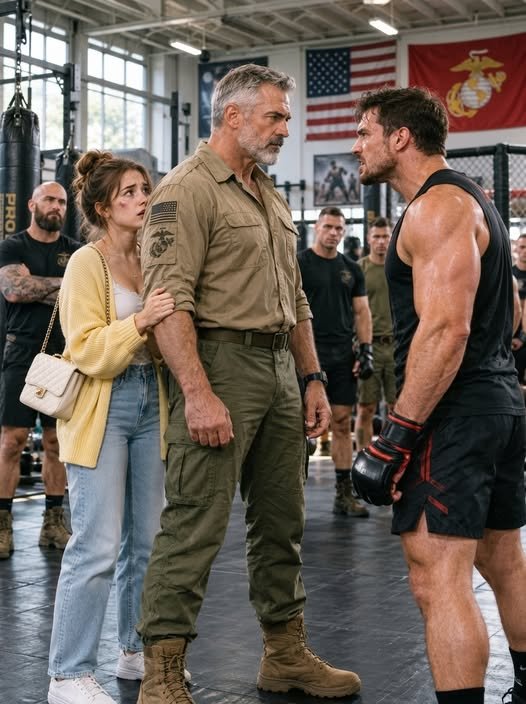
The coach’s face had gone the color of old paper.
“Dustin,” he said, very quietly. “Stand down.”
“What?” Dustin laughed. “Coach, he’s a carpenter.”
“His name is Gunnery Sergeant Raymond Hale. Retired.” The coach didn’t take his eyes off me. “He wrote the combatives manual they still use at Quantico. I took one of his seminars when I was twenty-six. He put a three-hundred-pound heavyweight on the mat with two fingers.”
Nobody in the room spoke. A heavy bag creaked on its chain.
“Coach, come on,” said the friend on my left, but his voice had lost its edge.
“I’m not here to fight you,” I said. “I’ve never wanted to. I told every Marine I trained the same thing: the best fight is the one you never need. I came for one reason.”
I looked at Dustin.
“Look at me when I say this. You will never contact my daughter again. Not a call, not a text, not a message through a friend. You will not go near her, her mother, or our home.”
Dustin’s smirk had thinned to a line. “Or what? You don’t know who my uncle is.”
“I know exactly who your uncle is,” I said. “I know he’s been under investigation for two years. I know the county sheriff’s office has a file on this gym. And I know something else.”
I took out my phone.
“Marcy’s doctor photographed every injury. The ER logged the report. A nurse who’s worked there twenty years told me, off the record, that she’s seen your name before.”
That was true, and it was the first moment I saw real fear on his face.
I had not planned to do what came next. I’d planned to speak, and to leave, and to let the law finish it.
But Dustin did what arrogant men do when they feel the ground shift. He lunged.
It was a good shot, honestly. A fast, clean double-leg takedown, the kind that wins fights in a cage. Twenty years earlier, it might have worked on me.
I turned my hip, let his momentum carry him past, and guided him to the mat with one hand on his collar and the other on his elbow. I didn’t strike him. I didn’t need to. He landed flat on his back, the air leaving his lungs in a whoosh, and I rested my knee lightly against his shoulder, the way you’d hold a pin in a demonstration.
“That,” I said calmly, “is what it looks like when someone chooses not to hurt you.”
His friends stood frozen. One of them took a step back and lifted both hands. The coach pressed his palm against his forehead.
I let Dustin up. I stepped away.
“Everyone in this room just watched a man attack a civilian with a witness list longer than his arm,” I said. “Three of you filmed it, I think. That’s fine. Keep the footage.”
I walked out.
My hands were steady all the way to the car and not at all once I got inside. I sat in the parking lot gripping the wheel, shaking, because I had broken the one rule I’d lived by for fifteen years, and I knew it. Even a controlled takedown was putting hands on a man.
Then I drove to the hospital.
Marcy was propped up in a bed with a bandage near her temple and a hospital gown that swallowed her small frame. My wife sat beside her, holding her hand. When I came in, my daughter looked at me with eyes that were red and exhausted and, I thought, a little afraid.
“Dad,” she whispered. “What did you do?”
“I told him to stay away from you.”
“He’ll come after us.”
“No.” I pulled a chair close. “Marcy, I need you to listen. I’m not going to handle this alone, and I’m not going to handle it with my hands. That’s not who I am, and it’s not what you need. What you need is for him to be accountable. The right way.”
She started to cry. “I told them I fell.”
“I know. Tell the truth now. The nurse will help you. A victim advocate is waiting down the hall. You don’t have to say it for me. Say it for you.”
She looked at her mother. My wife nodded, tears running down her face.
Marcy took a shaking breath. “Okay.”
It took nine months. The advocate, a patient woman named Carla Vasquez, walked Marcy through every step. She filed for a protective order. She gave a recorded statement to a detective. Two other young women, previous girlfriends, came forward once they heard the case had started. One had photographs she’d kept in a drawer for two years.
Dustin was charged with assault, domestic battery, and witness intimidation. The last charge was the heavy one. His uncle’s attorney had called Marcy’s phone twice, and both calls were logged. Investigators had been waiting for exactly that kind of mistake.
The uncle was indicted in the spring, on charges that had nothing to do with my daughter and everything to do with the gym’s books. When detectives searched the office, they found the records they’d been trying to find for two years. I never learned the full story. I didn’t want to.
Dustin pleaded guilty. The judge gave him three years, with a lifetime no-contact order. His MMA license was revoked. The gym closed that fall, the sign taken down by two men in a pickup truck on a cloudy Tuesday.
The coach sent me a letter. It was short. I should have stopped him sooner. I saw things I pretended not to see. I’m sorry. He had testified for the prosecution. I never wrote back, but I kept the letter.
Marcy healed slowly, the way people do.
She started therapy with a counselor who specialized in what she’d been through. She went back to school for her last semester. She stopped wearing turtlenecks. One evening in June, I heard her laughing in the kitchen with her mother, the old laugh, the real one, and I stood in the hallway with my hand against the wall until it passed.
In September, she asked if I would teach her something.
“Self-defense?” I said. “Marcy, you don’t have to.”
“I know.” She tucked her hair behind her ear. “I want to. Not because I’m afraid. Because I want to know what my body can do.”
So every Saturday morning, in our garage, I taught my daughter to stand, to breathe, to move. I started with the hardest lesson, the one I’d taught three thousand Marines.
“The first skill,” I told her, “is leaving. If you can leave, you leave. If you can call for help, you call. You use force only when there’s no other way, and then you use exactly as much as you need.”
“That’s the opposite of what I expected,” she said.
“Strength isn’t about winning,” I said. “It’s about being able to walk away because you could have done otherwise.”
She practiced a block until it was clean. She laughed when she knocked me off balance, then apologized, then laughed again. By October, she could break any of my holds.
On the anniversary of the day I walked into that gym, Marcy found me on the porch at dusk, a mug of coffee in each hand.
“I read the transcript,” she said. “From the hearing. The part where you were asked whether you used force.”
“I did.”
“You told them the truth. You didn’t lie about the takedown.”
“No.”
“Do you regret it?”
I considered it honestly. “I regret that it came to that. I regret that I wasn’t paying closer attention before. I don’t regret protecting you.” I took the mug. “But I regret that I couldn’t do it without breaking my own rule.”
She sat beside me on the step. For a while we watched the light fade over the field behind our house.
“Dad,” she said. “I don’t think you broke it.”
“No?”
“You didn’t hurt him. You stopped him, and then you left.” She leaned her head against my shoulder. “You told me once that the best Marines are the ones who know when to stop. You stopped.”
I put my arm around her.
For fifteen years, I taught men how to fight. The most important lesson, it turned out, I had to learn from my daughter: that protecting someone means standing between them and the harm, and then having the courage to step aside and let them walk forward on their own.
The porch light flickered on above us.
“Ready for Saturday?” I asked.
“Always,” she said, and smiled.