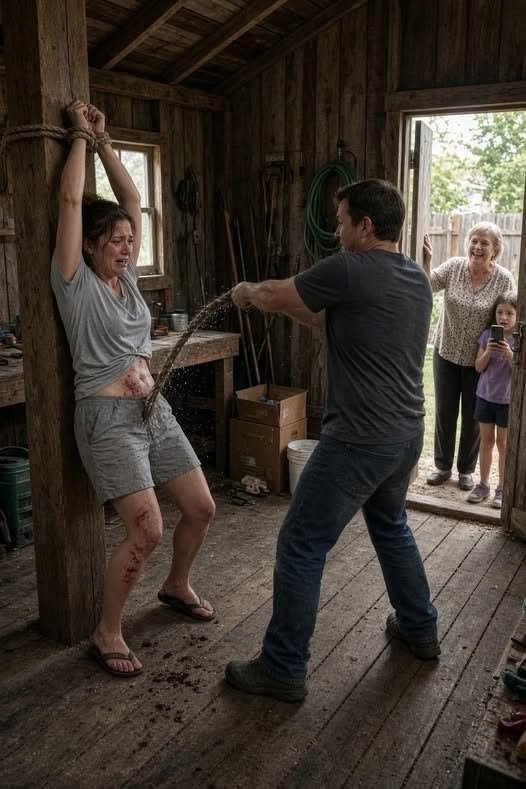
I looked down at the phone in my hand. The video was paused on a blurred frame of the shed door, my mother-in-law’s shadow stretched across the floor.
“Press play,” my sister said gently. “I’m right here.”
My thumb shook. I pressed it.
The scrape of the rope came first, then my own muffled sobbing, which I barely recognized as mine. Then my husband’s voice, low and almost calm:
“Sign it, and this stops. The deed, the land your father left you. Sign it over to me, and you go back to your life.”
I remembered him asking. I had thought it was just another cruelty, another way to break me. I had been too frightened to hear what came next.
My mother-in-law spoke from the doorway, and her laughter was gone.
“Don’t waste time on her. If she won’t sign tonight, we do what we discussed. A fall on the porch steps. She’s been so unsteady lately, everyone has seen it. Nobody will question a wife who’s been clumsy for years.”
My husband answered without hesitation. “The doctor already believes the bruises. Every excuse she made for us is a witness for us.”
The video ended there.
For a long moment, the only sound was the hum of the hospital lights.
“Years,” I whispered. “Every excuse I made. They were planning to use them.”
My sister took my free hand. “They built that story with your own words. But they didn’t count on one thing.”
We both looked at my daughter.
She had pulled her hood down. Her face was pale, her eyes red, but her chin was lifted.
“I heard them last week,” she said. “In the kitchen, when they thought I was asleep. Grandma said the steps would be quick. That’s when I knew I had to record something. Not just what they did, Mama, but what they said.”
I pulled her into my arms and held her so tightly that she gasped. She was twelve years old, and she had been gathering evidence against her own father.
“You should never have had to do that,” I said into her hair.
“I know,” she said. “But I’m glad I did.”
My sister had not waited for me to wake up or to be ready. She had taken the video to the police before she ever drove to the hospital. When she told me, I felt something loosen in my chest that had been clenched for years.
“They’re here,” she said. “A detective and an advocate from the women’s shelter. Whenever you’re ready. Or not today, if you can’t.”
I thought about the excuses. The cabinet, the laundry, the tiredness. Every one of them had protected the person hurting me.
“Send them in,” I said.
The detective was a quiet woman with tired eyes who did not once tell me to calm down. She listened to the whole video, then to my account, and wrote everything down. She explained that the recording captured coercion, assault, and a stated plan to cause me serious harm. The hospital records of the older injuries would strengthen the case. She said my daughter’s decision to keep the phone, and to send it to someone she trusted, might have saved my life.
“Is there somewhere safe you can go tonight?” she asked.
“With me,” my sister said, before I could answer. “Both girls. The spare room is made up.”
The advocate, a young man named Daniel, sat beside the bed and explained what would happen. There would be an emergency protective order. My husband and his mother would be arrested that evening, and a hearing would follow. He gave me a folder with phone numbers, a legal aid contact, and information about securing the land my father had left me. When he said secured, I almost cried, because nothing had ever been secured for me before.
“You’re not alone in this,” he said. “I know people say that and it sounds hollow. But you have a witness, and she’s twelve.”
They were arrested that night. I did not see it. I was in my sister’s spare room with my daughters asleep on either side of me, and the first thing I felt was not triumph but an enormous, aching tiredness, like setting down something I’d carried for fifteen years.
The weeks that followed were not easy. My husband’s family called relatives, sent messages, and told everyone I had exaggerated, that I was unstable, that the video was edited. For a while, some people believed them. That was the old pattern: arrive after the damage with a softer voice.
But a recording does not soften. At the preliminary hearing, the judge listened to every second of it. When my mother-in-law’s voice filled the courtroom, describing the accident she planned for me, I watched her face go gray. The woman who had always stood just close enough to watch, and just far enough to deny, had nowhere left to stand.
My husband took a plea. He did not look at me when he accepted it. I had spent years studying his moods, and I realized I felt nothing at all. No fear, no hope. Just an empty room where something used to live.
My mother-in-law’s case went to trial. The jury took less than a day.
Months later, my youngest daughter, the one we’d always kept in another room, asked why Mama was smiling so much.
“Am I?” I said.
“You never used to.”
I thought about it. “I think I’m learning how.”
My older daughter still keeps the cracked phone in a drawer. The screen has never been repaired. She says she doesn’t need it anymore, but she can’t throw it away.
I understand that. I keep something too. In a notebook beside my bed, I’ve written down every excuse I once made, one line at a time, and next to each one I wrote the truth. The cabinet: he pushed me. The laundry: he tore it. Too tired to visit: he forbade it.
I wrote them not to relive them but so I could never again make them sound believable.
On the first night we spent in my own place, a small apartment with a window that opened onto a crooked jacaranda tree, my daughter climbed into bed beside me and said, “Mama, you don’t have to be brave all the time.”
“Neither do you,” I said.
She was quiet for a while. Then she whispered, “I just wanted someone to believe us.”
“They did,” I said. “You made sure of it.”
Outside, the wind moved through the branches, and for the first time in years I did not listen for footsteps. I only listened to my daughters breathing, safe and slow, beside me.
I was home. And no one in that house would ever tell me to remember my place again.