Nine Thousand
“Megan,” Tom said, and his voice came out so low that Owen leaned forward to hear it. “Whose name is on the account?”
Nobody moved. Down the table, a candle guttered in its glass. Megan’s mother, Sheila, had her napkin pressed halfway to her mouth, and the cranberry sauce sat in the middle of the cloth like a small red wound.
Megan opened her mouth. Her lips shaped the first sound of a word and stopped.
“Meg,” said her sister, Dana, still holding the printout. “That’s my branch. I deposit there every Friday. Whose name?”
My name is Carol Whitaker. I’m seventy-four. I taught high school chemistry in Dayton, Ohio, for thirty-three years, which means I spent my career watching sixteen-year-olds swear a solution was clear when it plainly had a haze in it. I know what a lie looks like in a beaker. It clouds slowly, and then all at once.
My husband, Walt, sold insurance for forty years and died six years ago in April, of a heart attack, on the golf course, on the fourteenth hole. He left me the brick house on Alder Street, a modest pension, and a checkbook I have balanced to the penny every month since 1974. I do it at the kitchen table, in pencil, with a cup of weak tea. It’s the nearest thing I have to prayer.
Tom is forty-six. He’s an electrician, big and gentle, with Walt’s shoulders and a habit of nodding at whoever spoke last. He’s never won an argument in his life, and has made peace with it. I love him more than I can say. That’s the trouble with sons. You can see everything and still have no way to say it.
Megan is forty-two. She’s a dental office manager, pretty and brisk, with glossy hair and a laugh she can turn on like a porch light. She’s been married to Tom for fourteen years. For thirteen of them, she was nothing but kind to me.
You know about July. She came on a Saturday with a laptop bag and a box of lemon bars. Carol, you shouldn’t be driving to the bank at your age. Let me set you up. It’s so much easier. She sat at my table for two hours, with my checkbook open beside her, typing, nodding, saying “There, now.”
She set up the email, too. So I can keep an eye on things for you, Carol. I said, “I don’t mind a paper statement.” She said, “Oh, those are so wasteful.” I said nothing.
I should have said something. I’d like to tell you why I didn’t. A woman my age has been told she’s a nuisance so many times that she begins to apologize in advance. I thought, she’s helping. Don’t be difficult.
I went to the bank in September anyway, because I like paper. I sat at a desk across from a young man named Luis Okafor, who wore a tie with tiny anchors on it and had the grave, courteous manner of a nephew. He printed my statement. He slid it across.
I read it with a pencil in my hand. I always do.
You know the three lines. August 4. Transfer out, $2,000. August 19. Transfer out, $3,000. September 2. Transfer out, $4,000. To an account number I’d never seen.
I put my pencil down.
“Mrs. Whitaker?” said Luis. “Is something wrong?”
“I didn’t make these.”
He frowned at his screen. “They were made online. From your login. Two were from a device registered in July.”
“What device?”
“I can’t say, ma’am. A laptop.” He hesitated. “Would you like to dispute them?”
I thought about it. I thought about Megan’s lemon bars and her warm hand on my arm. I thought about Tom, nodding.
“Not yet,” I said. “Can you tell me where the money went?”
“I can’t tell you who owns it. That’s privacy.” He lowered his voice. “I can tell you what bank. And that it was opened in July.”
He wrote it on a sticky note. He folded it in half and handed it across with both hands, as one does a prescription.
I put it in my purse with the printouts. I thanked him. I drove home with both hands on the wheel at thirty miles an hour and the radio off.
I put the papers in the drawer with the Christmas cards. It’s a deep drawer in the hall desk, under the stamps. Nobody ever looks there. I waited.
I want to say I had a plan. I had a headache. I sat in Walt’s chair that night, in the dark, and ran the chemistry in my head. A solution doesn’t clear because you wish it. You add a reagent and watch what precipitates.
I changed nothing at first. I let the statements keep going to Megan’s email. I paid my bills the old way, with paper checks, from a second account at a credit union that she didn’t know about, which I’d had since 1981. I did a great deal of nothing, carefully, for ten weeks.
In that time, three things happened.
Megan began to call more. Just checking in, Carol. Then she began to correct me. You told me that already. Did you take your pills? I do not take pills. I take an aspirin on Tuesdays.
Then in late October, Tom came to the house alone, sat at my kitchen table, and asked, very gently, whether I’d “thought about getting evaluated.”
I looked at my son’s face. I saw a man who’d been handed a script.
“For what?” I said.
He looked at his hands. “Just, you know. Memory.”
I’ll tell you what I did next, because it’s the only clever thing I’ve ever done.
I went to my doctor. Not for a visit. For a test. I’d known Dr. Hale for nineteen years. She’s a brisk, silver-haired woman in a white coat, with a laugh like a bark. I said, “I’d like a full cognitive evaluation. The long one. With a letter.”
She looked at me over her glasses. “Carol, is something wrong?”
“Something’s going to be said. I’d like a record.”
She didn’t ask more. She ran me through ninety minutes of it. I drew a clock. I counted backward from a hundred by sevens. I named forty animals in a minute. I remembered five words after twenty minutes. I did all of it with my hands folded in my lap, like a woman at a church supper.
At the end, Dr. Hale put down her pen. “Carol. You’re in the ninety-ninth percentile for your age. I’d say, frankly, you’re better than I am.”
“I’d like that in writing.”
“You’ll have it Friday.”
“And the date.”
“Of course,” she said, gently. “Whose idea was it?”
“Mine,” I said. “Always mine.”
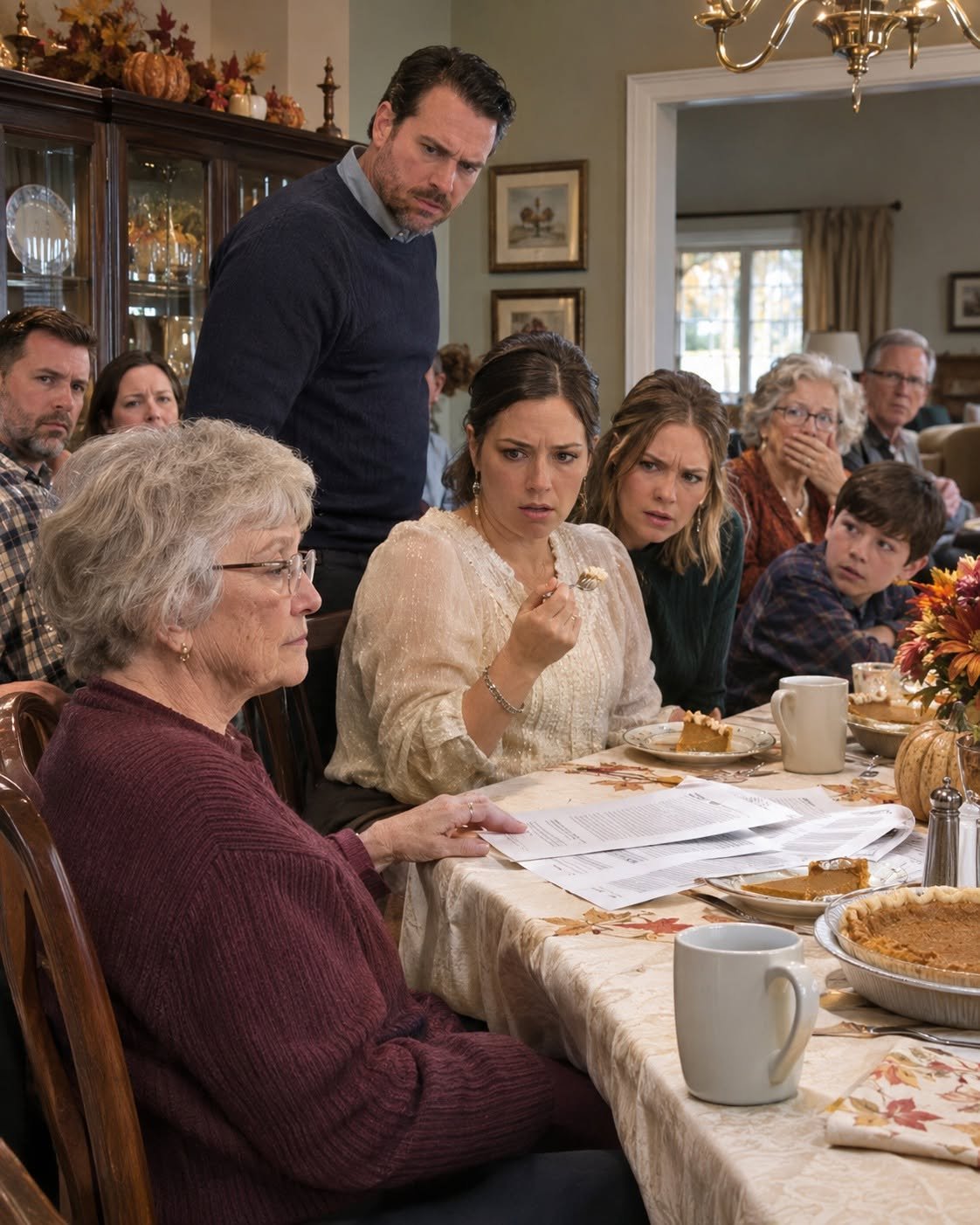
You know about Thanksgiving. Tom’s house, a split-level in Beavercreek with a deck and a basketball hoop. Eleven people at a table with a leaf in it. Megan’s parents, Sheila and Ron, in their holiday sweaters. Dana, her sister, with her husband, Paul, a quiet man who sells hearing aids. The kids: Owen, nine, with Walt’s ears; Lily, twelve, with her mother’s chin; and Dana’s two small boys.
I’d brought a pie. Pumpkin, from Walt’s mother’s card. I set it on the sideboard. Nobody thanked me. Megan took it from the table and put it with the store-bought ones.
Dinner was fine. Turkey, dressing, green beans from a can. Ron told a long story about a boat. I ate slowly, and watched.
Megan tapped her glass.
She does it beautifully. A bright, ringing, schoolteacher’s tap. Eleven heads turned. She stood at her end of the table, in a cranberry-colored sweater and her good pearls, with one hand on her husband’s shoulder.
I just want to say something, because we’re all family.
I’ve never been so calm. That’s the strange thing I’d like you to know. I sat there with a forkful of dressing, in my own good navy dress, and listened to my daughter-in-law lay out the case against my mind.
We’ve been worried about Carol. She’s been forgetting things. Repeating herself. A small, brave pause. Tom and I think she’s losing it a little. And we’ve decided it’s safer if she’s not alone with the kids anymore.
Tom nodded. He studied the tablecloth.
Sheila, her mother, said, in a voice like warm syrup, “Oh, honey. That must be so hard for you.”
For her.
Owen said, very clearly, from the end of the table, “Grandma’s not losing it.” Someone said, “Owen, eat your pie.” He did, with his head down and his ears red.
Eleven faces turned toward me. I watched them. Ron, with his fork halfway to his mouth. Dana, white and still. The little boys, who’d stopped kicking each other. They all had the same expression, a soft, pitying, careful look, the one people give a house they’ve decided to demolish.
I set down my fork.
You know what I asked. I said it in my classroom voice, which is pleasant and carries.
Megan, honey. Can I ask you one question? Since we’re all family.
Of course, Carol.
Since you set up my online banking in July. Where did the $9,000 go?
She stopped chewing. I watched it. A forkful of turkey sat in her cheek, and she did not swallow, and her hand on Tom’s shoulder went very still.
What $9,000? said Tom.
I told him. I took the printouts from my purse and laid them beside the pie, on the white cloth, three lines highlighted in yellow by a young man with anchors on his tie.
Megan swallowed. She said, with a thin, bright laugh, “Carol, I think this is exactly what we’re talking about. You’re confused. There were no transfers.”
Dana leaned over and looked at the paper. Her face changed.
Meg, she said, very quietly. That’s our bank. That’s the branch by my house.
I’d like to describe the silence. It was complete. A pipe ticked in the wall. In the living room, a football game played on a muted television. A child’s fork touched a plate and stopped.
Megan had gone white. It began at her forehead and moved down, like a tide going out. She put down her glass, very carefully, as if it might break.
“Dana,” she said. “Don’t.”
“Whose name is on it?”
“Dana.”
“It’s the account at First Miami Valley. The one from July. I drove you there.” Dana’s voice rose, cracking. “You said it was for the, for the business.”
“What business?” said Tom.
Nobody answered.
Tom stood up. His chair scraped. He’s six-two, with big hands, and he stood at the head of his own Thanksgiving table in a flannel shirt, looking at his wife.
“Megan,” he said. “Whose name is on the account?”
She couldn’t answer. I watched her try. Her lips moved. A small, strangled breath came out. Beside her, Sheila had put down her napkin.
“Megan,” said Sheila. “Answer your husband.”
“Mom.”
“Answer him.”
“It’s, it’s mine,” whispered Megan.
And her mother began, quietly, to cry.
I won’t give you all of it. It took an hour. Nobody ate the pie.
It came out the way things do when a table’s gone silent, in pieces, with pauses. Megan sat down at last, and put her hands flat on the tablecloth, and looked at them. She said it in a small, flat voice, like a woman reading a lab report.
The practice had cut her hours in June. She’d hidden it. She’d been paying the mortgage on their house, $2,300 a month, from a credit line Tom didn’t know existed. By July, the line was at $41,000. She’d opened a second account at a different bank, in her own name only, and begun moving small sums into it. Just until the bonus, she said. Just until I get caught up.
“And my money?” I said.
“I thought you wouldn’t notice.”
“Why not?”
“You never look.” She laughed, thin. “You’ve got that, that paper thing. I thought, she doesn’t use the online. She’ll never see.”
“I looked in September.”
“I know.” She put the heel of her hand against her eyes. “I got the alert. A, a message from the bank. ‘Account holder visited branch.’ I thought, ‘She knows.’”
“And you decided to say I was confused.”
Megan flinched. It was a very small movement, like a horse’s skin twitching under a fly.
“I panicked,” she whispered.
“I’d like to say something,” said Tom.
Everyone turned. He was still standing, with one hand gripping the back of his chair. His face was gray. He’d put down his napkin, and his hands were shaking, a fine tremor, like a man who’s carried something too heavy for a long way.
“I nodded,” he said.
Nobody spoke.
“Mom. I sat here and I nodded.” His voice broke. “She said you were losing it, and I nodded. I didn’t ask a single question.”
“Tom.”
“I should’ve asked.” He pressed his lips together. They trembled. “Owen asked. A nine-year-old asked. And I told him to eat pie.”
Owen, at the end of the table, put down his fork. He was staring at his father with enormous eyes.
“I’m sorry, buddy,” said Tom, to his son. “You were right. I was wrong.”
“It’s okay, Dad.”
“It isn’t.” He wiped his face with the back of his wrist. “Mom. I’m so sorry.”
I stood. My knees cracked. I walked down the length of the table, past Ron and Sheila and the silent children, and put my arms around my son. He bent, because he’s tall, and I felt him shaking against my shoulder.
“I know,” I said. “I know, honey.”
“I should’ve known you.”
“You do,” I said. “You just got nervous.”
Megan’s father hadn’t spoken. Ron is sixty-eight, a retired mail carrier, with a white mustache, a soft belly, and a face made for being agreeable. He’d sat through the whole thing with his big hands flat on the cloth. Now he stood up, very slowly, and walked around the table to his daughter.
He didn’t touch her. He stood behind her chair.
“Meg,” he said.
“Dad.”
“How much?”
“Nine thousand. From Carol.” Her voice cracked. “And the credit line. Forty-one.”
“Anything else?”
She was silent. He waited. He’s a patient man. He’d walked a route in Kettering for thirty-four years in all weather.
“The kids’ college fund,” whispered Megan.
Tom made a sound.
“Eleven thousand. From Lily’s.” She put both hands over her face. “I was going to put it back.”
“Oh, Meg,” said her mother.
I stood at the head of the table with my hand on my son’s arm and watched my daughter-in-law fold in on herself. It was not a graceful thing. She bent over the cloth with her shoulders heaving, and a pearl earring caught the candlelight, and slipped, and dropped into her plate.
I’d like to say I felt triumph. I’d carried those printouts for ten weeks like a stone. I’d imagined this table a hundred times, in the dark.
What I felt was the end of a long lab. The reaction was complete. The precipitate had fallen. There was no pleasure in it, only the flat, exact knowledge of what had been in the solution all along.
“Megan,” I said.
She didn’t look up.
“I’d like to tell you what happens next. May I?”
A small nod, behind her hands.
“I’m not going to the police.”
Her head came up. Her face was a ruin. Mascara ran in two black lines. She stared at me as if I’d spoken another language.
“Not today,” I said. “I want to be clear. I could. The bank would open a fraud investigation. Luis said so. It’s a felony. Unauthorized transfers from an elderly account holder.” I folded my hands. “I’m not doing it. Not because you don’t deserve to answer for it. Because I don’t think prison will teach you what you need.”
“What do I need?”
“To say it out loud, to people who love you.”
She looked around the table, at her husband, her father, her sister. At the children, who’d gone silent and wide-eyed. At the cranberry sauce.
“I’m so ashamed,” she said.
“I know.”
I set it out in order, as I’d set it out for a class. I’d written it on the back of an index card, in pencil, the night before, and I read it standing, with my glasses on.
“One. You’ll repay me. Nine thousand dollars. At two hundred a month, from your own paycheck, by check, with a number in the memo line. It’ll take forty-five months.”
“Carol, I can.”
“I haven’t finished. Two. The college fund. You’ll put the eleven thousand back into Lily’s account. In writing, with a bank statement. I’ll look.”
“Yes.”
“Three.” I turned the card. “You’ll tell Tom everything. Every card, every loan, every secret account. Tonight. At this table, with your father present.”
She closed her eyes.
“And four. You’ll see a woman I know. Her name is Rosalind Park. She’s a credit counselor in Dayton. She has a sign on her desk that says DEBT IS A SHAPE, NOT A SENTENCE. You’ll go every Tuesday, for three months. I’ll pay for the first six sessions.”
“Carol,” whispered Megan. “Why would you?”
“Because you’re Owen’s mother,” I said. “And I’d like him to see what repair looks like.”
It was very quiet. Owen, at the end of the table, had slid off his chair. He walked, slowly, around the cloth, and stopped at his mother’s elbow. He’s nine, thin, with Walt’s ears and Tom’s solemn eyes.
“Mom,” he said. “Are you in trouble?”
She stared at him. Her mouth worked.
“Yes,” she said. “I think I am.”
“Is it a big one?”
“It’s big.”
“Does Grandma Carol know how to fix it?”
I put my hand over my mouth.
Megan laughed. It was a thin, wet, hiccuping sound. She pulled her son against her side and pressed her face into his hair. “I think she might,” she said, muffled. “I think she’s the only one who does.”
He patted her back, twice, briskly, the way I do.
Then he looked up at me. Over his mother’s bent head, with a crumb of pie on his cheek, he gave me a very small, serious, grown-up nod.
I nodded back.
It took a year, and I won’t pretend it was tidy.
Megan told Tom the whole of it that night, in the kitchen, with her father in the doorway and the dishes standing in the sink. I wasn’t there. I sat in the living room with Sheila, who held my hand in both of hers and said, over and over, in a cracked voice, “I’m so sorry, Carol. I’m so sorry.” She’s sixty-six, a retired school secretary, plump and soft and kind, and I’d never once seen her cry.
“It’s not your fault,” I said.
“I raised her.”
“You raised her to be afraid. It’s different.”
She looked at me, with her wet, pale eyes. “Afraid of what?”
“Of being found out.”
She put her face in her hands.
At eleven, Tom came into the living room. His eyes were red. He sat on the arm of my chair, awkwardly, a big man on a small perch, and put an arm around my shoulders.
“She told me,” he said. “Everything. Sixty-three thousand, all told.”
“I thought it might be.”
“I didn’t know.”
“I know, honey.”
“I’m going to fix it.”
“You’ll do it together,” I said. “That’s the only way it takes.”
Dr. Hale’s letter arrived on the Friday. I’d asked her to send copies to Tom and Megan. She’d written it on practice letterhead, two paragraphs, in the dry, exact prose of a woman who has no patience for euphemism. Mrs. Whitaker was evaluated on October 28. Her cognitive function is excellent for any age. In my clinical opinion, she is fully capable of managing her own financial and personal affairs.
Tom framed it. I don’t know why. He hung it in his hall, between a school picture of Owen and a print of a covered bridge, and when anyone asks, he says, “That’s my mother’s report card.”
Megan took it harder. She read it standing in her kitchen, in her stocking feet, and went very still. Then she sat down on the floor, against the dishwasher, and read it again.
She called me that night. I was at my kitchen table, balancing the checkbook, in pencil.
“Carol?”
“Megan.”
“I read the letter.”
“I thought you might.”
She didn’t speak for a long moment. I heard a refrigerator hum. I heard, faintly, a child’s laugh.
“Ninety-ninth percentile,” she said. Her voice shook. “I told everyone you were, I said you were losing it. And you’re smarter than all of us.”
“I’m a chemist.”
“I’m so sorry.”
“I know you are,” I said. “Come Sunday. Bring the receipts.”
She came. I want you to know that. She came on the first Sunday of December, at two, in a gray parka and her hair in a ponytail, with a shoebox under her arm. She stood on my porch in the cold, the way a student stands at the door of a teacher she’s wronged, and I let her in.
I’d made tea. I put out a plate of molasses cookies. She sat across from me at the kitchen table, in Walt’s chair, and opened the box.
It was full of statements. Credit cards, a line of credit, a car loan, the account at First Miami Valley. She’d put them in order, in rubber-banded bundles, with sticky notes. Highest rate. Lowest rate. Can’t explain.
“I thought you’d want to see them,” she said. “All of them.”
I put on my glasses. I took out a pencil. I turned over the first sheet, and began, as I’ve done a thousand times, to add.
We sat there until dark. I showed her how to rank the debts by interest. I showed her the snowball, and the avalanche, and why I preferred neither. I taught her to write each balance in a column, with the date, in pencil, and cross it off when it was paid. She did it with her tongue between her teeth, copying my slanting hand.
“Carol,” she said, around four. “Why are you doing this?”
“Because you asked.”
“I didn’t.”
“You brought a shoebox,” I said. “It’s the same thing.”
Rosalind Park called me in February. She’s sixty, brisk, flat-voiced, unsentimental. She said, “Mrs. Whitaker, I’m not at liberty to discuss details. But your daughter-in-law brought every statement in a shoebox and laid them out on my desk herself.”
“Did she read them?”
“Aloud. To her husband.” A pause. “I’ve done this twenty-six years. I’ve never had a woman do it first.”
Megan repaid me, every month, by check, on the first. She put a number in the memo line. Payment 1 of 45. The second month, in smaller letters: Sorry. The fifth: Thank you. The ninth: I read the whole statement today. It took forty minutes. I understood it.
I wrote nothing back. I read every one.
She put the eleven thousand into Lily’s account in January. She did it in person, at the bank, with Tom beside her, and brought home the receipt, and Lily, who is twelve and sharp as a tack, read it twice at the kitchen counter.
“Mom,” she said. “You took this.”
“I did.”
“Why?”
“Because I was scared,” said Megan. She was drying a pot. She didn’t turn around. “I’m sorry, Lil.”
Lily considered. “Are you still?”
“A little.”
“Okay.” She folded the receipt. “I’ll keep this.”
Megan took a second job in March. It was weekends, at a pharmacy, ringing up cough syrup, for $15.50 an hour. She told me, at my kitchen table, with her coat still on, that it was the first job she’d had where nobody pretended it was a calling.
“Do you like it?”
“I like the customers.” She grinned, shaky. “A man cried at the counter last week because we had the last bottle of his wife’s vitamins. They’ve stopped making them.”
“That’s a good day.”
“I felt like a hero.”
“You were.”
“I was in a smock.”
“It’s the same thing,” I said.
She laughed. She put her head down on her folded arms on my table, in her coat, and I let her.
I sat there with my pencil, watching a young woman doze at my table, with a ponytail coming loose and a ring of mascara under one eye. I thought of a classroom in 1987. A girl of sixteen in the back row, who’d swapped a vial and sworn she hadn’t. I’d kept her after class. I’d said, Tell me what happened. She’d told me, in a rush, with her face in her hands.
She’d gone on to be a pharmacist. She sends me a card every Christmas.
You can’t hurry a precipitate. But you can stand by the beaker, and wait.
It’s November again. A year since the pie. I’m seventy-five. I live in the brick house on Alder Street, with Walt’s chair by the window and my checkbook in the second drawer. I do it every month, in pencil, with a cup of weak tea.
I have the grandchildren on Wednesdays. All four, now, with Dana’s boys, who come for the cookies. Owen sits at my kitchen table and does his fractions. He’s ten. He likes to check my work.
“Grandma,” he said, last week. “You carried the one wrong.”
I looked. He was right.
“I did.”
“It’s okay.” He patted my arm, solemnly. “Everyone gets one wrong.”
At Thanksgiving, we were at my house. I’d said I’d host. Tom had protested, and I’d said, I’ve been cooking this meal since 1974. Eleven of us, around two tables pushed together. Megan’s parents. Dana and Paul. Tom and the children. And Megan, at the far end, in a green sweater, with her hair down and no pearls.
She had brought a pie. She set it on the sideboard herself. It was pumpkin. It was lopsided, and a little dark at the edge, and had been made, she said, from a card in her own hand, copied off mine.
“It’s not as good,” she said.
“It’s a beginning.”
I cut it myself. I put the first slice on a plate. I walked it down the table, past the turkey and the green beans from a can, and set it in front of her.
She looked at it. She looked at me.
“Carol.”
“Eat.”
She picked up the fork. Her hand was steady. She took a bite, and chewed, and swallowed.
“Well?” I said.
“It’s a little salty.”
“It’s perfect,” I said. “Sit up straight.”
Down the table, Owen, with a dollop of cream on his nose, gave me a nod. I nodded back. And at the head of my table, in Walt’s chair, my son raised his glass, and the whole family, eleven of them and one, with a pie, said it together.
“To Grandma.”
I drank my tea. It was weak. It was exactly right.