The House Remembers
The envelope was a plain white one, soft at the corners, tucked into a plastic sleeve between two rolls of silver dollars. Gil held it out to me with both hands, the way you hand someone a sleeping baby.
“It has your name on it,” he said.
It did. In Grandma’s upright schoolteacher print: PAIGE. NOT BEFORE THE APPRAISER, NOT BEFORE YOUR MOTHER. READ IT IN THE KITCHEN.
I looked around. We were standing in the kitchen. A strip of plaster the size of a door lay in pieces on the drop cloth, and the officer, a young woman named Reyes with a long braid and a very quiet voice, was writing something on a clipboard. She glanced up and said, “I’d take that to a chair, ma’am.”
I sat down at Grandma’s table with my hands shaking and slid a thumbnail under the flap.
My name is Paige Everett. I’m thirty-three, and I’ve been a hospice nurse for nine years. My job is to sit with people on the last days of their lives and listen to what they say when they think the work of living is over. People are very honest then. They stop managing their stories. I thought I’d gotten good at hearing the true thing under the polite one. It took my own grandmother’s wall to show me I’d missed it in my own family.
Helen Marsh taught high school math in Zanesville, Ohio, for thirty-one years. She was five feet tall and straight as a ruler, with white hair in a bun and reading glasses she wore on her head and then searched for. She kept a ledger for everything. Roof shingles in 1988. A new water heater in 1994. Every birthday card she ever mailed had a five-dollar bill inside, and she wrote the amount and the recipient’s name in a green notebook.
My grandfather, Arthur, died in 2009, after a long decline from a stroke. After that she lived alone in the brick house on Chestnut Street, built in 1938, with its narrow porch and its yellow kitchen. When anyone asked where she kept her important papers, she’d tap the wall beside the spice cabinet twice with one knuckle and say, “The house remembers what I spend.”
We thought it was a joke. She was a math teacher. Her jokes were all dry.
You know the rest of the setup. My mother, Renee, is sixty-one, a former bookkeeper, quick and capable, who gave up a promising job at forty-nine to care for Grandpa after his stroke. My father, Tom, is sixty-three, a mild man whose back has been operated on three times. Between his surgeries and her lost salary, my parents spent most of their savings. I knew that. I never held anything against them.
I trusted my mother with Grandma’s paperwork. She had the bookkeeping skills, and I had the evenings, so I took the care. I moved into the back bedroom for Grandma’s last six months, with my hospice employer’s blessing, and I handled her pills, her sheets, her tea. At night she’d talk in her sleep as though she were still at the front of a classroom. Once she said, quite clearly, “That is not a passing grade, Mr. Dolan.” I laughed so hard I had to leave the room.
She died on a Thursday morning in January, at 10:04, with my hand in hers. She wasn’t afraid. She’d said the day before, “Paige, don’t make a fuss. I’ve checked the figures.”
Three weeks later, we sat in an attorney’s conference room, and a man named Mr. Lindgren, who had been my parents’ choice and not Grandma’s, read the will.
My parents were to receive about $240,000, in savings, certificates of deposit, and two small annuities. I was to receive the house on Chestnut Street, “in its present condition.”
The roof was thirty years old. The wiring was knob-and-tube in the attic. The kitchen had a sagging floor and a stove that lit only if you leaned on it.
My mother squeezed my knee. “You were always the one who loved that house. Now you get to keep all those memories.”
Aunt Carol, Mom’s older sister, nodded firmly. My father studied his shoes.
I’d like to tell you I stayed calm. I did, mostly, because it’s a habit. But the date on the will sat in front of me like a stone. It had been signed in August, five months before Grandma died. And fourteen months before she died, at this same kitchen table, she’d taken my hand and said, “Paige, I want you to have this house and everything inside it. I’ve seen a lawyer. It’s written down.” She’d even told me the name of the firm.
Whitfield and Row.
This will had been drawn up by a different office entirely.
I asked my mother, privately, that same week.
She was wiping Grandma’s counter with a dishcloth, harder than it needed. “Honey, she changed her mind. She was eighty-six. People do.”
“Did she say why?”
“She said the house would be enough. She said you’d earned it.” Mom didn’t look up. “I showed you the signatures, Paige. There are two witnesses and a notary.”
“I know.”
“Then what’s the problem?”
“I don’t know that there is one.”
“Sometimes,” said my mother, folding the cloth in thirds, “somebody has to make practical decisions about money. I’ve done that for this family for thirty years. I’d think you’d see that.”
I did see it. That was what made it hard. I could picture exactly how a worn-out, loving daughter might sit down beside a failing mother and say, Mom, let’s make sure it’s simple. I could picture the August afternoon.
I could also picture a different one.
I saw a lawyer on my own. Her name was Anita Delgado, a plain-spoken woman of fifty-five in a small office above a pharmacy, with a battered briefcase and a sign on her desk that said PROVE IT. She listened for an hour and then told me the truth.
“Paige, a will that was signed, witnessed, and notarized is presumed valid. You’d have to show she lacked capacity, or that somebody pressured her. What you’ve got is a memory of a conversation. It’s real, and I believe you. But it isn’t evidence.”
“Is there any way to find the earlier will?”
“Whitfield and Row will have a copy, if she used them. But a revoked will is just paper. The later one wins.”
“Then there’s nothing.”
“Not unless something turns up.” She tapped the desk. “Write down everything you remember. Dates. Words. Keep it somewhere safe. Things surface.”
I wrote it down, in a spiral notebook, in the evenings. I put Grandma’s birthday cards in a shoebox. Then I did the only thing left to me, which was to take care of the house.
I want to tell you what it cost, because it’s part of how I got to that wall.
Four contractors walked through. All four said some version of the same thing. The roof needed replacing, $14,000. The wiring was a fire waiting to happen, $9,500. The kitchen floor had a rotted joist under the sink. They said, “You’d be better off gutting the whole thing, honey. New cabinets, new floor, open it up.”
I had $18,000 in savings and a $22,000 home-equity line I’d been saving for a rainy day. I did the arithmetic at the kitchen table on a legal pad, in Grandma’s own chair, with her reading glasses still on the windowsill. It came out to about $40,000, give or take, and give or take was the part that worried me.
But I didn’t want to gut the kitchen. It was the place where she’d taught me fractions with a pie. It was where I’d done homework with my feet on the rung of a chair. It was where, at nine, I’d cut my chin on the oven door and she’d held a dish towel to my face and recited the multiples of seven until I stopped crying.
I wanted the yellow walls. I wanted the stove that needed leaning on. I wanted somebody to understand that.
Gil Andrusk understood. He was the fifth contractor, a lean, weathered man of sixty-six with a gray crew cut, enormous hands, and a seed cap he took off when he came in the door. He walked through the house in silence for forty minutes, tapping and looking. At the end, he stood in the kitchen, ran a palm along the wall by the spice cabinet, and said, “I’d save this.”
“Everyone else says gut it.”
“Everyone else is selling cabinets.” He turned his cap in his hands. “Roof first. Then the wiring. Then you patch what’s patchable. It’ll take longer. It’ll cost about thirty-one thousand.”
“That’s less than the others.”
“It’s not less work. It’s a different kind.” He smiled a little. “I knew your grandmother.”
I hadn’t expected that. “You did?”
“Danced with her. At the Grange Hall, in the nineties. Second Saturday of the month.” His face creased. “She was a better dancer than me. She’d count out loud.”
I laughed. It cracked in the middle. I put the back of my hand to my mouth.
“Hired,” I said.
Before he was a carpenter, Gil had been a county sheriff’s deputy for twenty years. He didn’t talk about it. I learned it from a neighbor. He’d retired at fifty-one after a bad winter, and picked up a hammer, and said he’d never been so relaxed.
It’s why, on the third week of work, with the roof on and a crew of two peeling plaster off the kitchen wall, he stopped what he was doing. He’d been working beside the spice cabinet, and he set down his pry bar very gently. He stood looking at the opening.
He called me at the hospice at 2:40 in the morning, on my break, in the nurses’ lounge.
“Paige. I’m sorry. I know it’s late. There’s something behind the cabinet.”
“What kind of something?”
“A box. In the wall. I did the framing myself, back in ’96. Your grandmother asked me to reinforce a section with plywood and leave a cavity. She said it was for a, what did she say. A ‘dry place.’ I thought she meant a wine cellar.” He cleared his throat. “I should have opened it sooner. I never thought.”
I stood very still, with a cup of cold tea in my hand.
“Don’t touch it,” I said.
“I haven’t.”
“Don’t let anyone.”
“I’ll sit here,” said Gil. “I used to do this for a living.”
He called again ten minutes later.
“Paige. I called a friend at the sheriff’s office. A deputy’s on her way. I figure it’s best to have it written down, who found it and when. Since the house just changed hands. So nobody can say later we rearranged anything.”
I put my head against the cinderblock. The lounge smelled of burnt coffee and disinfectant. Down the hall, a call light chimed, and a night aide hurried past with a pitcher.
“That’s smart,” I said. “Thank you.”
“You’d better come over. I’m not touching it till you do.”
I told my supervisor, a calm older nurse named Dolores, that there was a family matter. She looked at my face and said, “Go. I’ll cover.” I drove across town at three in the morning in my scrubs, with the heater going and the streets empty and every stoplight turning green as if somebody had arranged it.
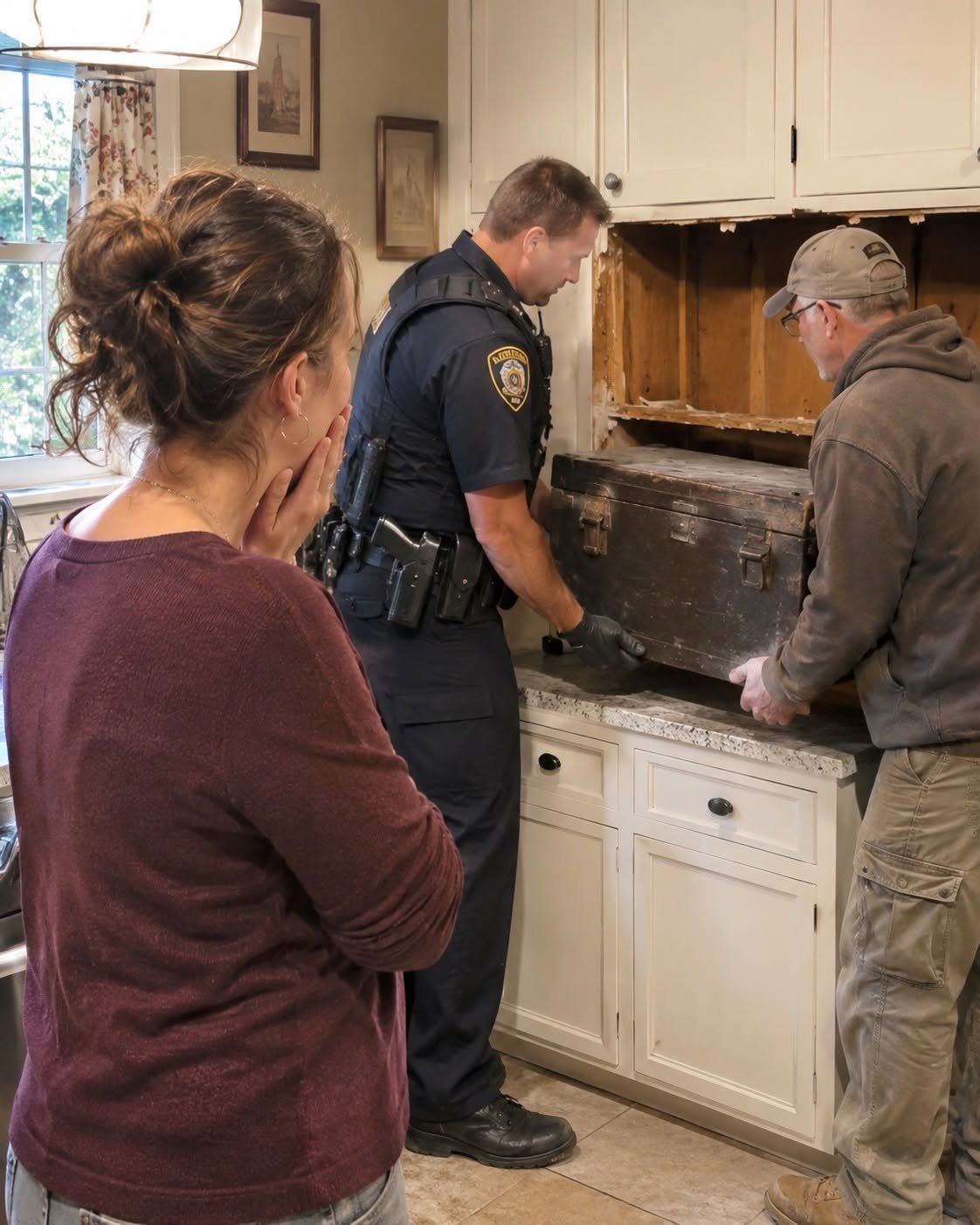
You know what I found. The cruiser in the drive. The torn wall. A faded green steel box in a reinforced alcove, about the size of a milk crate, with handles on both ends.
Officer Reyes had them lift it out together, onto a moving blanket, and photographed it from four sides. Then she asked me whether I wanted to open it.
“No,” I said. “I’d like an appraiser here. And an attorney. I don’t want anyone to say I took anything.”
Reyes looked at me with some surprise. “Most people want to look.”
“I’m a hospice nurse. I’ve watched families fight over a quilt.” I pushed my hair back. “I’d rather do it slowly.”
She nodded. She wrote something. Gil, standing by the stove with his cap against his chest, let out a small breath, as if I’d passed something.
It took two days to arrange. Anita Delgado came, in her gray suit, with her battered briefcase. A man from the probate court’s approved-appraiser list came, a thin, bald coin dealer named Mr. Pruitt, with a magnifying loupe and an enormous patience. They opened the lid on Grandma’s kitchen table at ten in the morning, with Officer Reyes watching and Gil in the doorway.
I’ll tell you what was inside, because I’ve gone over it a hundred times.
Rolls of silver dollars in paper sleeves. Wrapped in tissue, older coins, gold eagles, double eagles, half-eagles, each in a tiny envelope with a date in Grandma’s handwriting. Bundles of U.S. savings bonds, tied with kitchen string. And a green cloth ledger, soft as flannel.
Mr. Pruitt took off his loupe and laid it on the table. His hands were not quite steady.
“Mrs. Marsh,” he said softly, to the empty chair. “Well.”
The preliminary estimate came two days later, by phone, while I was at work. I was in a patient’s room, adjusting a pillow. I stepped into the hall to take it.
“Approximately one million, nine hundred thousand,” said Mr. Pruitt. “That’s a working figure, Ms. Everett. The bonds will need redemption schedules. The gold’s fluctuating. But I’d be surprised to see it fall below one-eight.”
I leaned against the wall. A cart rattled by. Someone down the corridor was playing a radio, low, an old country song.
“One-point-nine million,” I said.
“Yes.”
“In my grandmother’s kitchen wall.”
“Yes.”
“She had a roof that leaked.”
“I noticed,” said Mr. Pruitt, gently. “It’s a very common thing, in my experience. People who lived through a bank failure. They don’t trust the paper. They want it where they can tap it.”
I thought of Grandma’s knuckle on the plaster, twice, and her dry little smile. The house remembers what I spend.
She hadn’t been joking at all. She’d been telling me where to look for sixty years.
But I want to be honest, because it’s the thing that mattered most to what came next. A million nine hundred thousand dollars in a box in a wall did not tell me who it belonged to.
Anita explained it in her plain way, at her desk, over a sandwich. “It’s tangible personal property, and some bonds. It was in the house. Under the August will, the house goes to you. But the will says ‘in its present condition,’ and it’s silent on contents. The residuary clause gives everything else to your parents. A court could say the box is residuary.”
“Everything else.”
“Everything not specifically left to someone. That means your parents.”
“So it’s theirs.”
“It might be.” She took a bite. “It might not. It depends on what the envelope says.”
“What envelope?”
“The one Gil handed you. You haven’t opened it.”
I hadn’t. I’d put it, unread, in the zippered pocket of my purse, and carried it like a stone. It said READ IT IN THE KITCHEN. I’d decided, for reasons I couldn’t have defended, that I was going to obey.
“I’ll read it tonight,” I said.
“I’d like to be there.”
“She said not before the appraiser, and not before my mother.”
“The appraiser’s done.” Anita wiped her fingers. “And I’m not your mother.”
So I read it in the kitchen. That evening, at seven, at Grandma’s yellow table, with the new roof overhead and the old wall still open to the studs, with Anita in the chair across from me and a mug of tea cooling between us.
The envelope held four things.
The first was a letter, three pages, handwritten in blue ink, on lined paper from the green notebook.
The second was a copy of a will. I recognized the letterhead. Whitfield & Row, Attorneys at Law. It was dated fourteen months before Grandma’s death, and it was signed by her, and by two witnesses, and by a notary whose stamp I could read.
The third was a single typed page, signed and dated in August, five months before she died. The heading read MEMORANDUM OF TANGIBLE PERSONAL PROPERTY.
The fourth was a small, flat key, tied with green yarn.
I read the letter first.
Dear Paige,
If you are reading this, Gil has found the box, and the house has told you what I could not. I’m sorry about the plaster. He will say it was not his fault.
I want to explain myself, and I would like you to read the whole thing before you decide how to feel.
In 1933, my father lost eleven hundred dollars when the Farmers & Merchants Bank in Zanesville closed its doors. It was everything. I was a child of eight. I watched him stand on the courthouse steps with a passbook in his hand. I decided that day that I would never again keep what mattered where someone else could lock the door.
So I bought coin, and bonds, and a little gold. I did it slowly, over sixty years, out of a teacher’s salary and my own mother’s silver. I wrote every purchase down. The ledger is in the box. It is a good ledger. You will find no error.
I did not tell your mother. I did not tell your father or your Aunt Carol. I want you to understand why, and I want you to understand it is not because I did not trust them.
It is because I knew exactly how they would behave if they knew.
I stopped. I put the page down. My hands were cold.
“Read on,” said Anita, very quietly.
Your mother is a good woman. She gave up a career for your grandfather, and for me, and she has never once been thanked properly. I know that. I also know she has been frightened about money since 2012, when your father’s first surgery wiped out their reserve, and that frightened people make bad decisions with good intentions.
In July of last year, she came to me with a folder. She said, “Mom, there’s a thing called Medicaid planning. If you’re going to need long-term care, we have to protect your assets. We have to move them.” She had a lawyer, a Mr. Lindgren, who she said was very kind.
I signed. I’ll tell you why, and I’ll tell you honestly. I was eighty-six and I was tired, and she was crying. I thought, let her think she’s saved me. And I thought of the box.
What I signed, in August, left the house to you, “in its present condition,” and the financial assets to your parents. I knew exactly what that meant. It meant your parents would get the $240,000 and you would get a house with a bad roof. I thought: that is almost fair. She needs it more than Paige does, this month. And Paige will do all right.
What I did not tell them is that I had already left you something else.
I put my hand over my mouth. Anita didn’t move.
In August, after I signed their paper, I asked Gil Andrusk’s wife to drive me to a notary at the Marathon station. Her name is Doris, and she is a good friend, and she has kept a secret for thirty years. We did a second paper, one page, a ‘memorandum,’ which my old attorney Mr. Whitfield told me years ago was a lawful way to leave tangible things to a person by name. I wrote that everything in the house, “including all contents of any concealed compartment, wall, or cavity,” belongs to my granddaughter, Paige Everett. I had Doris and the notary witness it.
It is in this envelope. Mr. Whitfield has a copy. Please give it to your lawyer.
I know it will look strange. I have been thinking about how it will look. I would like you to tell your mother that I did it for her, too, though she won’t believe it.
Here is why.
If I had left her the box, she would have spent it. Not on herself. On your father’s care, on Carol’s mortgage, on a cousin’s tuition. Every dollar. She would have been generous to everyone but herself. I have watched her do it for thirty years.
If I leave it to you, you will do something sensible with it, and you will not forget her.
I am trusting you with a hard thing. I think you can carry it.
The house remembers what I spend. Now it remembers what I trusted.
All my love, your Grandmother.
P.S. The key opens the safe-deposit box at Third Federal, number 212. It holds the receipts. And the first-edition Euclid, which Arthur gave me in 1971. It is worth more than it looks. Do not let Carol have it.
I read the postscript three times. Then I laughed, and then I was crying, and Anita, who is not a hugger, pushed the box of tissues across the table and waited with perfect patience.
“She planned all of it,” I said, when I could talk.
“She did.”
“She knew my mother would.”
“She knew your mother would do something. She planned for the likeliest version.” Anita picked up the typed page and held it to the light. “This is a real document, Paige. Whether a court will honor it as written is another question. Some states are strict about unattested memoranda. But this one is witnessed and notarized, and it identifies the property by location. I’d say it’s strong.”
“What do I do?”
“You don’t do anything tonight.” She set it down. “Tomorrow, we call Whitfield and Row.”
Mr. Whitfield was eighty-one, and still came into his office three days a week. He was a small, courtly man with a white mustache and a bow tie, and he received me in a room lined with law books and a framed map of Muskingum County from 1876. He rose when I came in.
“Miss Everett. I’ve been expecting someone.”
“You have?”
“For about two years.” He gestured at a chair. “Your grandmother came to see me in the autumn of 2019 and again that spring, and again last August. She was very particular. She made me promise to keep a copy of everything and to say nothing unless a Marsh descendant asked the right question.”
“What’s the right question?”
He smiled slightly. “‘Did Helen leave a memorandum?’”
I stared at him.
“It’s a code. She invented it.” He opened a folder. “It was a game, in her view. A teacher likes a good riddle. She said, ‘If they come asking about the will, they’re not the right person. If Paige comes asking about the memorandum, give her the file.’”
“I didn’t ask. I only found it.”
“Then you found it the old way.” He slid the folder across. “That’s entirely in the spirit.”
I’ll tell you what was in his file, because it mattered later.
There was a copy of the memorandum, signed and sealed. There was the first will, with a short, dry note clipped to it in Grandma’s hand: Superseded, August. Preserved for the record. And there was something I hadn’t expected, a typed, signed statement dated the day of the August visit to Mr. Lindgren’s office.
I, Helen Marsh, being of sound mind, hereby affirm that on this date I signed a will prepared by Mr. Lindgren at the request of my daughter Renee Everett. I did so freely. I wish it recorded that I was not pressured and that I was not confused. I knew precisely what I was giving and what I was keeping.
Beneath it, in a different hand, a short sentence from a physician: Patient alert and oriented, MMSE 29/30. —R. Okafor, MD.
“She had herself evaluated,” said Mr. Whitfield. “On the same afternoon. She said she didn’t want anyone to be able to say she’d been fooled.”
“She wasn’t fooled.”
“She was not.” He folded his hands. “She was, I believe, being kind to your mother. And making certain you’d be kind to her, too.”
I went home to the house on Chestnut Street. It was dusk. Gil’s truck was in the drive, and a light was on in the kitchen. I let myself in the back door.
He was at the table with a thermos and a sandwich, and the torn wall behind him. He’d spread a clean drop cloth over everything. When I came in, he stood.
“Mr. Andrusk.”
“Gil.”
“Gil. Sit.”
He sat. I took the chair across from him. I laid the folder on the table and told him all of it, the letter and the memorandum and the doctor’s note. He listened with his head down, turning his cap.
When I’d finished, he said nothing for a while. A clock ticked on the shelf, the old Seth Thomas Grandpa had wound every Sunday.
“She asked me to frame it,” he said at last. “The cavity. In ’96. I thought she was nuts.” He laughed softly. “She said, ‘Gil, a good hiding place is one you’ve forgotten you built.’”
“Did you forget?”
“I tried.” He looked up. His eyes were wet. “She made me promise never to look. Said I’d know when it was time. I promised. I almost didn’t, three weeks ago, when I took the cabinet off. I thought, ‘Not my business.’ But the plaster was bad. It had to come down.”
“You called the sheriff.”
“I did what I’d have wanted done.”
“You protected me.”
“I protected the box.” He smiled slightly. “It’s the same thing, in this case.”
I should tell you what I did next, because I’m a person who tries to do the right thing and doesn’t always know what it is.
I called my mother. I didn’t want to. I stood on the back porch, in the cold, with the phone against my ear, looking at the yard. The old clothesline sagged between two posts. A cardinal sat on the fence.
“Paige,” said Mom. Her voice was tight. “I heard you found something.”
“Who told you?”
“Carol. She heard from a neighbor. A cop car in the drive.” A breath. “What was it?”
“Mom, I’d like you to come over. Tomorrow. With Dad.”
“Is it about the will?”
“It’s about Grandma.”
A silence. I heard a television somewhere behind her, and the clink of a spoon.
“What did she leave?” said my mother.
I closed my eyes.
“Come at ten,” I said. “And please don’t bring Aunt Carol.”
They came at ten. I’d made coffee. I’d put the folder in the middle of the table and a plate of Grandma’s molasses cookies, from her recipe card, in the middle of the folder. I’d cleaned the kitchen, as much as it could be cleaned.
Mom came in first, in a camel coat and her good wool scarf. She stopped in the doorway. She looked at the open wall, the drop cloth, the plaster dust, with the exposed framing and the little hollow behind the cabinet. She put a hand to her chest.
“Oh, Paige. It’s worse than I thought.”
“It’s getting better.”
“It’s a mess.”
“It’s a house.” I pulled out a chair. “Sit, Mom.”
Dad came in behind her. He’s a tall, stooped man, with a cane since the last surgery, and a gentle, apologetic way of entering a room. He took off his cap. He looked at me, and then, slowly, at the wall. His face changed.
“Is that where?” he said.
“Yes.”
“Did she, did Helen really?”
“She really did.”
He sat down. He did it carefully, with both hands on the cane, and set it across his knees.
I told them. I did it in order, without hurry, the way I’d explain a diagnosis. The box. The contents. Mr. Pruitt’s estimate. I watched my mother’s face while I said one-point-nine million, and it did several things, quickly, like a deck of cards fanning. Shock. A flare of something bright. Then, abruptly, a settling, as if a hand had pressed it flat.
“Where is it now?” she said.
“In a vault. At the bank. The court’s holding it in trust until the estate’s settled.”
“Then it’s the estate’s.”
“That’s what I thought.” I took a breath. “I’d like to read you something.”
I took out the letter. I read it aloud. I didn’t change my voice. I read about 1933, and the bank, and the ledger. I read, I knew exactly how they would behave if they knew. I read the part about Medicaid planning, and the folder, and the tears, and I saw my mother go white to the lips.
When I reached the end, I read the postscript. Do not let Carol have it.
Nobody laughed.
It was very quiet. The old clock ticked. Dad had put his hand over his mouth. Mom sat motionless, with both hands flat on the table, looking at the folder.
“She knew,” she said.
“Yes.”
“She knew what I did.”
“She knew you were frightened.”
“I wasn’t, Paige.” Her voice cracked. “I wasn’t trying to cheat you.”
“I know.”
“I was trying to protect her. The Medicaid thing is real. If she’d gone into a home, they’d take everything. Everything. I’ve seen it happen. I did the books for a nursing home for six years.”
“I believe you.”
“She was, she’d had a small stroke in June. She forgot the stove. I thought, ‘She’s going.’ I thought if I moved her money, she could keep her house. And she’d have somewhere. And your father.” She stopped. Her mouth trembled. “Your father’s back.”
“Renee,” said Dad, very low.
“Let me say it.” She pressed the heels of her hands against her eyes. “I did it for him. I did it because I was so afraid, Tom. I looked at the surgery bills and I thought, ‘If she dies, we’re done.’ We’d be done. There was nothing left.”
Dad put a hand on her arm. She didn’t look at him.
I’d braced for denial. I’d braced for a speech. Instead, my mother sat in the kitchen where she’d grown up, in a camel coat and a wool scarf, and wept without a sound.
I pushed the box of tissues toward her. I didn’t touch her. I’d learned that from nine years at bedsides. You don’t lean on a thing while it’s settling.
When she’d stopped, she wiped her face with a tissue. Her mascara had run in two thin lines.
“How much did you know?” I said. “About what she was hiding.”
“Nothing.” She shook her head. “I swear to you. I thought she had the CDs and the annuities. That was all. I did her taxes. Not once did a gold coin show up on a return.”
“They wouldn’t.”
“No.” A small, wet laugh. “She was a math teacher.”
“She was.”
“She was smarter than me.” Mom lowered the tissue. “She was always smarter than me. I thought I was running things, and she was running me.”
“She loved you.”
“I know that now.” Her chin trembled. “I read the part. ‘I did it for her, too.’ I don’t understand what she meant.”
I’d thought about that sentence for a day and a night. I’d sat on the edge of Grandma’s bed, in the back room, with the letter in my lap, and tried to read between the lines.
“I think I do,” I said.
Mom looked up.
“She knew if you got the box, you’d spend it on everyone but yourself.”
“That’s not true.”
“Mom.” I said it gently. “You gave up a career for Grandpa. You paid for Dad’s surgeries. You’ve been covering Aunt Carol’s mortgage since 2018.”
She opened her mouth. She shut it.
“I looked at your tax returns,” I said. “Last year. When you asked me to help with the paperwork. I’m sorry. I should’ve said. You paid forty-one hundred in Carol’s property tax.”
“She’s my sister.”
“She’s fifty-nine, and she’s had a job at the credit union for thirty years.”
“She lost her husband.”
“In 2011.”
Mom looked at the table.
“Grandma wasn’t punishing you,” I said. “She was trying to give you something you couldn’t give yourself. Permission to stop.”
It’s an odd thing to say aloud to a mother. I sat very still. My heart was going like a sparrow’s.
Mom didn’t answer for a long time. A drop of water fell from the ceiling, where the new roof had left one old stain, into a bucket by the stove. Dad’s cane shifted against his knee.
“I’d like to see it,” said Mom, finally. “The memorandum.”
I took it out. I laid it before her, on the table, with the notary’s stamp facing up.
She read it. She read it twice, slowly, with her lips moving. When she came to the last paragraph, including all contents of any concealed compartment, wall, or cavity, her face did something I can’t describe. It wasn’t crumpling. It was more like a person setting down a very heavy suitcase.
“She named the wall,” she whispered.
“She did.”
“She knew about the, she planned the wall.”
“For twenty-eight years.”
My mother put her hand over her mouth. Over it, her eyes were enormous and wet. And, to my astonishment, she began to laugh.
It was a thin, helpless, hiccuping sound at first. Then it grew. She put her head down on her arms on Grandma’s table, in her good coat, and her shoulders shook, and she laughed until she coughed. Dad, beside her, looked at me over her bent head, with an expression of utter bewilderment.
“Renee?”
“She,” said Mom, gasping. “Tom. She hid it in the wall. For twenty-eight years. While I was paying for a, while I did the, I balanced her checkbook. Every month. I thought she was poor.”
“She was frugal.”
“She had a million dollars next to the cinnamon!”
I started to laugh too. I couldn’t help it. It came up from deep in my chest, and I put a hand over my eyes. Dad began, helplessly, to wheeze. We sat in that wrecked yellow kitchen, the three of us, laughing until the tears ran, among the plaster dust and the cookies, with the old clock ticking.
When we finally stopped, Mom wiped her eyes with the scarf.
“I’m so sorry,” she said.
“For what?”
“For the will. For the house. For, I made you take the worst of it.” Her voice shook. “I thought I was being practical. I was being afraid.”
“I know.”
“Can you forgive me?”
“I’d like to,” I said. “I think I’m halfway there.”
We called Anita that afternoon. She came in her gray suit, with her battered briefcase, and sat at Grandma’s table with my parents and me. She laid out the options plainly, as she does.
“There are two ways this can go,” she said. “I want you to hear both.”
My mother nodded.
“One. We file the memorandum with the probate court. We ask the judge to find it valid. Your parents, Renee, Tom, would have the right to contest it. They could argue it wasn’t properly executed, or that it conflicts with the will. It could take a year. It could cost twenty thousand dollars or more on each side. And the box would sit in a vault, earning nothing, while everyone’s lawyer drew a salary.”
Dad winced.
“Two.” Anita folded her hands. “You agree. All of you, in writing. You sign a family settlement, and the court approves it. It’s quick, usually four to six weeks. Nobody pays a litigator. Nobody has to testify about what Helen was thinking.”
“What would the agreement say?” said Mom.
“That’s up to you.”
She looked at me. I looked at my father.
“Dad,” I said. “What do you think?”
He’d said almost nothing all morning. He sat with his cane across his knees, looking at his hands. They were big and scarred, a contractor’s, thickened by thirty years of drywall before the back gave out. He was sixty-three, with white in his stubble, and he looked very tired.
“I think,” he said slowly, “Helen was a remarkable woman.”
“She was.”
“I think she was trying to say something.” He cleared his throat. “And I’d like to do what she said.”
“Tom,” said Mom.
“I mean it, Renee. I’ve been sitting here an hour, thinking.” He lifted his head. “Your mother wrote that you’d spend it on everyone but yourself. I don’t want that. I’d like it to go where it was meant.”
“To Paige.”
“To Paige.” He nodded. “And I’d like Paige to decide what to do with it.”
I stared at him. My throat had closed.
“Dad, that’s, it’s a million nine.”
“I know what it is.” His voice wavered. “I’ve never had a thing that size in my life. I don’t know what to do with it. I’d be afraid to touch it.” He smiled, thin. “She knew that too, I think.”
I took a day to think. I walked through the house, from the attic to the basement, with a legal pad. I stood in every room. I stood on the back porch at dusk, with the cardinal on the fence, and thought of a woman in a bun, tapping a wall.
I didn’t want the money. I want to be honest. Or rather, I did, a little, for about an hour, in the mathematical way that anyone would. I did the sums. I could pay off my student loans. I could buy a car. I could take the year off I’d been dreaming of since my third year at the hospice, and sit with people without watching the clock.
Then I thought of Aunt Carol, in her small, tidy house in Marietta, with her thirty years at the credit union and a mortgage she couldn’t pay. And of my mother, who’d cried in a kitchen. And of my father’s cane.
On the third night, I sat at Grandma’s table with a cup of tea and wrote a letter. I wrote it in pencil, on the back of a ledger page, slowly. It took two hours.
Then I called Anita.
“I’d like to draft something,” I said.
It was a family settlement agreement. It was six pages, in plain English, and Anita had a way of making law sound like a recipe. We signed it on a Tuesday in March, in her office, over the pharmacy, with a notary and Mr. Whitfield sitting in the corner as an honored witness.
I’ll tell you what it said, because it’s what I’m proudest of.
The memorandum was valid, and the contents of the wall were mine.
Of the proceeds, after taxes and the cost of the appraisal, I’d put one-third into a trust for my parents. It would pay them, jointly, $2,600 a month for life, enough to cover Dad’s care and Mom’s peace of mind. It would not be a lump sum. Grandma had been right about lump sums.
One-fifth would go to Aunt Carol, in a smaller trust, with a clause paying off her mortgage directly to the bank. Not to her. Anita had insisted. “She’ll be fine, but she’ll never ask again.”
I’d keep the rest. And I’d use a portion, about $180,000, to finish the house properly. A roof, wiring, floors. A kitchen, restored, not gutted.
Mom read it three times. She held the pen over the signature line for a full minute.
“Paige,” she said. “This is too generous.”
“It’s what she’d have done.”
“It isn’t.” She looked up. “She’d have made me earn it.”
“Then earn it,” I said. “Come on Sundays. Help me paint.”
She signed. Her hand shook. Dad signed beneath her, in his square, careful print, and put down the pen and rubbed his eyes. Aunt Carol, who’d come in late, in a purple coat, with a look of bewildered suspicion, was handed a pen by Anita. She read the page about the mortgage. She went white.
“Is this a joke?”
“It’s a mortgage payoff,” said Anita. “Eighty-four thousand, two hundred, to Peoples Bank. By wire, on signing.”
“I didn’t ask for this.”
“No,” I said. “That’s why.”
Aunt Carol stood in the middle of the office in her purple coat, holding a pen. She’s a tall, gaunt, sharp-faced woman of fifty-nine, with a mouth that’s been pinched for forty years. She looked at me for a long time. Then her face crumpled, all at once, the way a paper bag does when you let go.
“I’ve been awful to you,” she said.
“A bit.”
“I told you not to start a family fight.”
“You did.”
“I thought, ‘She’ll make a scene.’ I thought you’d, I thought you were greedy.” Her voice broke. “I was the greedy one. I was counting what I’d get.”
“Carol.”
“I’m so ashamed.”
I crossed the room. I put my arms around my aunt, who stiffened like a board and then sagged against me, with her head on my shoulder. She smelled of lavender water and old coat.
“Grandma left you something,” I said into her hair. “In the letter. I didn’t read it to you.”
“What?”
“She said, ‘Tell Carol I am sorry about the Euclid.’”
She laughed. It came out wet and strangled. “That book. I wanted that book since I was nine.”
“It’s yours.”
“What?”
“The Euclid.” I stepped back. “I’m giving it to you. You can read the proofs. I never could.”
The renovation took five months. Gil did most of it. A young man named Teo came to help with the heavy things, and a plumber named Ms. Okafor with a laugh like a trumpet. I took a leave of absence from the hospice, six months, unpaid, for the first time in nine years. Dolores, my supervisor, hugged me at the door and said, “Go. Be a person.”
I was a person. It turned out to be a great deal of work.
I’ll tell you what we did to the kitchen. Gil rebuilt the rotted floor joist, and the sagging boards, and the window sash. He patched the plaster with lime, by hand, in the old way, and painted it the exact yellow of the original, which took four tries to match. He replaced the stove with a restored 1950s O’Keefe & Merritt that I found at an estate sale in Cambridge. It lights every time. I miss, a little, the leaning.
The one wall he left alone was the one beside the spice cabinet. He’d refilled the cavity. He’d replaced the plaster over it, smooth and cream, and then, on the last day, had stood back with a trowel and a thoughtful frown.
“There’s one thing,” he said.
“What?”
“A small hole. About the size of a quarter. I could fill it.” He nodded at it. “Or I could put a little brass plate.”
“A plate.”
“Your grandmother’s knuckle. She tapped right there.” He pointed. “I thought, a spot. Where somebody could tap.”
I stood in the golden kitchen, in my jeans and a faded T-shirt, with a paintbrush in my hand.
“Do it,” I said.
He fitted it that afternoon. A small oval of old brass, about the size of a thumbprint, set flush into the plaster beside the spice cabinet. It was engraved, in a plain, upright script he’d copied from one of Grandma’s ledgers.
THE HOUSE REMEMBERS.
I touched it. It was cool and smooth. I tapped it twice, with one knuckle, the way she had.
It made a small, dry, hollow sound.
Gil put his cap back on. He stood in the doorway, a lean, gray-headed man in a canvas jacket, and for a moment I thought he might say something. Instead he nodded, once, to the wall.
“Second Saturday,” he said. “At the Grange. They’ve got a band.”
“Gil.”
“I’m not asking you to dance.” He grinned. “I’m asking if you’d like to watch an old man try.”
I laughed so hard I had to hold the counter.
It’s October now. I’m thirty-four. The house is finished, as much as a house ever is. I live in it, in the back room, with a view of the yard. My parents come on Sundays. Mom brings a casserole she’s learned to make from Grandma’s card. She and I paint things, shutters, the porch, a bookcase, with the radio on low and the windows open. She’s taken up gardening. She says it’s the first time she’s done anything just to see if it’ll grow.
Dad sits on the porch swing, in the sun, with his cane across his knees. He’s started to whittle. He says it’s something to do with his hands. He’s making a small wooden bird for every person in the family. Mine is a cardinal.
Aunt Carol comes on Thursdays. She sits in the kitchen with the Euclid on her lap and reads the proofs aloud in a low, careful voice, with a pencil, like a child. “‘Things which are equal to the same thing are also equal to one another,’” she reads. She looks up. “It’s so simple. Why did I never read it?”
“Maybe you needed to be old.”
“I’m fifty-nine.”
“That’s what I said.”
She threw a dish towel at me.
I went back to the hospice in September, three days a week, because I wanted to. I’d told Dolores I’d be a better nurse after six months of being a granddaughter. She said, “Honey, you were already good. You’re just rested.”
A few weeks ago, I had a patient, an eighty-eight-year-old retired piano teacher named Mrs. Hale. She was dying quietly, in a room with a window onto a maple. She’d been awake and clear and polite until the last week, and then she’d slipped into a drowsy, murmuring state. One evening I was adjusting her pillow, and she opened her eyes.
“Dear,” she said. “Are you the nurse?”
“I am.”
“What’s your name?”
“Paige.”
She nodded slowly. Her eyes were blue and cloudy.
“Paige. I want to tell you something about my daughter.” She stopped. “Does it matter, who gets the piano?”
I sat on the edge of the bed. I took her hand, a thin, papery, spotted hand.
“I think,” I said, “it matters that someone does.”
She smiled faintly. “My daughter is afraid. She thinks if she has the piano, she’ll have me.”
“And will she?”
“No.” She closed her eyes. “But she’ll have the dust on the lid. I always found it comforting.”
I sat with her until she slept. I didn’t say anything else. When I left the room, I stood in the hallway with my back against the wall, with a clipboard against my chest, and thought of a woman with a ledger and a spice cabinet and a plan.
I thought: the house remembers what we trust.
I went home that night to Chestnut Street. It was late, after midnight, a still, clear, cold October night with the stars out and a thin crust of frost on the grass. I let myself in the back door. The kitchen was dark, and warm, and smelled of cinnamon.
I turned on the little light over the stove. I stood in the middle of the room in my scrubs, in my sneakers, with my keys in my hand. I looked at the yellow walls, and the old table, and the rug Grandma had braided in 1981.
I walked to the wall beside the spice cabinet. I put out my hand.
I tapped twice.
The brass plate answered with its small, hollow sound. And in the silence after, I could have sworn I heard the stove tick, or the pipes shift, or the old house settle into its bones. It sounded like a woman clearing her throat, preparing to say something dry and true.
“I checked the figures,” I said, aloud, to the empty kitchen.
Nobody answered. Nobody needed to.
I turned off the light, and went to bed.