The Red Apple Magnet
Arthur Okafor stood in my bedroom doorway at four o’clock, with his raincoat still on and a leather folio under his arm. He looked at the open closet and the empty safe. Then he looked at me, sitting on the edge of the bed with my purse in my lap, and he smiled.
“Margaret,” he said, “I believe they took the bait.”
“They took eighteen thousand dollars.”
“They took eighteen thousand dollars that the First Savings teller recorded, bill by bill, on a withdrawal slip you signed on March fourth.” He set the folio on the dresser. “And a blue folder full of statements for accounts that closed in April.”
I laughed. It came out as a hiccup, and then I put my hand over my mouth, because underneath it I was crying.
My name is Margaret Miller. I’m sixty-seven. I was a nurse for forty-two years, the last twenty on the surgical floor at St. Anne’s in Rochester, New York. I’ve held the hands of men on the way into the operating room, and I know the difference between a person who is frightened and a person who is performing it. It took my own son to make me use that skill on my own family.
Daniel and I were married thirty-nine years. He was a high-school shop teacher with a bad knee and a habit of making pancakes shaped like states. He died three years ago in February, of a stroke, in our kitchen, standing at the stove. I was at work. I got the call in the break room.
We had a two-bedroom apartment on Culver Road, paid off in 2015, my pension, his small pension, and $200,000 in savings. We’d built it forty dollars at a time. I want that understood, because it’s the whole reason I did what I did.
My son, Caleb, is thirty-six. He’s tall and gentle-looking, with Daniel’s long hands and my habit of saying “it’s fine” when it isn’t. He’s tried four things. A food truck, a car-detailing shop, a phone-case business, a “digital marketing consultancy” that consisted of a laptop and a logo. Every one ended with a favor.
His wife, Bianca, is thirty-four. She’s pretty and quick, with a good laugh and a very good memory for what things cost. She sells real estate part-time and says she’s “building her brand.” I don’t think she’s a bad woman. I think she’s afraid of being poor and has decided the cure is other people’s savings.
You know how they moved in. Three years ago, a month after the funeral, Caleb sat across from me at the table and said, “Mom, you shouldn’t be alone.” I said yes. I’d have said yes to anything that sounded like a voice in the apartment.
The first weeks were lovely. They brought coffee. Bianca rearranged my spice rack and called me “Margaret” in a warm, careful way. Then came the laundry, and then the dinners, and then the car payment.
You know about the money. Five thousand for repairs. Ten for “a promising opportunity.” Eight for taxes that turned out not to exist. Caleb always said, “I’ll pay you back, Mom, every cent.” I believed him, and each time I wrote the check I put a note in a spiral notebook in my nightstand. Date, amount, what he said it was for.
I didn’t plan it. I’m a nurse. We write things down. I’d charted every patient for forty-two years, and it never occurred to me to stop.
By the winter of last year, the notebook had a total at the bottom. It was $67,400.
And then Bianca started in on my mind. Maybe Caleb should handle your accounts. Have you thought about giving up driving? Everyone gets a little forgetful, Margaret. She said it with her head tilted and a hand on my arm. I’d never once in my life forgotten a medication dose. I could still recite the dosing of everything on a crash cart.
I said, “I’m fine.” They said, “Of course.”
Then, in September, I overheard them.
It was a Tuesday afternoon, around two. I’d lain down with a headache. My bedroom door was open a hand’s width. Through it I could hear Caleb and Bianca in the living room, on the couch, with the television off.
How much does she have left?
Caleb said a number. It was close.
That covers what Trey needs. The hundred and fifty.
She won’t just hand it over.
She will if you keep asking. She always does.
Then we do it before she changes her mind.
I lay very still. I looked at the ceiling, at the water stain shaped like Ohio that Daniel had always meant to fix. I listened to my son talk about my retirement the way you’d talk about a coupon.
I got up and closed the door, very quietly. That was all. I closed it. Then I sat on the floor with my back against the bed and put both hands over my face.
That evening I sat beside Daniel’s photograph on the dresser, and I said, out loud, “I need you to tell me what to do.” He didn’t answer. He never had to. I already knew what he’d say. Dot, write it down, and call somebody who can read.
The next morning I called Arthur.
Arthur Okafor is seventy-one. He’s a short, round, white-haired man in a bow tie, with a sign on his desk that says READ THE INSTRUMENT and a framed photograph of a bass. He’d done our wills, our deed, and Daniel’s estate. His office is above a bakery on Monroe Avenue, and the whole staircase smells of cinnamon.
I told him everything in one sitting. I’d brought the notebook. I put it on his desk and he read it page by page, with his glasses pushed up on his forehead, without saying a word. When he reached the last page he closed it gently, as if it might wake.
“Margaret, how long have you been keeping this?”
“Since the first check.”
“Why?”
“It’s a habit.”
“It’s a very good one.” He folded his hands. “I’d like to tell you what I see, and then I’d like to ask you what you want.”
“Please.”
“I see a woman who has been lent upon, repeatedly, without paper. Sixty-seven thousand, four hundred dollars. Some of it would be called gifts. Some of it your son called loans. Without documents, it’s hard to enforce anything.” He paused. “But I also see a woman who wrote down every dollar. That matters.”
“What do I do?”
“What do you want to happen?”
I’d been asked that by exactly one person in thirty years, and he was dead. I looked at the window.
“I want to keep what’s left,” I said. “And I want my son to stop.”
It took six months. I’ll give you the pieces, because they matter.
First, Arthur had me sit down with a woman at First Savings, a brisk, plump banker named Ms. Delgado who’d known Daniel from the credit union. We reviewed every account. There were four. A joint checking account, a savings account, a CD ladder, and a money-market fund. Together they held $203,640.
“Margaret,” said Ms. Delgado, “Caleb is listed as an authorized user on two of these.”
“I know. I put him on after Daniel died.”
“He has online access.”
“I know that too.”
“I’d recommend we remove it. Today.”
“Wait.” Arthur held up a hand. “Not today. If we remove it, he’ll know.”
Ms. Delgado frowned. “Know what?”
“That she knows.” Arthur leaned forward. “I’d like to move the real money. Quietly. Into a structure he can’t touch. And I’d like to leave a small amount where he can see it.”
I stared at him. “Like a trap?”
“Like a lesson,” said Arthur. “With a receipt.”
I didn’t love it. I want to be honest. I’m a nurse, not a schemer. I sat in that bank office with a cup of terrible coffee and thought about how my mother would have felt. She’d have said, Dorothy, you don’t set traps for your own child.
But she’d also have said, and you don’t leave your purse open on a bus.
Here’s what we did. Arthur set up a revocable living trust, in my name as trustee and his firm as co-trustee, with an independent bank as custodian. It took two weeks. I signed in front of a notary, a quiet woman named Mrs. Ochoa, who read every line aloud to me without being asked. We moved $182,000 into the trust, in three transfers, between March and April. It sat in an account at a different bank, in a different town, under a different account number, with a requirement that any withdrawal over $500 have two signatures.
I closed the old accounts. I did it in person, in April, on a Thursday, while Caleb was at a job interview that turned out to be a lunch with Trey Reyes.
I kept $18,000. I withdrew it in cash, in hundreds, from the teller line. Ms. Delgado, who has a very straight face, counted it out loud twice, wrote down the serial numbers on a slip, and had me sign. I put it in the safe in my closet, with a blue folder of old statements, a withdrawal record, and a typed page I’d written myself, Margaret’s Accounts, 2023.
“They’ll take it,” said Arthur. “I’d bet my practice.”
“And if they don’t?”
“Then I’ve been wrong about people for fifty years.” He smiled. “I’d be delighted.”
Mike came in May. I’d never met a private investigator. I’d pictured a man in a trench coat. He was a thin, tired, bald man of fifty-eight in a corduroy jacket, with a leather notebook and a habit of saying “huh” very quietly when he found something. His full name was Michael Brandt. He’d been a state-police financial-crimes detective for twenty-four years.
He met me at Arthur’s office on a rainy Tuesday, and laid three things on the conference table.
“Mrs. Miller. Trey Reyes.”
He slid a photograph across. A handsome man of about forty, in a white shirt and expensive sunglasses, standing in front of a restaurant with a grand-opening banner. He had very white teeth.
“He runs a company called Coastline Hospitality Partners. Miami. It claims to be opening three restaurants in Wynwood.” Mike turned a page. “It has no liquor license. No lease. No permits. And the address on the website is a UPS Store.”
“What do they want from Caleb?”
“A hundred and fifty thousand dollars. In exchange for a ten-percent stake in the first location.” He tapped the page. “Which doesn’t exist.”
I looked at the photograph. A grinning man. I thought of my son in the living room, saying, She’ll agree if I keep asking.
“Is it a crime?” I said.
“In my opinion, yes. A pretty standard one. I’ve seen it eleven times.”
“And Caleb?”
Mike looked at me with kind, tired eyes. “I think Caleb’s the mark, Mrs. Miller. Not the mastermind. He’s the one who thinks he’s getting a deal.”
I have to tell you about the next part, because it’s the part I’m least proud of and the part that mattered most.
For three weeks after that meeting, I didn’t say a word. I cooked their dinners. I folded their laundry. I smiled at Bianca across the breakfast table, and she smiled back, and passed me the orange juice. I wanted so badly to say, I know. I wanted to say, Caleb, sit down. I need to tell you something.
I didn’t, because Arthur had said, “Margaret, if you tell him, he’ll lie. And then you’ll lose the chance to see what he does when he thinks nobody’s watching.”
I hated that. I’d spent my career believing that you tell people the truth early, kindly, and clearly. You don’t wait. It’s cruel to wait.
But I’d also watched patients, the ones who say I’m fine to a doctor, and the family who says she’s fine at the bedside, and I’d learned something else. Sometimes a person can’t hear it until they’ve run into the wall.
I told myself that was why. I’m still not entirely sure it wasn’t cowardice.
You know about the document. Caleb brought it home on a Thursday, a three-page form with yellow tabs. Mom, this will make managing your accounts so much easier. He’d highlighted the signature lines. Bianca stood behind him with her arms folded.
I said, “What exactly am I agreeing to?”
“It’s nothing complicated.”
“What is it called?”
He hesitated. “A durable power of attorney.”
“For what?”
“Everything. Finances. Property.” He gave a little laugh. “It’s just a formality, Mom. In case something happens.”
“I’d like Arthur to read it.”
His face fell. I saw it. A very small thing, a drop at the corner of the mouth. He said, “Why do you always have to involve your attorney?”
“Because I like knowing what I’m signing.”
“It’s not a trick.”
“I know it isn’t,” I said, and put it in the drawer.
That night I heard him on the phone in the garage. His voice was low and fast. I stood at the window and watched him pace the concrete in the porch light, with his free hand in his hair.
Arthur read the document the next morning. He took off his glasses.
“Margaret, this would give him authority to sell your apartment, empty your accounts, and place you in a facility without your consent.”
“Would it?”
“And it’s got a witness line already filled in. Someone named Bianca Reyes.”
I looked at him. “Reyes?”
He pushed his glasses up. “Is that a common name?”
“I don’t know. Her maiden name was Alvarez.”
Arthur said nothing. He picked up his phone and called Mike.
Mike called me back in an hour. His voice was very quiet.
“Mrs. Miller. Are you sitting down?”
“I’m at the bakery counter.”
“Find a chair.”
I sat. A girl behind the register was boxing cinnamon rolls. The smell was warm and sweet, and my hands, I noticed, were perfectly still.
“Trey Reyes,” said Mike, “is Bianca’s brother.”
I didn’t speak.
“Half-brother. Same mother. Different father. She dropped his last name in 2012, after he took a plea in Broward County for a fraud against an elderly couple. Eighteen months.” A pause. “I found it in a clerk’s index. It took me four days.”
“Does Caleb know?”
“I’d be surprised.”
I closed my eyes. I thought of Bianca, in her pretty cream sweater, passing the orange juice. I thought of the way she’d said, Everyone gets a little forgetful.
“She’s setting him up too,” I said slowly.
“Maybe. Or she’s using him.” Mike cleared his throat. “I can’t tell yet. But I’d say your son thinks it’s an investment. And his wife knows it’s a collection.”
I’d like to describe that night, because it’s the night I almost told him.
It was a Friday in late May. Caleb was watching a baseball game in the living room, with his feet on the coffee table and a bag of pretzels in his lap. Bianca was in the bath, singing something. I came out of my room in my robe and stood in the doorway.
He looked up. “Hey, Mom. You want to watch?”
“What’s the score?”
“Tied. Top of the seventh.” He patted the cushion. “Sit.”
I sat. He passed me the pretzels. He had Daniel’s hands, I noticed, long and square, with the same crooked little finger. He had Daniel’s ears, too. He’d grown a beard, and it made him look older, and kind, and tired.
I watched a man hit a ball. I watched my son laugh at a joke on the screen, a real laugh, rusty and surprised. I thought: he’s thirty-six years old, and he’s sitting on my couch.
I opened my mouth.
I wanted to say it. Caleb, I know about Trey. I know about the document. I know who Bianca’s brother is. I wanted to say, Please don’t.
He turned his head. “What is it, Mom?”
I looked at his face. It was open and tired, with Daniel’s brown eyes, and it was completely without suspicion.
“Nothing,” I said. “I just like this part of the game.”
You know about the morning. Pancakes, shaped like nothing in particular. Three glasses of orange juice. Bianca cheerful, with her hair done. Don’t rush home after your appointment, Mom. Caleb suddenly very interested in his eggs.
I went to the clinic. It was a routine checkup, Dr. Hale, who’s known me nineteen years. She took my blood pressure and said it was fine. I sat on the table in a paper gown and looked at a poster of the human heart and thought, I know what’s happening at home.
I drove back at noon. The apartment was quiet. The suitcases were gone, from the hall closet, the blue ones, a wedding present. The bathroom smelled faintly of Bianca’s perfume, a peony-and-vanilla scent. A single dish sat in the sink.
The note was on the refrigerator, under the little red apple magnet. I’d bought it at a school fair when Caleb was six. He’d picked it out himself, from a tray of cheap magnets, and carried it home like a jewel.
Mom. Bianca and I are going to Miami. Please don’t call us. We need some privacy. —C.
That was all. No explanation. No I love you. Not even his usual reminder about my pills.
I read it twice. I took the magnet off the refrigerator and held it in my palm. It was small, and red, and chipped at the stem. Then I put it back, exactly where it had been, and the note beneath it, and walked down the hall.
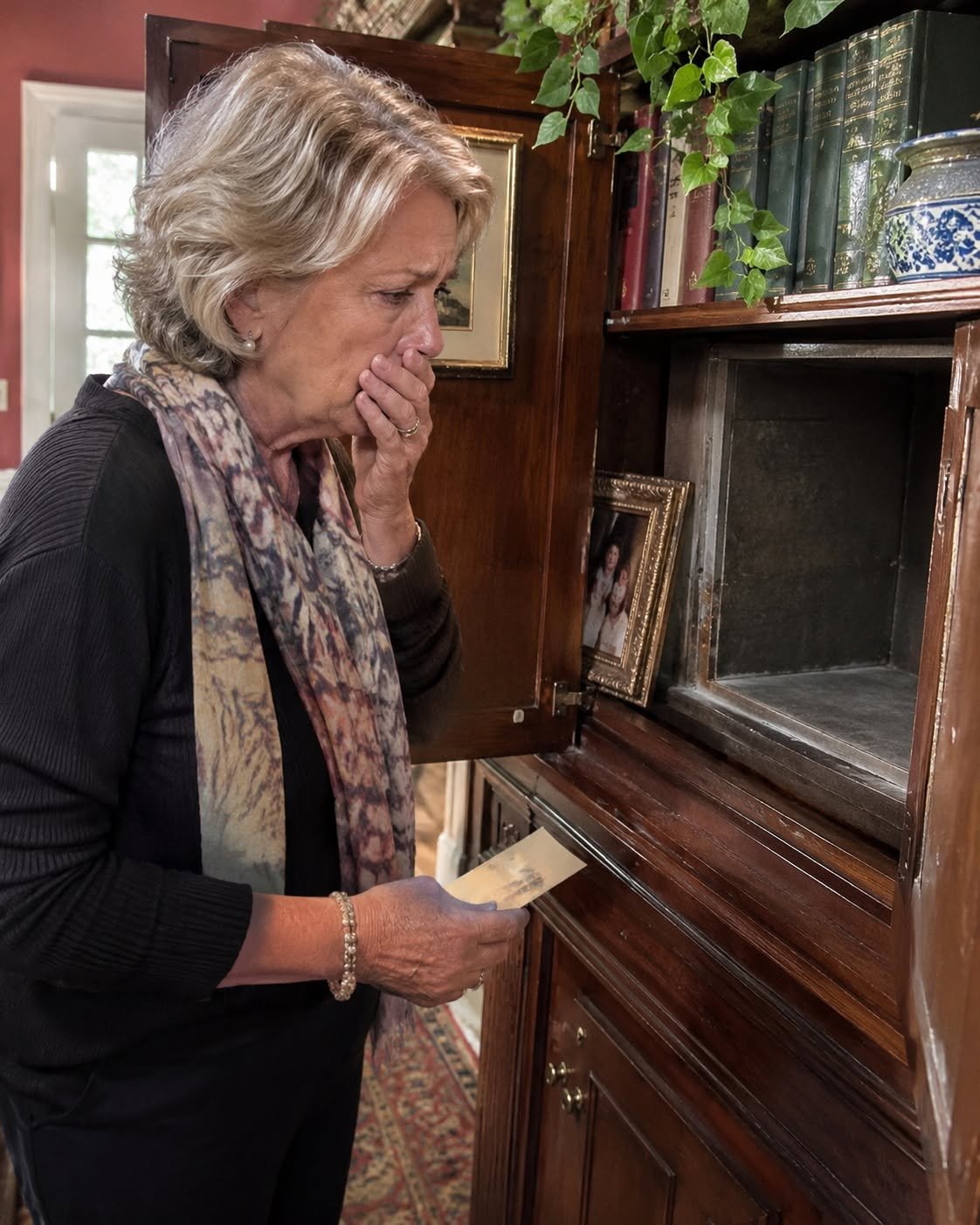
The closet door was partly open. The safe was open too. I’d never changed the combination, which was Daniel’s birthday, and which, I now realized, Caleb had known since he was fourteen.
Empty. The blue folder was gone. The withdrawal slip was gone. The typed page was gone.
I stood there a long time. I’d expected it. I’d rehearsed it, in the shower, in the car, at three in the morning. I’d told myself I’d feel something clean and vindicated.
I felt like I’d been struck on the breastbone with a bat.
I sat on the edge of the bed. My hands shook. I put them between my knees, to still them, and looked at the little photograph on the dresser, Daniel at fifty, in a ridiculous hat, grinning.
I took out my phone. I called the number I’d come to know very well.
“Arthur. It’s Margaret.”
You know the rest. I’ll be there shortly. Leave everything exactly as you found it.
He came in twenty-five minutes, with his raincoat and his folio. He walked through the apartment slowly, taking photographs on his phone. The note. The magnet. The closet. The empty safe. He had a young associate with him, a tall, solemn woman named Ms. Reyes. No relation, he said, with a quick glance at me. A coincidence of a common name.
“Do you want to file a report?” he asked.
“I don’t know.”
“You don’t have to decide today.”
“They took eighteen thousand dollars.”
“They took eighteen thousand dollars, in recorded bills, from a safe in a home they lived in, with a combination they knew.” He tilted his head. “A prosecutor might call it theft. A judge might call it a family matter. I’d call it evidence.”
“Of what?”
“That you gave them the chance, and they took it.” He put his phone away. “I’m sorry, Margaret.”
“Don’t be.”
“I wanted to be wrong.”
“I know.” I looked at the empty safe. “So did I.”
It took us twenty minutes to do what he’d planned. I’ll tell you, because it’s why Caleb and Bianca’s plane landed to a message.
Arthur sat at my kitchen table with his laptop. He drafted three things.
The first was a letter, addressed to Caleb, on firm letterhead, polite and precise. It said that his mother had retained counsel; that the accounts he believed he had access to had been closed and their contents transferred to a trust; that the cash in the safe, $18,000, had been recorded by the bank, and its serial numbers were on file; and that Ms. Miller wished to speak with him “at the earliest opportunity, without prejudice to any action she may choose to take.”
The second was an email to Trey Reyes at the address on the Coastline website. It informed him that Ms. Margaret Miller of Rochester, New York, was not a party to any investment; that no funds from her would be forthcoming; and that his company’s registration was under review by the Florida Office of Financial Regulation, to which Mr. Brandt had submitted a detailed complaint. It cc’d the Miami-Dade state attorney’s office.
The third, I hadn’t expected. It was a short note, handwritten, on a piece of my own stationery. Arthur slid a pen across the table.
“Margaret, I’d like you to write it.”
“Write what?”
“Whatever you’d say to him. If he were in this kitchen.”
I looked at the page for a long time. A truck went by below, shaking the window glass. The refrigerator hummed. On the counter, the kettle had gone cold.
I picked up the pen. My hand was perfectly steady. It’s the thing I’ll always remember. It had shaken for an hour, and now, with a pen in it, it stopped.
I wrote four sentences. I’m not a writer. They came out plain.
Caleb. I know about Trey. I know about the document. I know who Bianca’s brother is.
I’m not angry. I’m very, very sad.
I kept the money for you, too. Not all of it. A little. In a place you’ll find, when you’re ready.
Come home, and I’ll tell you where.
I folded it. I put it in an envelope. I wrote his name on the front, the way I had on a thousand lunch bags. Arthur took it without a word, and slid it into his folio.
“It’ll go with the letter,” he said.
“When?”
“The minute they land.” He checked his watch. “Their flight touches down at 6:47.”
I should tell you what I did that evening. I didn’t sit by the phone. I went into the kitchen and made a pot of soup.
It was Daniel’s recipe. Chicken, with too much dill, and tiny star-shaped noodles from a box. I stood at the stove in my cardigan, with the radio low, and stirred. I thought of nothing at all. The apartment smelled of onions and warm broth, and for a few minutes it smelled like the old days, when the three of us ate at the little table by the window.
At 6:47, my phone buzzed. A text from Arthur.
Landed. Delivered.
I turned off the burner. I sat down at the table. I put my hands flat on the cloth, and looked at the empty chairs.
At 7:20, the phone rang. CALEB.
I let it ring. Four times. Five. I thought, I’m not ready.
Then I picked it up.
“Mom?”
His voice was very small. It was the voice of a boy of nine who’d broken a window. I’d braced for fury, for excuses, for Bianca’s voice behind his, cool and bright. I heard only wind, and a car door, and the roar of a distant jet.
“Hello, Caleb.”
“Mom. I’m at the airport. I’m in the, I’m standing by the baggage claim.” He took a breath. It shook. “I got the letter.”
“All right.”
“And your note.”
“I see.”
“Mom, it, I don’t know what to say.”
“You don’t have to say anything.”
“I do.” His voice cracked. “Mom, I’m so sorry.”
I closed my eyes.
I’d waited thirty-six years to hear a certain kind of sentence from my son. I’d imagined it a hundred ways. I’d thought it would feel like a door opening.
It felt like a fever breaking. A cold, wet, shaky relief.
“Where’s Bianca?” I said.
“She’s, she went to the bathroom. She’s on the phone with Trey.” He lowered his voice. “Mom, she’s been, I don’t know. She’s been so angry. She keeps saying you set us up.”
“Did I?”
He didn’t answer.
“Caleb,” I said. “Did I?”
“No,” he whispered. “I took it.”
It was a long silence. I heard an announcement in the background, a woman’s voice in Spanish, then English. Passengers on flight 1482. I heard a child shrieking with laughter, and the rumble of a suitcase wheel.
“Mom, I need to tell you something. And I need you to let me say it all.”
“Go ahead.”
“I knew.”
I stood very still at the kitchen table.
“About Trey. About, not the, not that she was his sister. I found out in the plane. She told me, over Georgia, when the drinks came.” His voice broke. “But I knew about the investment. I knew it was, I didn’t want to know. I told myself it was real.”
“Caleb.”
“I’ve known for a month, I think. That it’s, there’s no restaurant. I saw the lease. It’s a, there’s a lot with a chain-link fence.” He gave a short, ragged laugh. “I kept thinking, if I just, if I get the hundred and fifty to Trey, then he’ll, and then I’ll make it back, and I’ll pay Mom.”
“And the document?”
“That was Bianca’s idea.” A sharp, cracked inhale. “I printed it. I didn’t read it. She said it was for your protection.”
“Did you believe her?”
“I wanted to,” said my son.
I sat down. I’d stopped being able to stand. The kitchen chair was a hard one, with a crack in the seat that Daniel had meant to fix, and I felt it in my spine.
“Caleb. Do you remember the magnet?”
“The, what?”
“The red apple. On the refrigerator.”
A pause. “Yeah.”
“You picked it out. At the school fair. You were six.”
“I remember.” His voice was thick. “It was fifty cents.”
“You gave the lady two quarters. You’d saved them from your allowance.” I smiled, though he couldn’t see it. “You said, ‘It’s for Mom’s kitchen. So she’ll know I live there.’”
He made a sound. It was small, and wet, and entirely unguarded.
“You left your note under it.”
“I know.” He was crying, openly now. “I thought, if I put it there, you’d, I don’t know what I thought. I wanted you to find it. I couldn’t just take the stuff and leave.”
“Why not?”
“Because it was you.”
I put my hand over my mouth.
“I’m in the airport in Miami,” said my son, “with eighteen thousand dollars in my carry-on, and I want to throw up.”
It’s an odd thing to do, tell a person to stay put. I said it anyway.
“Caleb. I want you to sit down. Right there, on the floor if you need to. And I’d like you to put the money in the bag it came in. All of it. Don’t spend a dollar.”
“I haven’t.”
“I know.”
“It’s all there. I counted in the cab.” He gave a wet laugh. “I counted twice.”
“I’d like you to bring it home.”
“Mom, I, they’re going to arrest me.”
“Who?”
“The, the police. Trey said, he said once you’ve, if you file, I’ll be a, it’ll be a felony.”
“It would be.”
“Then why would I come back?”
I looked at the table. A clean, scrubbed, yellow-checked cloth. A little ceramic hen, for salt.
“Because I’m asking you to,” I said. “And because, Caleb, I’ve spent six months and sixty-seven thousand dollars finding out whether you would.”
A long, long silence.
“Sixty-seven?” he said.
“And four hundred.”
“I didn’t, I never added it.”
“I did,” I said. “In a notebook. You can read it when you get here.”
He came home on the red-eye. I didn’t sleep. I sat in the living room in my robe, with the lamp on, and a cup of tea going cold, and watched the clock. At five-forty in the morning, I heard the elevator. A key in the lock. The door opening, slowly, as if he were afraid it might bite.
He stood in the hall in yesterday’s clothes, a wrinkled blue button-down and chinos, with his carry-on in one hand. He was gray under the eyes. He’d shaved, on the plane, badly. He had a small cut on his chin.
He saw me. He didn’t move.
“Mom.”
“Come in, honey. You’re letting the draft in.”
He came in. He set the bag on the floor, by the door. He stood in front of my chair, with his arms hanging.
“I brought it,” he said.
“Thank you.”
“It’s all there.”
“I believe you.”
He bent. He picked up the bag. He unzipped it, with a shaking hand, and drew out a bundle, a thick, rubber-banded roll of hundreds, wrapped in a plain white dish towel. He set it on the coffee table, in front of me, and stepped back.
I looked at it. It was my own towel. The one with the faded rooster.
“You took a dish towel.”
“I didn’t want it to get dirty.” His voice broke. “I don’t know why.”
We sat in the living room until the sun came up. I’d like to tell you it was a great scene. It was two people on a sofa, in a lamplit room, not looking at each other.
He told it in pieces. He’d met Trey Reyes in a bar, in January. A friend of a friend. Trey had said he was opening a “concept” in Wynwood, a Peruvian-Japanese fusion place, with a rooftop. He’d shown Caleb a video, an architect’s rendering, with palm trees and a neon sign. He’d said, “Man, I need a partner who understands people.”
“I thought I was good at people,” said Caleb. “I thought it was, I’d finally found a thing.”
Bianca had been, he said, tireless. She’d researched. She’d made a spreadsheet. She’d looked at him over the rim of a wineglass and said, “Cal, this is it. This is how we get out.”
“Out of what?”
“I don’t know.” He laughed shakily. “Out of your mother’s apartment, I think. Out of being thirty-six and sleeping in the guest room.”
I put down my tea.
“It was your apartment.”
“I know.” He pressed the heels of his hands against his eyes. “Mom. I wanted to buy you one. A better one. With a balcony. I thought, if I do this, I’ll say, ‘Here, Mom. It’s yours.’ And you’d, and Dad would’ve been, you’d be proud.”
“Caleb.”
“I’m so sorry.”
I took his hand. It was cold, and trembling, and enormous, the hand of a man.
“I was proud of you already,” I said.
Bianca came at ten. I hadn’t expected it. I thought she’d stay in Miami, or fly to her brother’s, or vanish into the large forgetful places where such women go. At ten o’clock, the doorbell rang, and Caleb, asleep on the sofa under an afghan, startled upright.
I opened it.
She stood in the hall in a cream trench coat, with a small suitcase. She’d done her hair. Her eyes were swollen. She wore dark glasses, which she took off, as if for a ceremony.
“Margaret.”
“Bianca.”
“May I come in?”
I stepped aside. She walked into the living room, past her husband, who stood by the sofa in his socks, white-faced. She stopped at the coffee table. She looked at the roll of money in its dish towel.
“I came to say I’m sorry.”
“All right.”
“I’d like to say it properly.” Her voice was low and rough. “Not as a performance. I’ve been performing for eleven years. I’d like to try something else.”
I sat down in my chair. I folded my hands.
“Go ahead.”
She took a long breath. She looked at Caleb, then at me.
“Trey’s my brother,” she said.
“I know.”
“He’s been in trouble since he was sixteen. He’s the, I’ve always bailed him out. I was twenty-two when I paid his first lawyer. I told myself, he’s family.” Her voice broke. “He called in January. He said it was a real thing this time. He said, ‘Bee, it’s a restaurant.’”
“And you believed him.”
“No.” She said it very quietly. “I didn’t. Not for one day.”
It was very still in the room. A radiator ticked. Outside, a garbage truck ground slowly down Culver Road.
“I knew it was a fraud,” said Bianca. “I’ve known since the first phone call. I knew he’d take the money and send an apology.”
Caleb made a small sound.
“I wanted it anyway.” She was crying, silently, with her chin up. “That’s the part I’m ashamed of. He promised to give me twenty percent. For the, for finding the investor. He said I’d never have to work again.”
“Bianca,” said Caleb. His voice cracked. “You knew?”
“I knew.”
“You let me, we, I took my mother’s money.”
“I know.”
“You said it was real!”
“I said a lot of things.” She turned to him, and her face crumpled. “Cal, I’ve been so scared. We’ve got, I haven’t told you. I owe forty-one thousand dollars. On credit cards. And a car loan. I’ve been hiding the statements in the glove compartment for a year.”
He stared at her.
“I wanted it to stop,” she said. “I wanted somebody to find me out. And then, when your mother said she’d read the document, I thought, ‘Oh, she knows.’ And part of me was so, I was so relieved.”
I’d like to tell you what I felt. I’d braced for hatred. I looked at her, at a thirty-four-year-old woman in a good coat, with her mascara in two black lines, and I found only a long, dull ache.
“Bianca,” I said. “Sit down.”
She sat. She did it slowly, on the edge of the armchair, with her knees together. She looked at her hands.
“I’m a nurse,” I said. “I’ve sat with a great many people on a bad day. I’ve learned something about it. When a person tells you the whole truth, in one go, it’s rarely the first time she’s tried.”
She lifted her head.
“How many times did you try?”
She was quiet. A long, long time. Her lips moved.
“Eleven,” she said.
“Tell me.”
“At Thanksgiving. In the kitchen, when you were making the stuffing. I almost said, ‘Margaret, I’m in trouble.’” She laughed, thin. “And you handed me a spoon.”
I put my hand over my mouth.
“I took the spoon,” said Bianca. “I stirred. And I thought, ‘I can’t. She’s being so kind.’”
I won’t tell you everything that was said that morning. It went on a long time. It had silences in it, and sobs, and at least one very long pause when Caleb got up and walked into the kitchen and ran the tap. I sat in my chair. Bianca sat in hers. We didn’t look at each other.
At noon, Arthur came. He’d been called, by me, at eleven. He arrived in his raincoat with the leather folio, and sat at the dining table, with Ms. Reyes at his elbow, and laid out three things.
“Margaret has asked me to propose a way forward,” he said. “I want to be clear that it isn’t a trap. It’s an offer, with consequences, and it’s entirely hers to withdraw.”
Caleb and Bianca sat side by side on the sofa, not touching. He had a pillow in his lap. She had her hands clenched in her coat.
“One. The eighteen thousand dollars has been returned. I’d like to document that. Caleb, you’ll sign a short statement, acknowledging that you took it from the safe, and returned it, voluntarily, on the morning of June fourth.”
“I’ll sign,” said Caleb.
“Two. The sixty-seven thousand, four hundred.” Arthur took off his glasses. “Margaret’s kept a ledger. I’ve reviewed it. It’s accurate, and it’s remarkable. She’s willing to treat the entire sum as an advance against your share of her estate. She would not require repayment in cash.”
Caleb stared at him.
“But,” said Arthur, “that does mean it would reduce what you’d inherit. By that amount, with interest at three percent.”
“That’s fair.”
“It’s more than fair,” said Arthur. “I’d like you to understand that.”
“Three,” said Arthur. He turned a page. “The trust.”
He explained it plainly. Over fifteen minutes, in his dry, kind voice, he laid out what we’d done. The $182,000 was in a revocable living trust, with Margaret as trustee. On her death, it would pass to Caleb, but not in a lump. In thirds, at forty, forty-five, and fifty, with an independent trustee, a bank, and a requirement that distributions be used for housing, health, or education.
“I did it that way on purpose,” I said.
Caleb looked at me.
“Not to punish you. Because I’ve watched what money does when it arrives all at once.” I took a breath. “It was your father’s, too, Caleb. I’d like it to last.”
“I understand.”
“Do you?”
He didn’t answer. He was looking at his hands.
“Four,” said Arthur. “The criminal question. Mrs. Miller has not filed a police report. She isn’t going to, today.”
I saw Bianca’s shoulders drop.
“I want to be clear what that means. It means she’s chosen not to, for now. The option remains. If there’s another incident, of any kind, with anyone in her family, I will send the documents to the district attorney that afternoon.” He folded his glasses. “They aren’t a threat. They’re a record.”
Caleb nodded slowly.
“Five,” I said. “That one’s mine.”
I’d written it on the back of an envelope, at five in the morning. I held it in both hands, and read it, as I would a dose.
“Caleb. You’ll see a counselor. A real one, for as long as it takes. I’ll pay for the first six months. Her name is Dr. Yusuf. I found her through the hospital.”
“All right.”
“Bianca. You’ll see one too. Separately. And you’ll tell Caleb about every dollar. All forty-one thousand. At the kitchen table.”
She nodded, with her face bent.
“Two. You’ll move out. Not today. In thirty days. You’ll rent your own place. I’ll help with the first month’s deposit, and not one dollar more.”
“Where would we go?” whispered Bianca.
“There’s a one-bedroom on Alexander Street. Four-fifty a month. I looked.” I smiled slightly. “It’s got a window onto a maple.”
She put her hands over her face.
“And three.” I looked at my son. “You’ll come for dinner on Sundays. Both of you. And I’ll make the soup.”
Caleb’s face broke.
He put the pillow down. He got off the sofa. He knelt, on the carpet, in front of my chair, a thirty-six-year-old man in wrinkled clothes, and put his forehead on my knees.
I put my hand on his hair. It was thin at the crown, like his father’s. He shook, and shook, without a sound.
It took a year, and I won’t pretend it was tidy.
Trey Reyes was arrested in October, in a rented condo in Coral Gables, by agents of the Florida Office of Financial Regulation. Mike told me, over coffee at Arthur’s office, in his flat, tired voice. “Eleven victims,” he said. “A dentist in Fort Lauderdale. A widow in Naples. A retired fireman. A hundred and twelve thousand, a hundred and forty, sixty-four. The fireman’s the one who gets me.”
“What happened to him?”
“He put it all in for his granddaughter’s tuition.” Mike took off his glasses. “Mrs. Miller, you did something I see about twice a year. Your son’s a victim, and he’s also, a participant. You caught it before it cost.”
“I didn’t do anything.”
“You wrote down every dollar,” said Mike. “It’s the thing no one does.”
Trey pleaded in February. Four years. Bianca testified, voluntarily, against him. She flew down on her own, at her own expense, in a gray suit. She sat in a witness box in Miami and told a courtroom that her brother had been lying since he was sixteen, and that she’d helped him, and that she was sorry. A young prosecutor, Ms. Okafor, told me afterward that she’d never seen a witness do it so plainly.
“She didn’t ask for anything,” said Ms. Okafor. “She just said it.”
They moved out on the first of July. A one-bedroom on Alexander Street, as promised, with a window onto a maple. Caleb took a job at a hardware store on Monroe, in the paint department, for $17.40 an hour. He told me it was the first job he’d had in which he didn’t pretend it was a stepping stone.
“Do you like it?”
“I like the paint.” He grinned. It was Daniel’s grin, crooked at one corner. “It’s a good business. People come in, they say, ‘I want a color like my mother’s kitchen.’ And I, I can do that. I mix it.”
“What color was your mother’s kitchen?”
“Yellow,” said Caleb. “With a red apple.”
I laughed so hard I had to put down my cup.
Bianca got a job at a dental office, at the front desk. She hated it for six weeks. Then, to her astonishment, she found she liked the patients. She told me, over lunch, in a diner on Culver, that it was the first time in years she’d been tired from something that wasn’t pretending.
She repaid her credit cards at three hundred a month. She kept the statements in a binder, with tabs. She showed it to me, once. I’d never seen anything so neat.
“I’m very bad at it,” she said.
“You’re a beginner.”
“I’m thirty-five.”
“So was I,” I said, “when I learned to read an EKG.”
She sat across from me on a Sunday in October, at the little kitchen table by the window. Caleb was in the living room, assembling a bookshelf from a flat box, with a screwdriver and a great deal of muttering. A pot of soup simmered on the stove.
“Margaret,” she said. “May I ask you something?”
“Of course.”
“Why did you, I mean, why didn’t you call the police? When you knew. When we left.”
I thought about it. The kitchen smelled of dill and onion. A fly buzzed at the window.
“I called a lawyer,” I said.
“That’s not what I meant.”
“I know.” I turned my cup. “I’ll tell you. I spent forty-two years in a hospital. I’ve seen a lot of people at the worst moment of their lives. And I’ve noticed that most of them aren’t bad. They’re frightened.”
She said nothing.
“I wasn’t sure which you were. I didn’t want to decide for you.” I looked at her. “So I left a door. A small one, with a key. I thought, ‘If they walk through it, I’ll know.’”
Her eyes filled.
“You walked through it,” I said. “You flew home.”
“I didn’t want to.”
“I know. You did.”
She put her hand over her mouth. I got up, and went to the stove, and ladled soup into a bowl. I set it in front of her, with a spoon.
“Eat,” I said. “It’s Daniel’s.”
She took the spoon. Her hand trembled. She ate, slowly, with her eyes on the bowl, and the tears ran down into it, and neither of us said anything at all.
It’s June again. A year since the red apple magnet. I’m sixty-eight. I live in my apartment on Culver Road, with Daniel’s photograph on the dresser and the ceiling stain shaped like Ohio. I’ve finally had it painted. The man who did it, a sturdy, soft-spoken fellow named Mr. Hale, said, “Ma’am, it’s a nice stain. You sure?”
“I’m sure.”
“It looks like a state.”
“It was my husband’s idea of a map,” I said.
I’ve kept it. He painted around it, a neat, careful circle, like a frame.
On Sundays, they come. Caleb and Bianca arrive at five, in a battered gray Honda, with a paper bag of something. He brings paint chips, and holds them up to the window light, and asks my opinion. She brings flowers, grocery-store ones, in a cone of paper. I put them in a mason jar.
We eat at the little table. I make the soup. Caleb says it needs more dill. I say it has plenty. Bianca says nothing, and eats two bowls.
Last Sunday, after dinner, Caleb stayed behind. Bianca was in the bathroom. I was at the sink, washing the pot.
“Mom.”
“Hm.”
He came and stood beside me. He had something in his hand, and he held it out. It was small, and red, and chipped at the stem.
“You left it on the fridge,” he said. “When you, after. I took it down, to clean.”
I dried my hands. I took the magnet. It lay warm in my palm.
“I wanted to tell you what it meant,” said my son. “When I put the note under it.”
“Tell me.”
“I thought,” he said slowly, “if I left it there, you’d see the apple first. Before you saw the note.” His voice was low and cracked. “I thought, she’ll remember I was six. And she’ll, maybe it’ll hurt less.”
I couldn’t speak. I looked at the apple. A little red thing, cheap, fifty cents, with a tiny crack in the paint.
“It hurt,” I said, finally.
“I know.”
“But I saw the apple first.”
He put his arms around me. He’s tall, and he bent, and I felt him shake. He smelled of paint thinner, and soap, and, faintly, of his father.
I stood in my kitchen, holding a red apple magnet and my son, with the soup going cold on the stove, and the late sun coming in over the sink.
Then I put it back on the refrigerator. In the middle, where it belongs. Where you’d see it first.