
The paper inside was folded in thirds. I unfolded it slowly, and the smell of Grandma’s lavender sachets rose from it so strongly that my eyes stung before I read a word.
“Do you want me to read it aloud?” I asked.
My mother said nothing. Great-Aunt Margaret nodded for her.
“My dearest Layla,” I began, and my voice wobbled. “If you are reading this, then Rebecca has finally found the courage to tell you the truth, and I am prouder of her than she will ever know. I have waited a long time for this day.“
Rebecca made a small sound and put her hand over her mouth.
“Your mother made a terrible mistake, not in having you, but in believing she had to hide you. I tried for years to change her mind, and I failed. That failure is mine to carry. I left you this house because you were the only one who ever visited me without wanting something, but also because I hoped it might finally force the truth into the light. A house can be a wall or a door. I leave the choice to you.“
I stopped to breathe. Nobody on that driveway moved.
“Please do not hate her. Fear makes people do cruel things, and she has been afraid since she was nineteen. But please do not let her off easily either. You have waited long enough to be chosen. When the time comes, choose yourself first. And then, if your heart allows it, open the door.“
I folded the letter and held it against my chest. The ocean filled the silence behind me, steady and patient, the sound Grandma had loved most.
My mother was crying now, not the elegant tears she used at funerals, but real, broken sobs that bent her at the waist. Hannah put an arm around her, and I saw that Hannah was crying too.
“Layla,” Rebecca said, “I’m sorry. I don’t know how to say how sorry. I took your whole childhood and I…” She could not finish.
I let her stand there with it. I did not rush to ease her pain. Grandma had been right about that part.
“Thank you for telling the truth,” I said finally. “It took you fifteen years, and it came out because I changed the locks. That matters. But it doesn’t undo anything.”
“I know.”
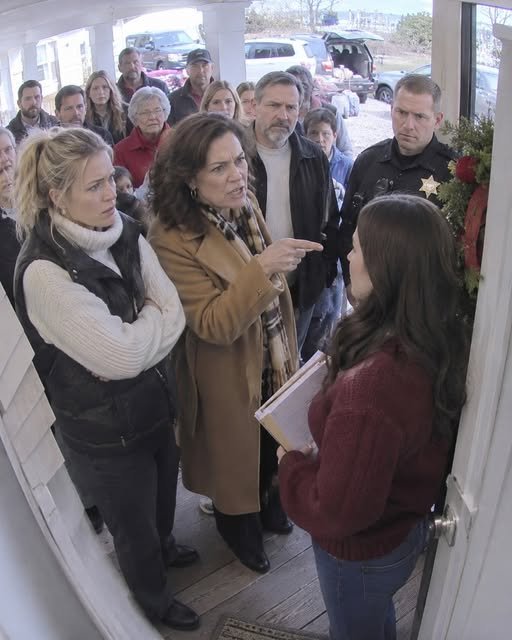
“So here is what is going to happen.” I took a breath and turned to the whole crowd. “Everyone has thirty minutes, as the notice says. You can pack up and leave.”
A murmur went through the relatives. Hannah’s shoulders sagged.
“Or,” I said, “you can stay for Christmas Eve dinner.”
The murmur stopped.
“I said the house should be a place where nobody has to beg to belong. I meant it, and I won’t make an exception for people who hurt me. But I also won’t turn into the person who locked the door on me.” I looked at my mother. “You can all come in. On my terms.”
“Terms?” Thomas asked carefully. It was the first word he had spoken.
“Three. First, no one touches my grandmother’s things without asking. Second, nobody sleeps in the master bedroom except me.” Hannah flushed and looked at her shoes. “And third, Mom reimburses me for nothing, and I reimburse her for nothing. The roof, the decking, the appliances, all of it stays with the house. Call it rent for fifteen Christmases.”
Rebecca let out a wet, shaky laugh. “That’s fair.”
“It’s more than fair,” Great-Aunt Margaret muttered. “It’s generous.”
Deputy Brooks tucked his notepad into his jacket and gave me a small nod. “I’ll be on my way, then. Merry Christmas, Ms. Layla.”
“Merry Christmas, Deputy.”
They came in slowly, awkwardly, like guests at a house they had never visited. Nobody carried suitcases. The cousins set their presents under the tree I had put up myself, a modest six-foot pine decorated with shells and white lights. It looked nothing like the glittering tree in those photographs, and it was the most beautiful tree I had ever seen.
I did not sit with my mother at dinner. I sat between Margaret and a teenage cousin named Josie, who whispered, “I’m sorry nobody told you,” and slid her dessert onto my plate. It was a small thing, and I almost cried.
Here is how the story ended, because you deserve the whole truth.
Rebecca did not become a different woman overnight. She called me the following week and could not speak, and we sat on the phone in silence for twelve minutes before she said, “I’m trying.” That was all. But she kept calling. She came to the house in February, alone, and walked the beach with me without asking for a thing.
In March, she gave me an envelope with everything she knew about Daniel Whitaker. He had passed away eight years earlier, but he had a daughter from his marriage, a woman named Carol, living in Wilmington. I wrote to her with shaking hands. She wrote back within a week. We met for lunch in April, and she took one look at me and said, “You have his chin.” I have a sister I never knew about, and I would not have found her if my mother had stayed silent.
Hannah and I are slowly rebuilding what we should have had all along. She apologized without excuses, and I believed her. She visits in summer now, and she sleeps in the room with the best view of the water, because I gave it to her.
The beach house is full these days. At Christmas, I send invitations in the mail, real paper ones, addressed by hand. Every name on the list gets one, and every card says the same thing: You are welcome here. I wanted nobody to ever wonder again.
On the last night of that first Christmas, after everyone had gone to bed, I stood alone on the back porch where Grandma had held my hand. The tide was coming in. Behind me, the house was warm and loud with sleeping relatives, and I thought about the girl at seventeen who had stared at a photograph and wondered what was wrong with her.
Nothing was wrong with her. She had simply been waiting for a door to open.
I had spent fifteen Christmases outside, and then I became the one who held the key. What I learned is that you can lock out the people who hurt you, or you can unlock the door and decide for yourself who gets to walk through it and how. The second choice is harder. It is also the only one that frees you.
THE END. ❤️