Four torn pieces of paper on a dinner table. Four relatives who laughed at a dying woman’s final Christmas gift. And one grandson on the floor of his Boulder apartment, holding a check he was finally beginning to believe was real.
I called the bank the next morning.
I did not expect anything. I told myself I was only being thorough, the way I teach my students to check a source before quoting it. The woman who answered put me on hold for four minutes, then returned with a voice that had changed.
“Mr. Harper, this check was drawn on a verified account held by Margaret Ellen Harper. The funds are available. Would you like to deposit it or discuss options with a private banker?”
I sat down on my kitchen floor.
“Are there other checks?” I asked. “Written to my family?”
“I can’t discuss other account activity,” she said. “But I can tell you the account was fully funded when each check was issued.”
Six million dollars. Times five. Possibly more.
My grandmother, who wore the same brown wool sweater for thirty years and had thawed her own pipe with a hair dryer, had been quietly holding thirty million dollars.
And my father had torn his check into four pieces and let it fall like paper snow.
I drove back to Sheridan that weekend.
I did not call ahead. I wanted to see the cabin the way she lived in it, not the way she prepared it for company.
Smoke rose from the chimney. The snow on the porch had been shoveled badly, by someone who could not lift the shovel high. I sat in the car for a moment with my throat tight, listening to the engine tick as it cooled.
The door opened before I reached it.
“I heard the engine,” Grandma said. “You came early.”
“I had a question,” I said.
“I thought you might.”
She poured tea. We sat by the fire in the same two chairs. I put the check on the table between us.
“Grandma,” I said, “why did you give everyone six million dollars?”
She looked at the fire for a long time.
“Your grandfather and I did not start with money,” she said. “Walter drove a delivery truck. I kept books for a feed store. We bought forty acres of rocky ground outside Sheridan in 1971 because it was all we could afford.”
“I know the story.”
“You know the soft version,” she said. “In 1984 a mining company wanted the mineral rights under that ground. They offered us a lease. Walter negotiated it himself, with a library book on contract law and a lot of stubbornness. That lease, and the royalties that followed, and every careful investment afterward, became what you are holding.”
“Why did nobody know?”
“Because we told no one,” she said. “Walter and I agreed that our children would learn to stand on their own, and then we would decide what to do with it. He died before we finished deciding.”
She turned her teacup slowly.
“For nine years I have watched them,” she said. “I wanted to know what kind of people my money would make of them. So I did one more thing. I wrote the checks, invited them all to Christmas, and handed them over in front of each other.”
My stomach dropped.
“It was a test,” I said.
“It was a question,” she said. “I wanted to see who treated it as a gift and who treated it as a joke. I wanted to see who asked why.”
“Nobody asked,” I said.
“Nobody,” she said. “Except you, three days later. On your own, on a Thursday, when nobody was watching.”
She told me the rest slowly, over two more cups of tea.
My father, her eldest son, had borrowed from her four times over twenty years. Never repaid. Never thanked her. He called each loan a temporary arrangement between family. Uncle Martin had asked for money to invest in a restaurant and then lost it. Eric had never held a job longer than eight months. Olivia, her granddaughter, had once asked her for a loan the day before posting vacation photos from Bali.
“I am not angry,” Grandma said. “I am eighty-six, and anger takes more energy than I have. But I wanted to know whether any of them loved me, or whether they loved what they thought I was worth.”
She coughed, a long, dry sound that made me lean forward.
“Grandma. That cough.”
“It’s nothing.”
“It is not nothing,” I said. “I noticed it at Christmas. You’ve been steadying yourself against the walls.”
She hesitated.
Then she folded her hands the way she always did and said, very simply, “I have heart failure, Daniel. The doctors in Billings say eight months, perhaps a year. I did not want to tell anyone until I knew who would be at my table.”
The fire cracked.
I got down on my knees beside her chair and put my head in her lap, like I had when I was six, and she stroked my hair with her thin, papery hand.
“I’m sorry,” I said. “I’m so sorry I didn’t come more.”
“You came,” she said. “That is the part that matters.”
I did not cash the check.
I told her this on the third evening, after making dinner and washing every dish. I had spent the afternoon fixing the weather stripping on the back door and fighting with the greenhouse latch.
“Grandma, I don’t want it.”
“That is exactly why I wrote it,” she said.
“I don’t need six million dollars to know what you mean to me.”
“I know,” she said. “But I need you to take it.”
She reached into the drawer of the side table and drew out a thick manila envelope.
“My attorney in Sheridan has drawn up my will,” she said. “The six-million-dollar checks were never my estate. They were an experiment, funded from a separate account that holds only what I could afford to lose. Everything else, the land, the mineral royalties, the main portfolio, will go into a trust.”
“A trust for what?”
“For the people who stay,” she said.
She slid the envelope toward me.
“You will be the trustee,” she said. “With a small committee, which my attorney has named. The money will fund rural clinics and home health care for elderly people who live alone, people like me, in places like this, with nobody to shovel the roof.”
I opened the envelope with shaking hands. Her signature, trembling but unmistakable, sat at the bottom of every page.
“What about Dad?” I asked quietly. “And Eric, and Olivia?”
“Each of them will receive a modest, fair sum,” she said. “Enough to live without desperation. Not enough to live without effort.”
“They’ll be furious.”
“Probably,” she said, with a small, dry smile. “They have never been good at gratitude. But I would rather leave a world that is slightly better than a family that is slightly richer.”
Grandma lived another eleven months.
I took a leave of absence from my school. My department head, a kind woman named Ruth, said go before I finished asking. I moved into the cabin’s spare room, drove her to Billings for appointments, and learned to read her medication chart the way I once learned to read a sonnet.
Some evenings she knew the exact minute the sun would leave the window. Some evenings she forgot my name, called me Walter, and I answered to it.
In the spring we planted the greenhouse together. Tomatoes, peas, a row of marigolds she insisted Grandpa would have wanted.
“He never liked flowers,” she said. “But he liked how I looked at them.”
My father came once. He stayed forty minutes, ate a slice of pie standing up, and asked whether the paperwork was in order. Grandma said it was. He left looking uneasy.
Mom sent a card. Eric did not call. Olivia posted a photograph of a candle with the caption thinking of family.
Uncle Martin phoned once to say he’d heard about a trust and wanted to know the details.
Grandma took the phone from me.
“Martin,” she said. “Thank you for calling. Have you asked me how I’m feeling?”
A long silence on the line.
“I’m dying, dear,” she said gently. “I thought you might want to know.”
She hung up. Then she laughed, a real laugh, rich and dark and entirely herself.
She died on a Wednesday in November, in her own bed, with the snow starting outside the window and a fire in the grate. I was holding her hand. The tea on the nightstand had gone cold.
Her last words were not dramatic.
“I hear your engine,” she whispered. She was looking at the door.
“I’m here, Grandma,” I said.
“I know,” she said. “I always know.”
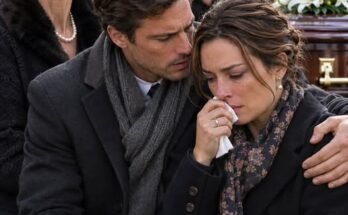
The funeral was small. The pews were half full. My father arrived late. Eric left early. Olivia filmed a tribute before the service ended.
At the reading of the will, six weeks later, the room went silent. Each of them received exactly what Grandma had described: a modest, fair sum. Enough to breathe. Not enough to coast.
The trust received everything else.
My father stood up first, red-faced. “This is outrageous. She wasn’t in her right mind.”
Her attorney slid a folder across the table. “Three cognitive evaluations, two witnesses, and a recorded video statement,” he said. “Mrs. Harper was entirely sound.”
He pressed play.
Grandma’s face appeared on the screen, small and white-haired and steady, seated in her brown wool sweater beside the fire.
“If you are watching this,” she said, “I am gone. I tore up no checks. I wrote six of them, and I watched what each of you did with yours. Only one of you asked me why.”
My father stared at the screen.
“I love all of you,” she said. “I always did. But love is not the same as trust, and money without character is just weight. I hope you each find something worth carrying.”
She smiled.
“Daniel,” she said. “Thank you for staying.”
The screen went dark.
I cashed the six-million-dollar check on my thirty-sixth birthday.
I did not keep it. I deposited it into the trust, the first gift to the foundation that now carries her name. The Margaret Harper Home Care Fund has opened four rural clinics in Wyoming and Montana. Last winter, a volunteer named Pete shoveled a roof in Buffalo, Wyoming, for an eighty-nine-year-old widower who had not spoken to another person in three weeks.
The widower sent a thank-you note, written in shaky pencil.
I framed it and hung it in the cabin.
I live in the cabin now. I teach at a small school in Sheridan, and I fix the roof myself. In the evenings I sit in the chair by the fire and listen for engines on the road.
Sometimes I hear one.
Sometimes it is only the wind.
I like to imagine it is her, coming home.
— As told by the grandson who stayed past Christmas, and understood that the real inheritance was never six million dollars.