
I stayed on the bathroom floor until I heard his bedroom door close. Then I counted to one hundred, slowly, the way I used to count when Eli had nightmares and I needed something to hold onto.
At 2:31, headlights swept across the frosted window. Dana. She had not called, just as I’d asked. I crept down the stairs, skipping the third step because it creaked, and opened the front door before she could knock.
My sister took one look at me and didn’t ask a single question. She just stepped inside and wrapped her arms around me. I shook against her shoulder without making a sound.
“Where’s Eli?” she whispered.
“Upstairs. Down the hall from Grant.”
“Then we get him now.”
“The police are coming.”
“Then we get him before they come.”
We went up together, barefoot, carrying our shoes. Grant’s door was shut. Eli’s was open a crack, the way he’d always insisted, though I’d never wondered why until tonight. He wasn’t sleeping. He lay on his side with his eyes wide open, staring at the wall, fully dressed. Shoes beside the bed. Jacket on the chair.
He had been waiting to be put outside.
I knelt beside him. “Eli.”
He flinched, then saw it was me. His face crumpled. “Did you find them?”
“I found them. I found all of them.” I pressed my forehead against his. “I’m so sorry I didn’t see it. That is not your fault. It is never, ever your fault.”
“He said you’d lose the house.”
“We’re not losing anything. Come with Aunt Dana. Right now. Quietly.”
He grabbed his backpack from under the bed. It was already packed. That detail broke something in me that I don’t think has fully healed.
Dana carried him down the stairs even though he was nine and too big for it, and he let her. I followed with the phone and the notes in a gallon freezer bag. Outside, she buckled him into her back seat and put her own coat around him.
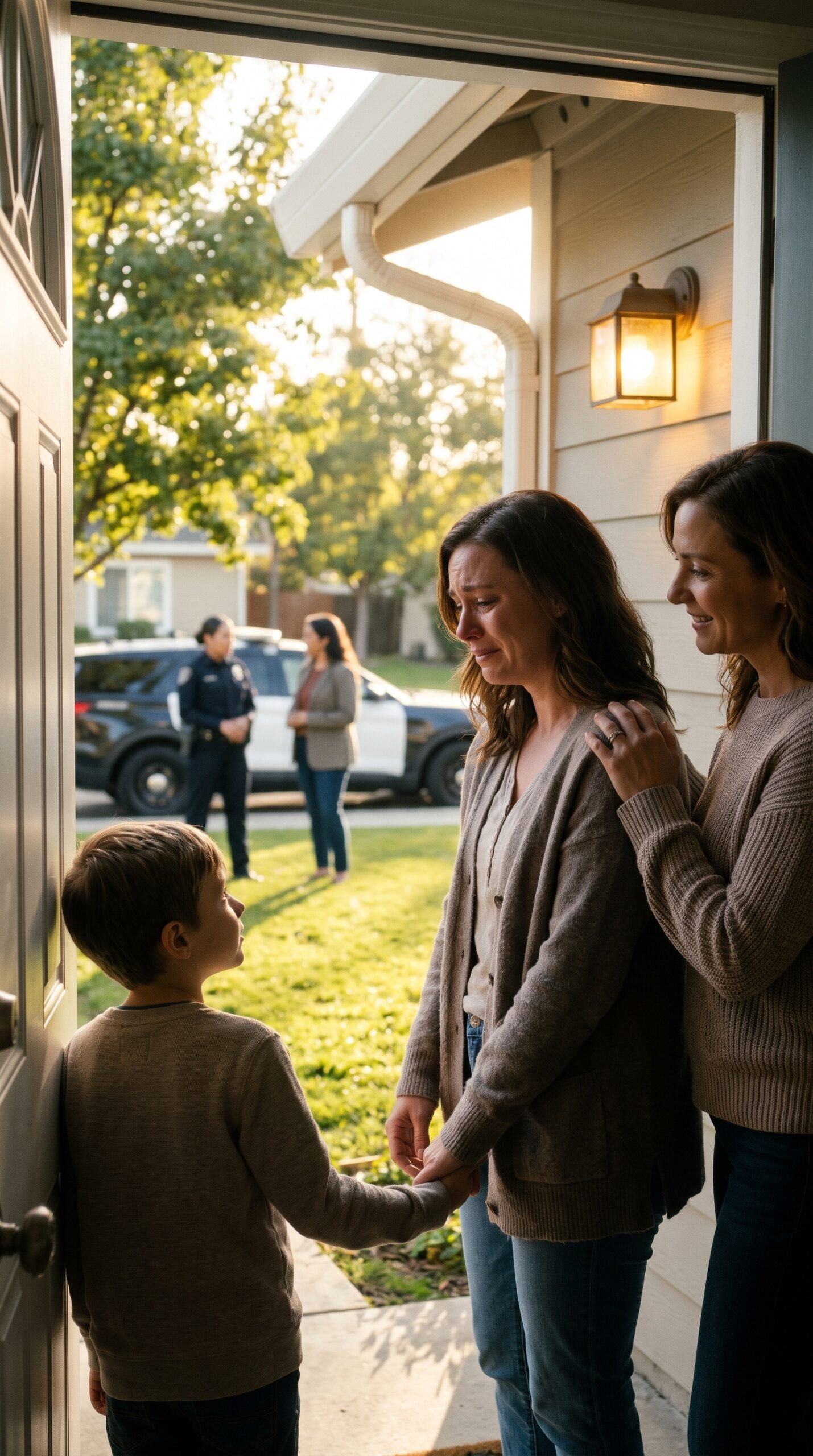
At 2:52, a patrol car turned onto our street, lights off, as I had asked. Two officers stepped out. One was a woman named Officer Ramirez, in her forties, with a steady voice and tired eyes. The other, a younger man, kept his hand away from his belt, and I was grateful for it.
I handed Ramirez the bag. “Ten notes. One phone. Dozens of videos. My son is in that car with my sister. The man is asleep upstairs.”
She watched the first video right there on the lawn, the screen lighting her face blue. When Grant’s voice said Good boy, her jaw tightened. She handed the phone to her partner and said quietly, “We’re going in.”
“Please,” I said. “Don’t let Eli hear it.”
“He won’t.”
I stood on the lawn with my arms wrapped around myself while they went inside. Through the upstairs window, I saw the light come on. I heard a muffled voice, then Grant’s, rising, indignant. “This is a misunderstanding. That boy lies. Ask his mother.” Then, much louder: “Michelle! Michelle!“
I did not move.
They brought him out at 3:07 in a T-shirt and bare feet, hands behind his back. He saw me and his face did something I had never seen before. The charm was gone. What remained was calculation, then contempt.
“You’ll regret this,” he said. “Who’s going to pay the mortgage? You think you can keep that house on your salary?”
I felt the old fear rise, the one he had spent eighteen months building in me.
Then I thought of Eli’s packed backpack.
“Then I’ll sell it,” I said. “I’ll live in a car if I have to. He will never again sleep one night in a house where he’s afraid.”
Officer Ramirez guided Grant into the cruiser. The door shut. He kept talking behind the glass, but I couldn’t hear him anymore, and I realized I didn’t want to.
The next weeks passed in a blur of paperwork and quiet kindnesses. A child advocate named Ms. Patel met with Eli in a room with beanbag chairs and a box of crayons. The school counselor, who had called back at 7:02 that first morning, sat with me for an hour and told me, gently, that she had noticed Eli withdrawing but hadn’t known what to ask. “You asked the right question tonight,” she said. “Don’t carry the part before it.”
The videos did the rest. A prosecutor reviewed all of them and told me it was among the clearest evidence she had ever seen from a child. “Your son documented everything,” she said. “He was nine years old, and he built the case himself.”
I went home that night and cried harder than I had on the porch.
Grant was charged with child endangerment and unlawful restraint. His lawyer suggested a plea. I did not have to decide that. The prosecutor did, and she refused to dismiss anything. In the end he pleaded guilty to multiple counts. The judge granted a protective order that covered Eli and me for years to come.
The mortgage frightened me most. I sat at the kitchen table with a calculator and a legal pad, and my sister sat across from me, and for the first time I looked at the real numbers. Not the ones Grant had recited at me. The real ones. It turned out I could not afford $1,430 on my own, but I could afford a smaller place. Dana helped me find a two-bedroom rental near her, with a yard and a good school. We moved in March.
The house had held eighteen months of fear. I didn’t want to know what it would sound like empty.
On our first night in the new place, Eli stood in the doorway of his bedroom, looking at the window, the lock, the hall.
“Mom,” he said. “Can I leave the light on?”
“You can leave every light on.”
“What about the porch light?”
I understood then what he was really asking. For two months, that bulb had been the only thing he trusted to tell him someone was thinking of him.
“Come here,” I said.
I took his hand and led him to the front door. I flipped the switch, and the porch glowed gold across the new yard. Then I showed him the lock. It turned from the inside. Only from the inside.
“Nobody gets locked out of this house,” I told him. “Ever. Not by anyone. Not even by me.”
He studied the door for a long moment. Then he leaned against my side, small and warm, and let out a breath that sounded like it had been waiting two months to leave his body.
“Okay,” he whispered.
I kept the ten notes. I laminated them, which felt strange, but I couldn’t bear the thought of them fading. They live in a drawer in my room. Eli knows where they are. Years from now, when he’s grown, I want him to be able to look at them and see what I see.
A boy who was frightened, and cold, and told no one would believe him, who wrote down the truth anyway and hid it where only his mother might look.
I looked. It took me too long. But I looked.
And I will never stop.