The dog in this photo used to sleep at the foot of my bed. Three years ago I drove her to a shelter, handed over her leash, and walked out.
I told myself I had no choice. The divorce took the house. The only apartment I could afford had a strict no pets rule.
The lady at the front desk promised me Maggie would find a good family. I held onto that promise like a life raft. That promise was the only way I could sleep at night. Last Saturday I was dropping off winter coats at the community center downtown. Snow was coming down hard. And there he was, standing by the door with everything he owned in one army bag.
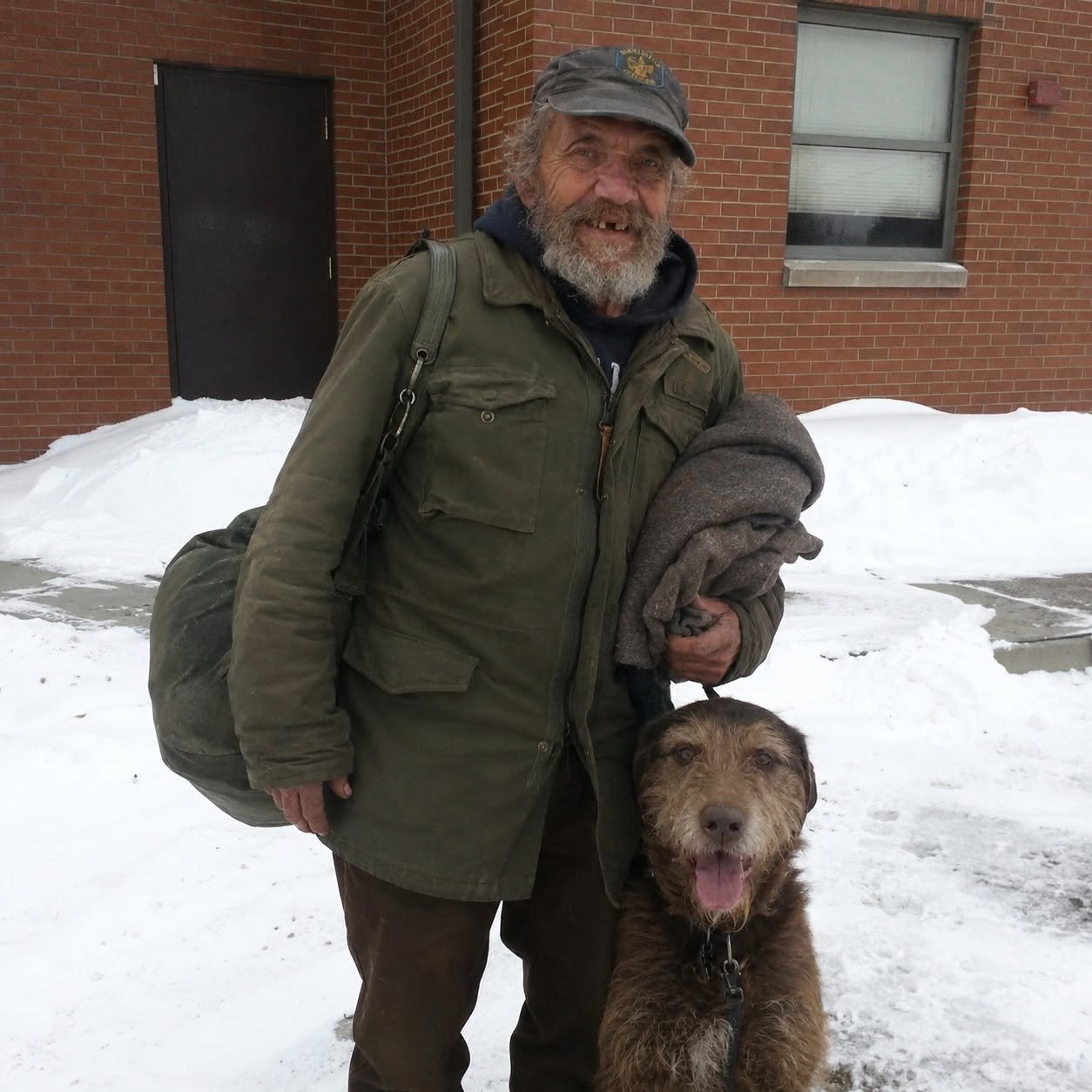
An old man with a gray beard and a kind, tired face. A rolled up blanket under his arm. And a scruffy brown dog sitting against his leg.
Sitting against his leg the exact way she used to sit against mine. Full body weight, leaning in, like the leg belonged to her.
Then I saw the torn left ear. My knees almost gave out right there in the snow.
I don’t remember crossing the parking lot. I just remember hearing my own voice crack when I said, “Maggie?”
That dog’s head snapped around so fast. Her whole body started shaking. She made a sound I hadn’t heard in three years, half whine and half cry, and strained at the leash to get to me.
The old man didn’t pull her back. He just watched me fall to my knees in the slush and bury my face in her fur.
“You know her,” he said. Like a fact, not a question.
I couldn’t speak. I just nodded, crying into the neck of a dog I gave away like she was furniture.
He was quiet for a long moment. Then he crouched down slowly next to us and looked me dead in the eye.
“Ma’am, I need to tell you where I found her. Because it wasn’t at a shelter. Three years ago I found her tied to a shopping cart rack behind the Save-A-Lot on Fulton Street.”
He said it slow and careful, watching my face the whole time.
“First hard freeze of the year. Somebody had run a chain through the rack and clipped it to her collar. Chain was so short she couldn’t lie down. No food anywhere. No note. Just a dog standing in the sleet, watching the corner of the building like somebody was about to come back around it.”
I sat back on my heels in the snow. My mouth opened, and the only thing that came out was the lie I had been living on for three years.
“But the shelter told me a family took her. A family with a farm. They had kids.”
He nodded slowly, like he had heard sentences like that before.
“I’m sure a family did take her,” he said. “And somewhere between that farm and that parking lot, they stopped wanting her. People do that, ma’am. The dog never understands it. But people do it all the time.”
He didn’t say it with any meanness, and that almost made it worse. He wasn’t accusing me of anything. He was just telling me how the world works, and I was part of how the world works.
His name was Walter. “Took me twenty minutes to get that chain off with the tools I had,” he said. “She never growled once. Never barked. She just stood there shaking and let me work. And when it came loose, she didn’t run. She pressed herself up against my leg, right here, and that was that. She’s been pressed against this leg for three years.”
He looked down at her for a while before he spoke again.
“I didn’t rescue her. I want to be honest with you about that. That first winter after my wife passed, I wasn’t doing so good. I’ll leave it at that. This dog gave me somewhere to put all of it. You want the truth, she found me tied to something too. She just got her chain off first.”
Then he asked me a question that took my legs out from under me all over again.
“You drive a gray car?”
I looked over at my Civic parked twenty feet away, gray as the sky, and I couldn’t answer him.
“First year I had her,” he said, “every gray sedan that passed us, she’d stop and sit down. Middle of the sidewalk, didn’t matter. She wouldn’t move until it was gone from sight. I used to wonder out loud who she was waiting on.”
He reached down and scratched her torn ear.
“Guess now we know.”
I would like to tell you I held myself together after that. I didn’t. I cried in that parking lot in front of a stranger until the snow soaked through the knees of my jeans and I couldn’t feel my hands. Maggie licked my face the entire time, tail sweeping the slush behind her. That’s the thing nobody warns you about with dogs. You can leave them, and they will still spend their love on you like you never did it.
Somewhere in the middle of all that crying, I got angry instead.
“Who chains a dog to a cart rack in November?” I said. “Who does that?”
Walter shrugged in that slow way of his.
“Spent a while being angry at them myself,” he said. “Then I did the math. If they hadn’t left her there, I don’t believe I’d have made it through that winter. It’s hard to keep hating somebody who saved your life by accident.”
We stood in that parking lot for over an hour, and I learned things in that hour I will be carrying for the rest of my life.
The building behind him was the community center. They serve a hot lunch every day, and the other side of the building has overnight cots. Walter eats the lunch. In three years, he has never once slept on a cot.
“They don’t allow animals in the overnight side,” he told me. “Rules are rules, and I don’t blame them for it. But she got left tied up outside alone one time in her life. That’s not happening twice. Not while I’m above ground.”
The blanket under his arm was folded into a neat square, and I found out it wasn’t even his. It was hers. He carries her bed all day so she has something warm and dry to lie on at night.
While we talked, he pulled a bread bag of kibble out of his jacket pocket, poured some into his cupped hand, and let her eat before he ever said a word about being hungry himself. The ladies who run the lunch line told me later that he does it in that order every single day. Her first. Always her first.
And then I did the thing I am most ashamed of, out of everything in this story.
I offered to buy her. I didn’t even have the decency to be delicate about it. I heard myself telling this man, this man who owned one bag and one blanket, that I had money now. That I had a house now. I moved out of that no-pets apartment two years ago. I have a yard with a fence and a quiet street. All the things I didn’t have back when they would have mattered, I have them now, and I stood there in the snow offering to trade them for the only family he had left.
Walter didn’t get angry. I think part of me wanted him to. Anger I could have carried home with me.
What he did instead was so much heavier.
He looked at Maggie for a long time. His jaw worked like he was chewing on something. Then he crouched down, and I watched his hands shake as he reached for the clip on her leash.
“Keep your money,” he said quietly. “But if you’ve got a warm house, and a yard, and she wants to go with you, then I’ve got no business standing between this dog and a soft place to sleep.”
He got the leash unclipped on the second try.
“Go on and call her.”
I will hear those four words in my head until the day I die. He was giving away the last thing he had in the world, and the only part of him that argued about it was his hands.
I called her.
She came to me. She sniffed my gloves and licked my chin and let me hold her face in my hands, and for about ten seconds the last three years didn’t exist.
Then she turned around, walked back to Walter, and sat down on his boot. She leaned her whole body into his leg, all of her weight at once, the lean I would know anywhere on this earth.
She had answered. Dogs don’t explain themselves. They just answer.
“I gave her up once to make my life easier,” I told him. “I’m not going to take her from you to make myself feel better.”
I clipped the leash back onto her collar myself. By then my hands were shaking too.
I would love to tell you I drove home at peace with all of it. I didn’t. I sat in my driveway for a long time. Then I went inside my warm house with my empty yard, and I did not sleep one minute.
At seven the next morning I was back at the community center with forty pounds of dog food, a box of hand warmers, and two coffees. Walter looked at that coffee like it might be some kind of trick.
“It comes with a condition,” I told him. “You have to tell me about her. All three years of her. I want every bit of it.”
That was the first Saturday. We have not missed a Saturday since.
The photo at the top of this post is from that morning. I asked Walter if I could take his picture, and he said only if Maggie was in it. Look at him smiling. The man owned one bag and one blanket, and he was smiling like a rich man. It took me months to understand that he was one.
Over those Saturdays, in bits and pieces, I got Walter’s story too. He was an Army mechanic a long time ago. He was married to a woman named Ellen for forty-two years. No kids. “We had dogs instead,” he told me. She got sick in 2019 and passed in 2021, and everything after that happened the way it happens to more people than any of us want to believe. The bills ate the savings. The truck got sold. The storage unit with his papers and her photographs lapsed while he was busy figuring out where to sleep.
“You’re only ever about three bad months away from a parking lot,” he said one Saturday, stirring his coffee with a plastic spoon. “Most folks just never have all three come in a row.” I think about that sentence every single day of my life.
Now, I am not telling this story so anybody thinks I’m a good person. Please hear me on that. The good person in this story carries a dog bed through the snow so an old dog can sleep dry. I’m telling it because of what happened next, and because Maggie deserves to have all of it written down.
In December I sat down with Carol, who runs the community center, and I asked her one question. What would it actually take. Not to fix everything. Just to get one man and one dog indoors before spring.
Turns out there is a transitional housing program for veterans about forty minutes from us, and it allows pets. The program had a waitlist, a mountain of paperwork, and one big problem. Proving Walter’s service meant replacing the discharge papers that disappeared with that storage unit. We mailed the records request the second week of December.
Then we waited.
January turned brutal. There was a stretch where the nights dropped below zero for a week straight, and I stopped asking anybody’s permission for anything. I booked him a week at the Starlite Motel out on Route 9, one of those old places that takes dogs for fifteen dollars a night. Walter stood in that motel parking lot and argued with me for ten solid minutes.
“You can pay me back,” I finally said, “by not freezing to death before your paperwork comes.”
He didn’t have an answer for that one. Maggie was already sitting at the door of room 114 like she’d read the reservation.
The records came at the end of January. Carol walked the application through herself, and on a gray afternoon in February my phone rang, and a woman I had never met said the words “a unit opened up.” I had to pull my car over on Fulton Street, two blocks from a certain Save-A-Lot, and just sit there and breathe.
Moving day took twenty minutes. Everything Walter owns in this world went up the stairs in one duffel bag and two of my grocery totes. The place is a third-floor studio with a radiator that clanks and one window that looks at a brick wall, and when Walter walked into it he stood in the middle of the room holding his hat in both hands like he was standing in a cathedral.
I had bought Maggie a dog bed. A big orthopedic one, for her hips. She sniffed it exactly once, politely, the way you thank somebody for a gift you are never going to use.
That night, and every night since, she has slept at the foot of Walter’s bed.
Some habits survive everything. That one is hers.
People keep waiting for me to say I got my dog back. I didn’t, and I want to be honest about that too. Maggie was never mine to get back. I just had her first. Walter had her when it counted.
But here is what I did get. Every Saturday I climb three flights of stairs with two coffees and a bag of the liver treats she loves, and before my hand even touches the door I can hear her tail start hammering the floor on the other side. She greets me like family. Some visits she leans her whole weight against my leg now too, and when she does it, Walter always says the same thing.
“Look at that. Enough of her to go around after all.”
Maggie is nine now. Gray around the muzzle, slower on the stairs, still the best thing that ever happened to two different people who didn’t deserve her at the time.
She sleeps at the foot of a bed again. Every single night.
It just isn’t mine.
Here is the last thing, and then I’ll let you go. In all these months of Saturdays, Walter has never once asked me why I did it. Not one time. I tried to explain it to him anyway back in the spring, the divorce, the apartment, the whole speech I had rehearsed for three years. He stopped me with one raised hand, the same way he stopped me from offering him money in the snow.
“Ma’am,” he said. “She forgave you before I ever met you. Only one of you is still carrying it.”
So I’m writing this to finally put it down.