
PART ONE — THE LAST GOOD DEED
Chapter 1 — The Sheriff at My Door
The morning after I mowed my elderly neighbor’s lawn, two patrol cars stopped outside my house.
I was thirty-four weeks pregnant, six weeks away from my due date, and one missed mortgage payment away from losing everything.
When the sheriff knocked, I thought he had come to serve foreclosure papers.
Instead, he asked about the eighty-two-year-old widow next door.
“Mrs. Higgins,” he said. “When did you last see her?”
“Yesterday afternoon.”
His expression grew serious.
“I’m sorry to tell you she passed away during the night.”
My hand flew to my stomach.
“No.”
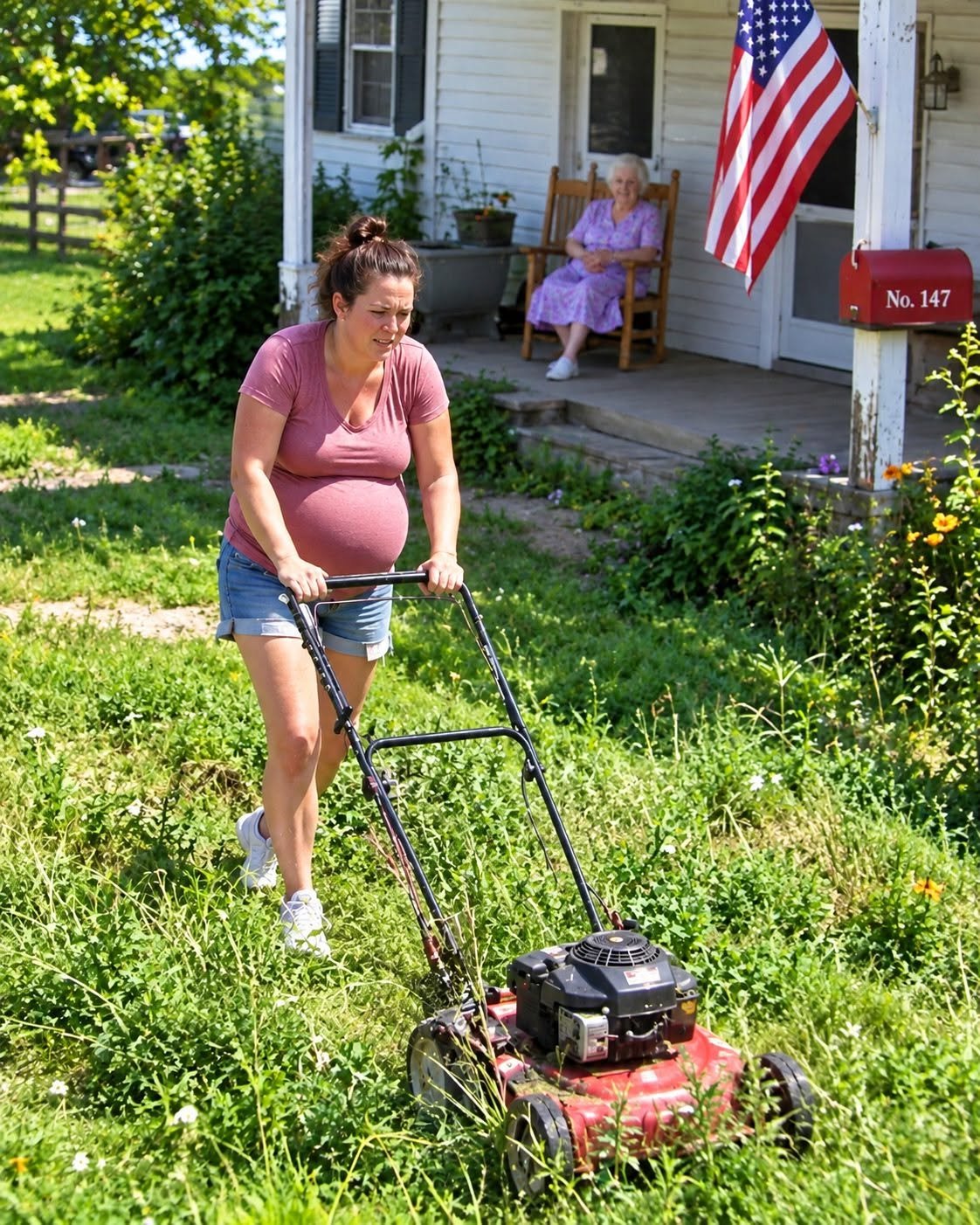
I had spent three hours cutting her overgrown grass in ninety-five-degree heat. Afterward, she’d held my hands and told me I was a good girl.
Now she was gone.
The sheriff glanced toward my mailbox.
“Before we go any further, there’s something you need to look at.”
“What?”
“Your mailbox, ma’am.”
I stared at him.
“Why?”
“Mrs. Higgins left something for you. We need to establish exactly what it is.”
My legs felt unsteady.
I walked down the porch steps, crossed the driveway, and lifted the little metal lid.
Inside was a thick cream-colored envelope.
My name was written across the front.
EMILY PARKER — PLEASE OPEN TODAY.
The handwriting was Mrs. Higgins’s.
I pulled out the envelope.
A smaller sealed packet slipped from behind it.
Across the packet were six words that made my heart stop.
FOR THE BABY I WON’T MEET.
I tore open the letter.
The first sentence read:
Emily, if the sheriff has come to your door, it means I didn’t get the chance to tell you myself.
I screamed.
Not because I was afraid of what she had done.
Because I suddenly understood that the woman who had thanked me for mowing her lawn had known she might not see another morning.
And she had spent her final evening thinking about my child.
Chapter 2 — Six Weeks From Losing Everything
My name is Emily Parker.
I was twenty-nine years old, living in a small house on the outskirts of Cedar Hollow, North Carolina.
It wasn’t a beautiful house.
The kitchen cabinets were scratched. The hallway carpet had faded. The back porch needed repairs.
But it was mine.
Or at least it had felt like mine until the bank began sending letters.
My ex-boyfriend, Ryan, left when I told him I was pregnant.
We had been together for four years.
He had promised marriage, a family, and a future.
Then one evening, sitting at our kitchen table, I showed him the pregnancy test.
He stared at it.
“Are you sure?”
I nodded.
He said he needed time to think.
Three days later, his clothes were gone.
He left a note beside the coffee machine.
I’m not ready for this.
That was all.
No apology.
No plan.
No promise to help.
I called him.
He didn’t answer.
Eventually, I stopped trying.
The mortgage, however, didn’t stop.
Neither did the electricity bills, insurance, groceries, or medical expenses.
I worked remotely handling customer service calls, but pregnancy-related complications had forced me to reduce my hours.
By the time I reached thirty-four weeks, my savings were gone.
And the bank had started foreclosure proceedings.
Chapter 3 — The Phone Call
The call came on Tuesday morning.
A woman from the mortgage servicing company spoke in the careful, professional tone people use when delivering terrible news.
“Ms. Parker, your account has entered the foreclosure process.”
I gripped the phone.
“I know I’m behind. I’m trying to arrange something.”
“We can review available loss-mitigation options, but you need to respond to the notices immediately.”
“How long do I have?”
She explained the next steps.
I wrote everything down.
Then stared at the numbers.
The amount needed to bring the account current was more money than I had earned in several months.
When the call ended, I sat at the kitchen table.
My baby’s tiny clothes were folded in a basket beside me.
A secondhand crib stood in the corner of the bedroom.
I had painted the nursery pale yellow because I couldn’t afford to hire anyone.
I looked at the little socks.
Then at the foreclosure notice.
And began crying.
Not loudly.
Just the exhausted, helpless crying of someone who has spent too long pretending she can manage everything alone.
Eventually, I stepped outside.
I needed air.
That’s when I saw Mrs. Higgins.
Chapter 4 — The Woman Next Door
Mrs. Margaret Higgins had lived next door for nearly forty years.
She was eighty-two.
Small.
Silver-haired.
Usually dressed in floral blouses and comfortable shoes.
Her husband, Walter, had died seven months earlier.
Before that, I’d often seen them working in their garden together.
Walter handled the lawnmower.
Margaret tended the roses.
They argued cheerfully about tomatoes, birds, and whether the weather forecast could be trusted.
After Walter died, the garden changed.
The roses grew wild.
The flower beds filled with weeds.
And the lawn became increasingly overgrown.
That Tuesday, I saw Margaret struggling behind a rusted push mower.
The grass reached almost to her knees.
The sun was merciless.
She pushed the mower forward.
It stalled.
She tried again.
Then stopped and leaned against the handle.
I watched from my porch.
I was heavily pregnant.
My back ached.
My ankles were swollen.
I had just learned I might lose my home.
Every sensible thought told me to go inside.
But Margaret looked exhausted.
And nobody else seemed to be coming.
Chapter 5 — Three Hours in the Heat
“Mrs. Higgins!”
She turned.
“Oh, Emily. Hello, sweetheart.”
“Let me help you.”
She waved a hand.
“Nonsense. You need to rest.”
“So do you.”
I walked across the grass.
She smiled weakly.
“Walter always handled this machine.”
I looked at the mower.
“Why don’t you sit in the shade? I’ll see what I can do.”
She protested.
I insisted.
Eventually, she sat on the porch with a glass of water.
The mower was difficult to start.
The grass was thick.
And I was in no condition to move quickly.
I worked in short stretches, taking frequent breaks, drinking water, and stopping whenever I felt uncomfortable.
More than once, Margaret told me to leave the rest.
But I wanted to finish what I reasonably could.
By late afternoon, most of the lawn was cut.
I was tired, sweaty, and ready to sit down for the rest of the week.
Margaret brought me lemonade.
We sat together beneath the porch awning.
She looked across the yard.
“Walter would have loved seeing it tidy again.”
I smiled.
“I’m glad.”
She reached for my hand.
“You’re a good girl, Emily.”
I looked down.
“I’m just your neighbor.”
She squeezed my fingers.
“Sometimes that’s the most important thing a person can be.”
Chapter 6 — The Conversation I Almost Forgot
We sat together for nearly half an hour.
Margaret asked about the baby.
“Have you chosen a name?”
“Lily.”
Her face softened.
“That’s beautiful.”
I smiled.
“Thank you.”
She looked toward the rose bushes.
“Walter and I always wanted children.”
I turned.
“I didn’t know that.”
“We tried for years.”
She spoke gently, without bitterness.
“It never happened.”
“I’m sorry.”
Margaret shook her head.
“We had a good life.”
She looked toward the house.
“But a good life can still have quiet rooms.”
I understood more than she knew.
She studied my face.
“You’ve been worried lately.”
I tried to smile.
“Just pregnancy things.”
She didn’t press.
Instead, she said, “Promise me something.”
“What?”
“Don’t let difficult days convince you that you’re alone in the world.”
I laughed softly.
“That’s easier said than done.”
“I know.”
Her expression grew thoughtful.
“Sometimes help arrives in ways we don’t expect.”
I didn’t know then how much those words would mean.
Chapter 7 — The Last Evening
When I returned home, I took a shower and ate a bowl of cereal.
I was too tired to cook.
My phone showed another missed call from the mortgage company.
I placed it face down.
Then I folded a tiny yellow blanket and put it in the crib.
My daughter kicked gently.
“It’s okay, Lily,” I whispered.
“I’ll figure something out.”
I wanted to believe it.
Across the street, Margaret’s porch light glowed.
I saw her silhouette moving behind the curtains.
For a moment, I considered calling to make sure she was all right.
Then I remembered she’d told me she was going to rest.
I decided not to disturb her.
I went to bed.
At some point during the night, I heard a car passing.
Then rain tapping against the window.
I slept badly.
By sunrise, I was awake again, thinking about money.
Then I heard the sirens.
And everything changed.
PART TWO — THE LETTER IN THE MAILBOX
Chapter 8 — The News
Sheriff Daniel Brooks stood on my porch.
He was in his late fifties, with kind eyes and a serious expression.
Behind him, two deputies waited beside their vehicles.
“Ms. Parker?”
“Yes?”
“I’m Sheriff Brooks. May we speak with you?”
My first thought was the foreclosure.
Then he mentioned Margaret.
My stomach tightened.
“Is she okay?”
He took off his hat.
“I’m sorry. Mrs. Higgins passed away during the night.”
I stared.
“No. I saw her yesterday.”
“I understand.”
“She was sitting on her porch.”
He nodded.
“A relative became concerned when she couldn’t reach her this morning. Emergency services responded.”
I covered my mouth.
“Was she alone?”
His expression softened.
“She appears to have passed peacefully. The medical authorities are handling the necessary review.”
I looked toward her house.
The lawn was neatly cut.
The porch chair was empty.
And suddenly the entire street felt different.
Chapter 9 — Why the Sheriff Came
Sheriff Brooks explained that Margaret had left a written note for her attorney.
The attorney had contacted his office because Margaret’s instructions referenced a neighbor who might need to be notified promptly.
There was no accusation against me.
No suspicion.
The deputies were simply helping establish the timeline of Margaret’s final day and making sure the appropriate people received the information.
“Mrs. Higgins mentioned you,” Brooks said.
I stared.
“Me?”
“Yes.”
He gestured toward my mailbox.
“She also indicated she’d leave you a letter. If it’s there, we’d like you to preserve the envelope.”
My hands shook.
I walked down the steps.
Opened the mailbox.
And found it.
The cream envelope.
The sealed packet.
The words about my baby.
I began crying before I reached the second paragraph.
Chapter 10 — Margaret’s Letter
The letter was written in blue ink.
Her handwriting slanted slightly to the right.
Dear Emily,
If you’re reading this, I may not have had the chance to speak with you again.
Please don’t be frightened.
I have been putting my affairs in order since Walter passed away. My attorney has the formal documents.
Yesterday, you did something very kind for me.
You were tired. You had worries of your own. Yet you came over because you saw an old woman struggling.
You didn’t ask what I could give you.
You didn’t expect anything.
You simply helped.
I want you to know that your kindness mattered more than you can imagine.
I stopped reading.
Tears blurred the page.
Sheriff Brooks waited quietly.
I continued.
There is something about my life you don’t know.
Walter and I spent many years hoping to have a family.
We never had children, but we saved carefully and built a comfortable life.
After he died, I began thinking about what should happen to the things we worked for.
I made decisions with my attorney before yesterday.
And yesterday reminded me why those decisions felt right.
My hands trembled.
The next paragraph changed everything.
Chapter 11 — The Unexpected Gift
Emily, I have arranged for a portion of my estate to support you and your daughter.
The details are with my attorney, Mr. Nathaniel Price.
Please do not assume the enclosed papers transfer anything immediately. They explain how to contact him and what happens next.
I know you’ve been struggling.
I saw the notices that arrived at your door. I saw how hard you worked to keep your home.
You never asked me for money.
That is not why I chose to help.
I chose to help because kindness deserves to be remembered, and because Walter and I always believed a home should be a place where someone feels safe.
I stared at the page.
My breathing became uneven.
Sheriff Brooks stepped closer.
“Ms. Parker, would you like to sit down?”
I nodded.
He helped me return to the porch.
I held the letter against my chest.
For months, I’d been afraid of losing my home.
Now my neighbor was gone.
And somehow, even in death, she was trying to help me keep it.
Chapter 12 — The Attorney’s Office
Later that afternoon, after resting and speaking with my medical provider about the strain of the previous day, I called Nathaniel Price.
He was Margaret’s longtime attorney.
His voice was measured and professional.
“Ms. Parker, Mrs. Higgins spoke very warmly of you.”
I swallowed.
“I only helped with her lawn.”
He paused.
“Her decision wasn’t based on one afternoon.”
“What do you mean?”
“Mrs. Higgins had been considering her estate plans for some time.”
I looked toward her house.
“She didn’t tell me.”
“She preferred to keep her financial affairs private.”
He explained that the formal estate documents would govern any distribution.
There would be legal procedures, administrative expenses, and time required before anything could be transferred.
He was careful not to promise money immediately.
But he confirmed something extraordinary.
Margaret had named me as a beneficiary of a substantial part of her estate.
I gripped the phone.
“Why me?”
Mr. Price was quiet for a moment.
“Perhaps she wanted you to hear that answer in her own words.”
Chapter 13 — The Second Envelope
Inside the sealed packet was another letter.
This one was addressed to my daughter.
FOR LILY PARKER — WHEN SHE IS OLD ENOUGH TO READ THIS.
I sat at my kitchen table.
The little yellow blanket lay beside me.
I opened the letter carefully.
Dear Lily,
We haven’t met, but your mother tells me you’re already very good at kicking.
I laughed through tears.
I hope you grow up knowing that the world contains kind people.
Your mother is one of them.
When I was old, she noticed I needed help.
She was carrying you, and she had every reason to rest.
Still, she found a way to show kindness.
I hope you learn from her example.
You don’t have to be rich to be generous.
You don’t have to be powerful to make someone’s day better.
Sometimes all you need to do is notice.
I pressed the paper to my chest.
Then I read the final sentence.
If you ever see an elderly neighbor struggling with a garden, I hope you’ll remember me.
Chapter 14 — Walter’s Story
At the attorney’s office, I learned more about Margaret and Walter.
Walter Higgins had worked as a civil engineer.
Margaret had been a school librarian for thirty-six years.
They lived modestly.
Drove older cars.
Repaired things instead of replacing them.
Saved carefully.
Over time, they built a substantial investment portfolio and paid off their home.
They also supported local education programs and community organizations.
When Walter died, Margaret reviewed their estate plan.
They had no children.
Their closest relatives lived far away.
Margaret wanted part of their savings to support community programs.
She also wanted to help someone personally.
Someone whose life might be changed by practical support.
She had been thinking about me for months.
I didn’t know it.
But she had noticed the late-night lights in my kitchen.
The grocery bags I carried alone.
The days when I sat on my porch staring at overdue notices.
She had seen more than I realized.
Chapter 15 — The Mortgage
Mr. Price explained that Margaret’s estate included a designated gift intended to help with my housing costs.
The amount was enough to potentially resolve the mortgage arrears and provide a meaningful financial cushion.
But the money would not arrive overnight.
There were legal procedures to complete.
I needed immediate help.
So Mr. Price suggested I contact the mortgage servicer and a housing counselor right away.
He offered to provide appropriate documentation of the anticipated estate distribution once legally permitted.
I called the mortgage company.
This time, I didn’t avoid the conversation.
I asked about loss-mitigation options.
I explained that my financial situation might soon change.
I submitted the requested paperwork.
There was no instant miracle.
No bank employee suddenly erasing the debt.
But there was a path forward.
And for the first time in months, I felt capable of taking the next step.
Chapter 16 — The Neighbors Who Appeared
News of Margaret’s passing spread quickly.
People brought flowers.
Someone left a card beside her porch.
An elderly man from the next street stopped to tell me how Margaret had helped his daughter learn to read.
A woman from the library remembered Margaret staying late to assist students who needed tutoring.
A former student said Margaret had bought him school supplies when his family couldn’t afford them.
I listened.
And realized that the quiet woman next door had spent her life helping people.
The lawn was only the last thing I’d done for her.
Her generosity had been part of the neighborhood for decades.
I began writing down the stories.
At first, I did it because I didn’t want to forget them.
Later, I understood that I was preserving something far more valuable than money.
I was preserving the memory of who Margaret had been.
Chapter 17 — The Memorial Service
Margaret’s memorial service was held at a small church.
The pews were filled with former students, neighbors, librarians, and friends.
I sat near the back.
My hands rested on my stomach.
The minister spoke about Margaret’s patience.
Her humor.
Her love of books.
Her devotion to Walter.
Then he invited people to share memories.
Several stood.
I hadn’t planned to speak.
But when the room grew quiet, I found myself rising.
I walked to the front.
“My name is Emily Parker,” I began.
“I lived next door to Mrs. Higgins.”
My voice shook.
“Last Tuesday, I helped her with her lawn.”
I looked across the room.
“I thought I was doing something small.”
Tears filled my eyes.
“But she reminded me that small acts of kindness can mean more than we realize.”
I paused.
“She made me feel seen at a time when I felt completely alone.”
Then I added, “I wish I’d known how much she needed someone to sit with her.”
Chapter 18 — The Woman Who Knew
After the service, a woman approached me.
She was about sixty, with silver-framed glasses.
“My name is Ruth,” she said. “Margaret and I worked at the library together.”
I shook her hand.
“She spoke about you.”
I blinked.
“She did?”
Ruth smiled.
“Frequently.”
I stared.
“She called you the young woman next door who always waved.”
I felt tears rising again.
Ruth continued.
“She knew you were expecting a baby. She worried that you seemed overwhelmed.”
I looked down.
“She never said anything.”
“Margaret didn’t want to embarrass you.”
Ruth touched my arm.
“She believed kindness should be offered without making someone feel small.”
That sentence stayed with me.
Because Margaret hadn’t simply wanted to help.
She had wanted to preserve my dignity.
PART THREE — THE LIFE SHE HELPED ME SAVE
Chapter 19 — The First Good News
Two weeks after the memorial, the mortgage company confirmed that my application for assistance was under review.
I still had paperwork to complete.
But the immediate timeline was less frightening than it had been.
Mr. Price kept me informed about the estate administration.
He explained what documents were needed and what I could reasonably expect.
I began organizing my finances.
For the first time, I opened every letter.
Made a list of bills.
Created a budget.
Asked questions when I didn’t understand something.
I also contacted a local community support program for expectant mothers.
A volunteer helped me find resources for baby supplies and transportation.
It was humbling.
But it was also freeing.
I had spent months believing that asking for help meant failing.
Margaret’s final gift helped me see things differently.
Accepting help was not the opposite of strength.
Sometimes it was how people survived difficult seasons.
Chapter 20 — Ryan’s Return
Ryan called three weeks before my due date.
I hadn’t heard his voice in months.
“Emily?”
I sat at the kitchen table.
“What do you want?”
He hesitated.
“I heard about your neighbor.”
My stomach tightened.
“Who told you?”
“Someone mentioned it.”
I waited.
He cleared his throat.
“I heard she left you money.”
I closed my eyes.
There it was.
Not a question about my health.
Not concern for our daughter.
Money.
“Ryan, I’m not discussing Margaret’s estate with you.”
He sounded offended.
“I’m just asking.”
“You haven’t asked how the baby is.”
Silence.
Then he said, “How is she?”
I looked toward the nursery.
“She’s doing well.”
He hesitated.
“Maybe we should talk.”
I took a breath.
“We can discuss your responsibilities as her father through the appropriate channels.”
He said nothing.
“But we’re not rebuilding our relationship because you heard about money.”
For the first time since he left, I ended the call without feeling abandoned.
Chapter 21 — The Baby Shower
Ruth and several neighbors organized a small baby shower.
I protested.
They insisted.
There were cupcakes.
Pink and yellow balloons.
A secondhand stroller in excellent condition.
Handmade blankets.
Books for Lily.
Ruth gave me a little wooden rocking chair that had belonged to Margaret.
“She wanted this to go to a child,” Ruth explained.
I ran my fingers over the smooth wood.
A small inscription had been carved beneath the seat.
FOR THE STORIES STILL TO COME.
I began crying.
Ruth hugged me.
“You don’t have to do everything alone, Emily.”
I looked around the room.
At people who had brought food.
Wrapped gifts.
Offered rides.
Asked how I was feeling.
For months, I’d believed my world was shrinking.
Now I realized it had been waiting for me to open the door.
Chapter 22 — The Night Lily Arrived
Lily arrived on a rainy Thursday evening.
Not dramatically.
Not in the middle of a crisis.
Just after hours of labor, with a nurse encouraging me and Ruth waiting nearby as my chosen support person.
When the nurse placed Lily in my arms, I stared at her tiny face.
She had dark hair.
A small nose.
And the most determined expression I’d ever seen.
“Hello, sweetheart,” I whispered.
Her fingers curled around mine.
I began crying.
Not because everything was perfect.
It wasn’t.
I was still tired.
Still uncertain.
Still learning.
But my daughter was here.
And she was safe in my arms.
I thought of Margaret.
The orange-colored sunset over her lawn.
Her gentle voice.
You’re a good girl. Don’t forget that.
I looked at Lily.
“Someone very special wanted you to know how loved you are.”
Chapter 23 — The Final Estate Distribution
Several months after Lily’s birth, the estate administration reached the point where the authorized distribution could be made.
Mr. Price called me into his office.
He reviewed the documents carefully.
Explained the financial and legal implications.
And confirmed the amount available to me.
I stared at the figures.
The gift was enough to resolve my mortgage arrears, stabilize my housing situation, and establish savings for Lily’s future.
I covered my mouth.
“Are you sure?”
He nodded.
“The documents are clear.”
I looked down.
Margaret had left me a financial opportunity I could never have imagined.
But Mr. Price gently reminded me that the gift came with responsibility.
“Mrs. Higgins wanted you to have stability,” he said.
“I know.”
“Use it thoughtfully.”
I nodded.
“I will.”
Chapter 24 — The House I Almost Lost
The day the mortgage situation was finally resolved, I stood in my kitchen holding the confirmation letter.
I read it three times.
Then sat down.
For months, every sound from the mailbox had frightened me.
Every phone call had made my stomach tighten.
Every bill had felt like proof that I was failing.
Now the immediate threat of losing my home had passed.
I looked toward the nursery.
Lily was sleeping.
Sunlight moved across her blanket.
I walked to the window.
Margaret’s house stood next door.
The lawn was green.
The roses were blooming again.
I pressed my hand against the glass.
“Thank you,” I whispered.
Then I cried.
Not because money had solved every problem.
But because someone had given me the chance to breathe.
Chapter 25 — A Promise to Margaret
I decided I wanted to honor Margaret in a practical way.
I contacted the local library where she had worked.
Ruth helped me speak with the director.
Together, we created a small annual fund to provide books and school supplies to children who needed them.
We called it the Margaret and Walter Higgins Reading Fund.
I didn’t donate more than I could responsibly afford.
I had a daughter to raise.
A home to maintain.
A future to plan.
But I wanted Margaret’s generosity to continue.
At the first presentation, I held Lily in my arms.
Several children received new backpacks filled with books.
One little girl opened hers and smiled.
“I get to keep these?”
The librarian nodded.
“They’re yours.”
I looked at Ruth.
Her eyes were shining.
“That,” she whispered, “is exactly what Margaret would have wanted.”
Chapter 26 — The Sheriff Returns
Nearly a year after Margaret’s passing, Sheriff Brooks stopped by my house.
This time, there were no patrol cars.
No sirens.
No frightening knock.
He was collecting donations for a community program.
I opened the door with Lily on my hip.
He smiled.
“Well, hello there.”
“This is Lily.”
He looked delighted.
“She’s beautiful.”
I invited him onto the porch.
We talked for a few minutes.
Then he glanced toward Margaret’s house.
“I think about that morning sometimes.”
“So do I.”
He nodded.
“She was a remarkable woman.”
I smiled.
“She was.”
He looked at Lily.
“And it seems she left quite a legacy.”
I kissed my daughter’s forehead.
“Yes.”
Then I added, “But not only the financial kind.”
PART FOUR — THE TRUE FINAL ENDING
Chapter 27 — The Garden Next Door
Two years passed.
Lily learned to walk.
Then run.
Then ask questions about everything.
Why did birds sing?
Why did rain fall?
Why did flowers grow?
One spring morning, she pointed toward Margaret’s garden.
“Mommy, flowers!”
I smiled.
“Yes, sweetheart.”
The property had eventually been sold through the estate process to a retired couple who loved gardening.
They had carefully restored the rose beds.
They knew Margaret’s story.
And they welcomed Lily whenever we walked past.
One afternoon, Lily asked why I always stopped near the roses.
I knelt beside her.
“Because a very kind lady used to live here.”
“Did she like flowers?”
“Very much.”
“Did she know me?”
I smiled sadly.
“She knew about you.”
Lily looked curious.
“How?”
“Because I told her you were coming.”
Chapter 28 — The Letter for Lily
On Lily’s fifth birthday, I took Margaret’s letter from the memory box.
I had kept it carefully protected.
The paper had yellowed slightly.
But the handwriting remained clear.
I sat beside Lily on the couch.
“Someone wrote you a letter before you were born.”
Her eyes widened.
“Really?”
I nodded.
“Her name was Margaret.”
I read it aloud.
Slowly.
Every word.
When I reached the part about kindness, Lily leaned against me.
“Was she your friend?”
I thought about the question.
“Yes.”
“Did you help her?”
“I did.”
“Did she help you?”
I smiled.
“More than she knew.”
Lily considered.
Then asked, “Can I help somebody too?”
I hugged her.
“Of course you can.”
Chapter 29 — The Little Girl With the Watering Can
That summer, Lily noticed our new neighbor struggling to water a flower bed.
The woman was recovering from surgery and moving slowly.
Lily watched from our porch.
Then turned toward me.
“Mommy, can we help?”
I looked at her.
She was holding a tiny yellow watering can.
My heart tightened.
“That’s a lovely idea.”
Together, we walked next door.
I carried a larger watering can.
Lily carried hers.
We asked whether our neighbor would like some help.
She smiled.
“That would be wonderful.”
We watered the flowers.
Pulled a few small weeds.
And sat in the shade afterward.
Our neighbor brought lemonade.
Lily proudly explained that she was learning about kindness.
I listened.
And for a moment, I could almost hear Margaret’s voice.
Sometimes that’s the most important thing a person can be.
Chapter 30 — What Money Couldn’t Buy
As Lily grew, I often thought about the difference between the life I’d feared and the life we were building.
Margaret’s gift had provided stability.
It helped protect our home.
It allowed me to return to work gradually.
It gave Lily a financial foundation.
But the most important changes weren’t listed on any bank statement.
I learned to ask for help.
To build friendships.
To set boundaries.
To plan carefully.
To recognize that generosity could exist without obligation or shame.
Ryan remained part of Lily’s life only through arrangements that prioritized her well-being.
Our relationship never resumed.
I no longer waited for him to become the person he’d promised to be.
Instead, I focused on being the mother Lily needed.
I made mistakes.
Of course I did.
Some days were exhausting.
Some bills were difficult.
Some nights I still worried.
But I was no longer living in constant fear.
Chapter 31 — The Day I Understood
On the tenth anniversary of Margaret’s passing, Lily and I visited the library.
She was ten years old.
Tall for her age.
Curious.
Kind.
The Margaret and Walter Higgins Reading Fund had helped hundreds of children receive books and school supplies.
A photograph of Margaret hung near the children’s reading area.
Lily stood in front of it.
“Mom?”
“Yes?”
“Is this the lady who helped us?”
I nodded.
“Yes.”
She studied the photograph.
“She looks nice.”
“She was.”
Lily turned toward me.
“Did she really give us money because you cut her grass?”
I smiled.
“That’s what I thought at first.”
“Wasn’t it?”
I shook my head.
“No, sweetheart.”
I knelt beside her.
“She had been thinking about how to help people long before that day.”
Lily looked back at the photograph.
“So why did the lawn matter?”
“Because it gave us a chance to know each other.”
I paused.
“And because sometimes one ordinary afternoon reminds people of the kindness they want to leave behind.”
Chapter 32 — The Letter I Finally Wrote
That evening, after Lily went to bed, I sat at the kitchen table.
I took out a sheet of paper.
And wrote a letter to Margaret.
Dear Mrs. Higgins,
It’s been ten years.
Lily is growing into a wonderful girl.
She loves books, animals, and helping people.
She knows your story.
She knows about the lawn.
She knows about the letter you wrote before she was born.
And she knows that your kindness helped us keep our home.
I wish you could see her.
I wish you could hear her laugh.
I wish we could sit on your porch again and drink lemonade.
But I want you to know something.
Your gift did more than help us financially.
It taught me that accepting help doesn’t make someone weak.
It taught me that generosity can be quiet.
And it taught Lily that noticing another person’s needs can change a life.
Thank you for seeing me when I felt invisible.
Thank you for remembering my daughter before she was born.
And thank you for reminding me that difficult days do not have to be the end of the story.
With love,
Emily.
I folded the letter.
Placed it beside Margaret’s original note.
And closed the memory box.
Chapter 33 — The Morning Everything Came Full Circle
The next morning, Lily came into the kitchen carrying a small envelope.
“Mommy, I made something.”
I smiled.
“What is it?”
“A thank-you card.”
“For whom?”
She pointed toward the window.
“For Mrs. Higgins.”
My throat tightened.
I opened it.
Inside was a drawing.
Two houses.
A green lawn.
A little girl holding a yellow watering can.
And above them, a bright orange sun.
Underneath, Lily had written:
Thank you for helping my mommy.
I promise I’ll help people too.
I covered my mouth.
Lily looked worried.
“Mom, are you crying?”
I laughed softly.
“Just happy tears.”
She hugged me.
“Can we put it by her picture at the library?”
I nodded.
“Yes, sweetheart.”
“We can.”
Chapter 34 — THE TRUE FINAL ENDING: THE KINDNESS THAT STAYED
I still remember that Tuesday.
The ninety-five-degree heat.
The foreclosure call.
The swollen ankles.
The rusted lawnmower.
The grass nearly reaching Margaret’s knees.
I remember standing on my porch, exhausted and frightened, wondering how I would survive the next month.
I had every reason to stay inside.
Every reason to tell myself that someone else would help.
Every reason to believe I had nothing left to give.
But I walked next door.
I offered what I could.
A few hours.
Some effort.
A little company.
And an elderly woman who had been grieving her husband received something she hadn’t expected.
A reminder that she wasn’t forgotten.
The following morning, a sheriff knocked on my door.
He told me Margaret had passed away.
He asked me to open my mailbox.
And inside, I found a letter that changed my future.
For years, people asked whether I believed the lawn had earned me an inheritance.
I always answered the same way.
No.
Kindness isn’t a transaction.
I hadn’t helped Margaret because I expected a reward.
And she hadn’t spent her life building a legacy simply to repay someone for mowing her grass.
She had made thoughtful decisions about her estate.
She had wanted to support people.
She had seen my struggles.
And our final afternoon together had reminded her of the kind of world she hoped to leave behind.
Her gift helped save my home.
But the deeper gift was the lesson she left me.
That people can notice one another.
That generosity doesn’t always announce itself.
That help can arrive without humiliation.
And that a person who feels completely alone may be surrounded by people who care, even if she hasn’t learned how to reach toward them yet.
One Sunday afternoon, Lily and I sat on our porch.
The sun was warm.
The grass was freshly cut.
The roses next door were blooming.
Lily leaned against my shoulder.
“Mom?”
“Yes?”
“Do you think Mrs. Higgins would be proud of us?”
I looked toward the garden.
For a moment, I pictured Margaret sitting in her old chair.
Her silver hair catching the sunlight.
A glass of lemonade beside her.
That gentle smile.
Those kind eyes.
I remembered her holding my hand.
You’re a good girl. Don’t forget that.
I looked at Lily.
“Yes, sweetheart.”
I smiled.
“I think she’d be very proud.”
Lily nodded.
Then she pointed toward the neighboring house.
“Mommy, Mrs. Wilson is carrying groceries. Can we help?”
I laughed.
“Of course.”
We stood.
Lily ran to fetch her little wagon.
I followed her down the steps.
And together, we walked across the grass.
Ten years earlier, I had believed that helping someone else was something I couldn’t afford to do.
Now I understood that kindness was one of the few things that could grow even when life felt empty.
Margaret Higgins had lived eighty-two years.
She had loved her husband.
Read thousands of books.
Helped generations of children.
Planted roses.
And quietly made the world better for the people around her.
Her final gift changed my circumstances.
But her example changed the way I lived.
I had once been a frightened pregnant woman standing alone beside a house I was about to lose.
Now I was a mother raising a daughter who believed that helping others was simply what neighbors did.
And every time Lily reached out to someone in need, a little part of Margaret’s kindness lived on.
Sometimes the smallest good deed becomes part of a much larger story.
Sometimes the person you think you’re helping has already been helping others for a lifetime.
And sometimes the greatest inheritance isn’t the money someone leaves behind—it’s the kindness they inspire you to carry forward.
That morning, when the sheriff told me to open my mailbox, I thought my world was ending.
Instead, I found the beginning of a life I never imagined was possible.
And it all started with an elderly woman, an overgrown lawn, and one decision to walk next door.
THE END.