“But I’ll hate it—” he said, and then I heard the creak of the couch as he leaned forward. “I’ll hate it if I’m not there for her the way Dad wasn’t there for me. That’s what keeps me up at night, Mom. I stare at the ceiling and I think, what if I get it wrong?”
I stood absolutely still.
“Oh, sweetheart,” Patricia said gently.
“I’m not like Clara. She grew up in a house where everyone showed up. She doesn’t know what it’s like to wonder if your father is going to walk through the door or if he’s going to forget the recital again. I keep thinking I’ll do the same thing. I’ll love her so much and still somehow not know how to be there.” His voice cracked. “I’d rather hate myself for being afraid than hate myself for being absent. I don’t want her to be afraid of me the way I was afraid of him.”
My hand was pressed to my mouth. I had braced for betrayal and gotten a wound instead, one I had never seen him carry.
George spoke then, slowly, in a voice I had never heard from him. “Son. I wasn’t there. I know that. I’ve known it for thirty years.” A long silence followed. “I was afraid too. I didn’t know how to hold a child without feeling like I’d break something. So I stayed at work, and I told myself it was providing. It wasn’t. It was hiding. I’m sorry, Daniel.”
Nobody spoke. I heard Patricia crying softly, and I realized I was witnessing something that had been waiting decades to be said.
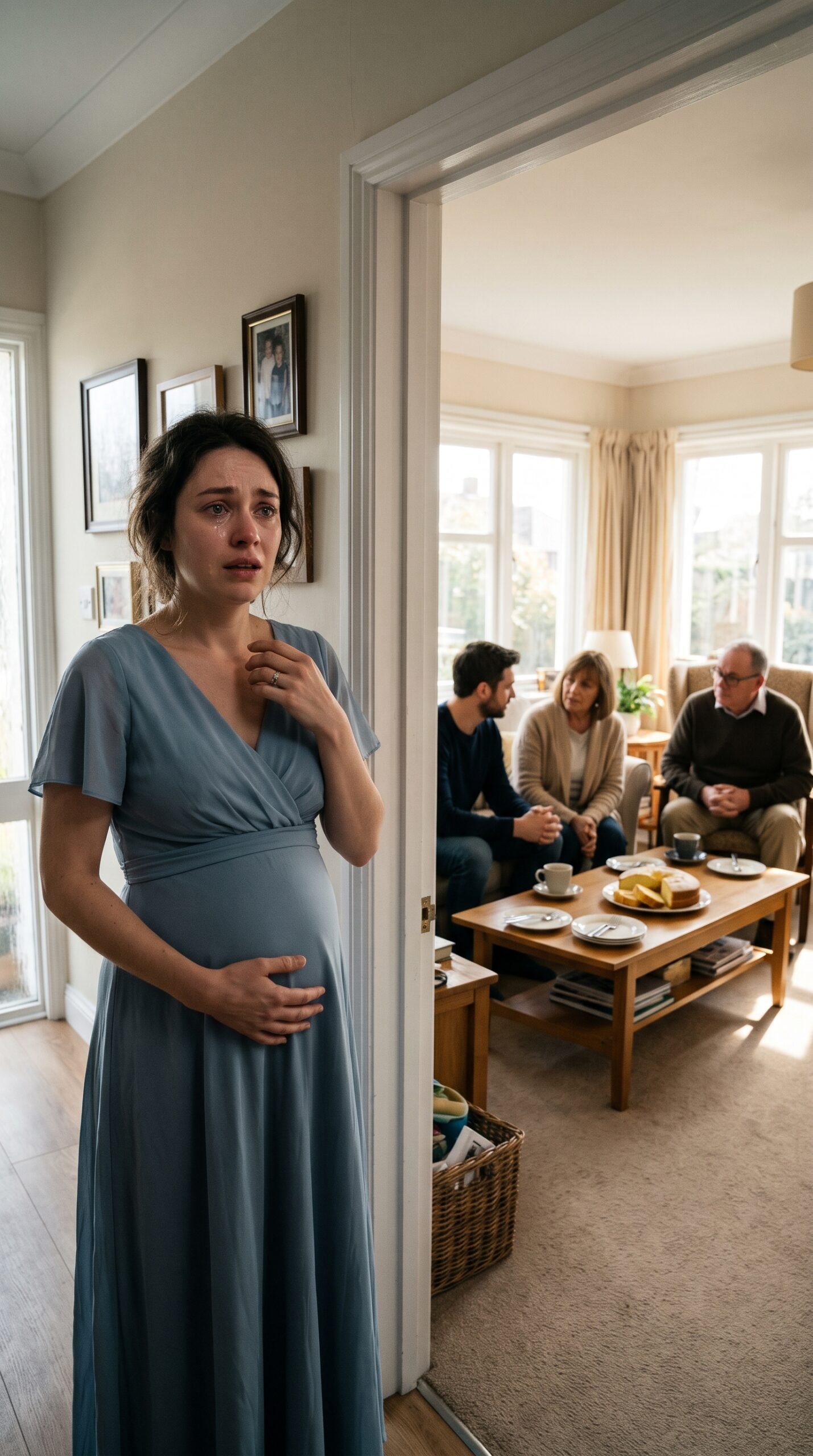
I should have walked away then. But I was thinking about the nightstand books and the two versions of coffee, and how a man who memorizes such small things had been quietly memorizing his fear for months, alone, because he did not want to burden me while I was carrying our daughter.
I stepped into the doorway.
All three of them turned. Daniel went white. “Clara. How long have you been…”
“Long enough,” I said. My voice shook. “Long enough to hear you say you would rather hate yourself for being afraid.”
“I didn’t mean for you to hear that.”
“I know.” I crossed the room, sat beside him on the couch, and took his hand. “Why didn’t you tell me?”
“Because you were so happy. You were glowing. I didn’t want to be the one who made it heavy.”
“Daniel.” I pressed his palm against my stomach, where Iris kicked as if on cue. “You are not going to be your father. You know why? Because your father never lay awake terrified of failing. You do. That fear is the proof.”
He broke then, completely, the way he had on the bathroom floor, and I held him while his parents looked on. George stood and came to us, and for a moment I wondered if he would speak. Instead he knelt, an old man with stiff knees, and put his hand over ours.
“Let me try,” he said quietly. “Not to fix the past. Just to be here for her. For both of you.”
Daniel nodded, unable to answer.
That night, driving home, we did not talk much. At a red light he said, “I’m sorry I kept it from you,” and I said, “I’m sorry I almost assumed the worst,” because it was true. I had stood in that hallway ready to believe the floor beneath me was gone. Instead I learned that love is not the absence of fear. It is the decision to show up inside it.
The following weeks changed us. Daniel started seeing a counselor, a gentle man named Dr. Whitaker, who helped him name what he had inherited and what he could choose to leave behind. I went to a few sessions with him. We practiced saying the unsaid things, the 3 a.m. ones, out loud, in daylight, where they lost some of their power. George started coming over on Saturdays to help finish the nursery, awkward at first with the paint roller, then quietly proud. Patricia knitted a blanket in soft yellow, and tucked a note inside: For Iris, who has already brought us all back together.
Iris was born on a gray March morning, eleven days early, with a full head of dark hair and a furious, wonderful cry. Daniel held her first, because I asked him to. I watched his face as he looked down at her, and I saw the fear and the love arrive at the same moment, neither one defeating the other.
“Hi, Iris,” he whispered. “I’m here. I’m not going anywhere.”
He kept that promise in a hundred ordinary ways. He learned the swaddle. He took the 4 a.m. shifts without being asked. He read her bad poetry and worse jokes, and when she was a few months old and screaming with colic, he walked the hallway with her for two hours, humming, refusing to hand her off even when I begged him to rest. “I want her to know,” he told me, “that someone always stays.”
George came to every birthday. He sat on the floor and built block towers with her and let her knock them down, and once, when Iris was three, she climbed into his lap and fell asleep there. He did not move for an hour, even when his leg went numb. When she woke, he looked at Daniel across the room, and nothing needed to be said.
Sometimes I think about that hallway, and how close I came to walking away from the sentence before the end of it. I think about how many of us do. We catch half a truth, build a whole betrayal around it, and never stay long enough to hear the rest.
I stayed. And what I heard was not the end of my marriage, but the beginning of a deeper one.
Iris is six now. She asks Daniel to tuck her in every night, and every night he says the same thing, softly, as he turns off the light.
“I’m right here.”
And he always is.