
“Before we discuss Mrs. Lawson’s injuries,” the man repeated, “I’ll introduce myself. I’m Richard Kessler, a forensic accountant with the state financial crimes unit. This is Detective Alana Ruiz, and Ms. Okonkwo here is from the district attorney’s victim advocacy office.”
Derek’s mouth opened, then closed. Patricia had gone rigid behind him in the hallway.
“Mrs. Lawson,” Ms. Okonkwo said, turning to Emily with a gentleness that made my eyes sting, “you don’t have to say anything tonight. We’re here to make sure you’re safe. Would you like to step outside with your mother?”
Emily looked at me. I nodded. She let go of the doorframe, and together we walked past Derek. He didn’t stop us. I think he couldn’t move.
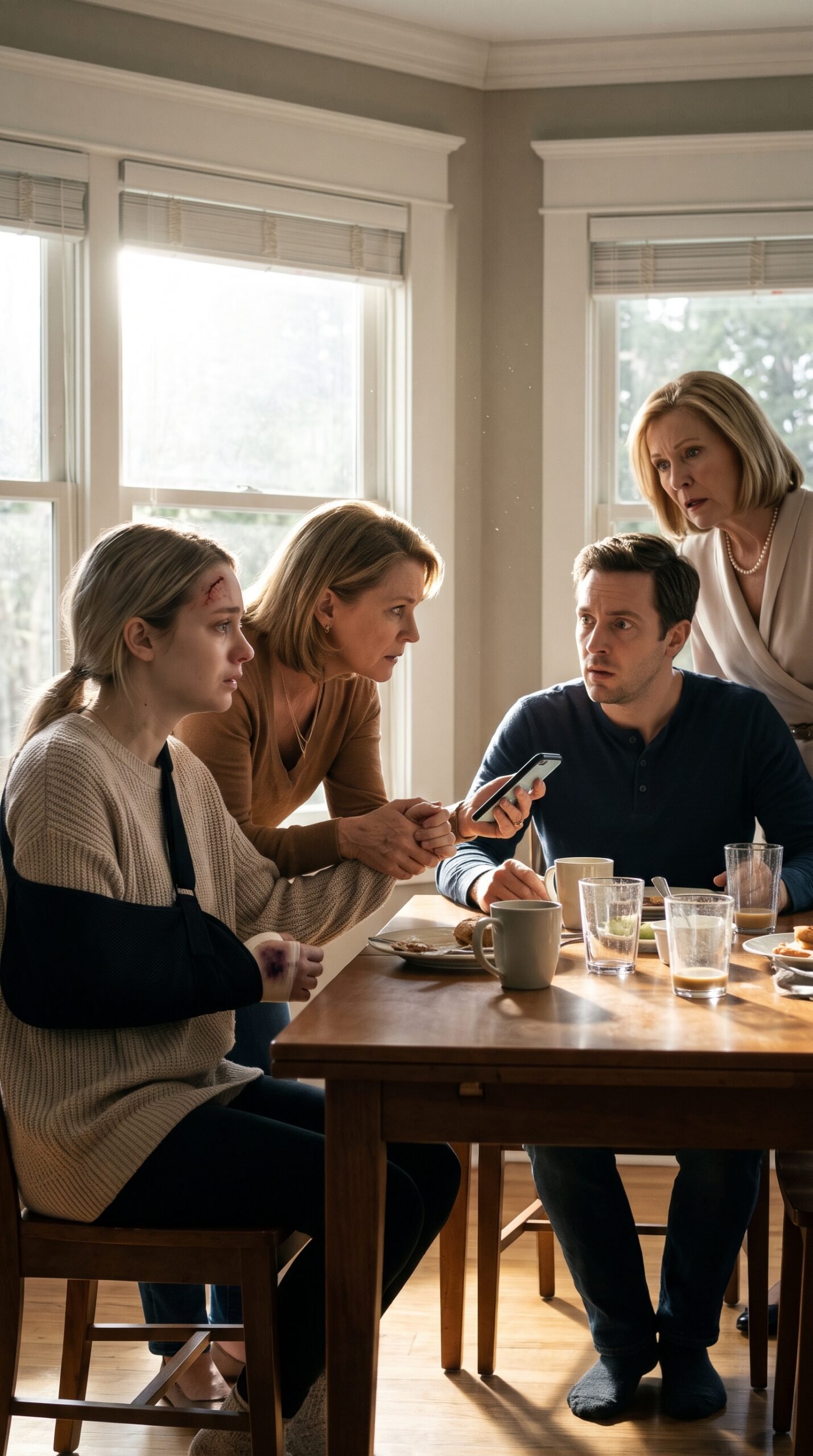
On the porch, the night air was cold and clean. A paramedic waited beside an ambulance I hadn’t noticed from the window. He examined Emily’s arm under the porch light and said quietly that it needed an X-ray. Detective Ruiz photographed the bruising on her wrist and the cut near her hairline, speaking softly the whole time, asking permission before every picture.
“Emily,” she said, “your mother brought us your records and your texts from the last year. Is there anything you want to add?”
Emily’s voice shook, but it came. “He broke it. Tuesday. He twisted it when I tried to leave the kitchen. I told the urgent care I fell.” She started crying. “He said if I told anyone, he’d make sure I never saw my kids again.”
The words went through me like cold iron. I wrapped my arm around her, and she leaned into me the way she had as a little girl after a nightmare.
Inside, the voices rose. Derek’s, high and sharp: “This is harassment. My mother-in-law is unstable, she’s been poisoning my wife against me.” Then Kessler’s, level as a ruler: “Mr. Lawson, I’d suggest you stop talking.”
Here is what I had learned over those three weeks. After Emily’s 2 a.m. call, I’d contacted a domestic violence advocate named Joan, who told me the first rule: never confront the abuser alone, and build a safety plan before anything else. Joan connected me with an attorney, and the attorney asked whether Emily had ever mentioned money. She had, once, offhandedly. Derek handled every account. He had opened a business consulting firm four years ago, and Emily had signed papers for it without reading them, because he’d said it was for taxes.
Emily had left copies of those papers in a shoebox at my house months earlier, saying only, “Just keep these for me, Mom.” I hadn’t understood why. Now I think some part of her had known.
The attorney showed them to Kessler. Within days, he found the pattern. Derek had been running client funds through the firm, money from retirees who’d trusted him with their savings, and moving it into accounts held in Emily’s name and his mother’s. If it collapsed, Emily would be the legal face of it. He hadn’t only hurt her. He had built a trap with her signature on every door.
Back in the house, Detective Ruiz read Derek his rights. I heard the click of the handcuffs from the porch. Patricia shrieked that this was a mistake, that her son was a good man, that no one had any proof of anything.
“Ma’am,” Ruiz said, “we have a recorded call, medical records, and financial documents. And we have your son’s own messages.”
Derek was led out in the same dress shirt he’d worn to dinner. He looked at Emily, and for a moment I saw him try on the old face, the wounded husband, the misunderstood man. It didn’t work. Emily met his eyes and didn’t look away.
“Don’t,” she said. Quietly. Steadily. The same word as before, but it meant something different now.
They put him in the cruiser. The door shut. Patricia stood in the doorway, small and gray, finally without an audience.
The next months were long. Emily’s arm healed in a cast, then a brace. She stayed with me, and her two children, Lily and Max, slept in my den on a pull-out couch, giggling about the “sleepover” until Lily asked one night why Daddy wasn’t coming. Emily knelt and told her the truth in words a seven-year-old could carry: that Daddy had hurt Mommy, that it wasn’t okay, and that grown-ups were making sure it wouldn’t happen again. Lily thought for a while and said, “Can I draw him a picture anyway?” I’ve never been prouder of my daughter than I was in that moment, for not teaching her children to hate.
The case moved faster than I expected. The financial evidence was overwhelming. Kessler’s team traced more than six hundred thousand dollars from eleven clients. Derek pleaded guilty to felony assault, coercive control, and multiple counts of fraud. The judge sentenced him to nine years. Patricia was charged with conspiracy for knowingly receiving funds, and accepted probation and restitution. The retirees recovered most of what they’d lost, in part because Emily cooperated fully and turned over every document she’d kept.
I will remember the courtroom for the rest of my life. When it was time for Emily’s statement, she stood without notes. She told the judge that for four years she’d believed marriage meant being quiet. “I thought love was something I had to earn by being smaller,” she said. “I was wrong. My mother showed me the door was never locked. I was just too afraid to look.”
I cried then, silently, in the second row.
Afterward, outside the courthouse, Emily hugged me so hard it hurt, and I didn’t mind.
“Mom,” she said. “That call you made. At dinner. How did you know it was time?”
“I didn’t,” I admitted. “I only knew that if I waited for you to ask, you might never be able to. Sometimes love has to knock on the door before anyone opens it.”
We moved Emily into a small rental near me with a bright kitchen and a yard for the kids. She went back to school for her accounting certificate, the very thing Derek had told her she’d never be smart enough to do. She finished first in her class. Last spring, she took a job with a nonprofit that helps survivors untangle financial abuse, spreadsheet by spreadsheet, signature by signature.
On Sundays, we still have dinner. The table is loud again. Plates clatter, Max argues over rolls, Lily draws on napkins, and someone always laughs too loudly. Emily laughs the loudest. Her left wrist has a faint scar, a pale line she no longer hides under long sleeves.
Last week, she caught me watching her across the table.
“What?” she asked.
“Nothing,” I said. “Just listening.”
She smiled and passed me the rolls, and I understood that this was the sound I had been waiting for all along: not silence, not fear, but my daughter’s voice, unafraid, filling the room.