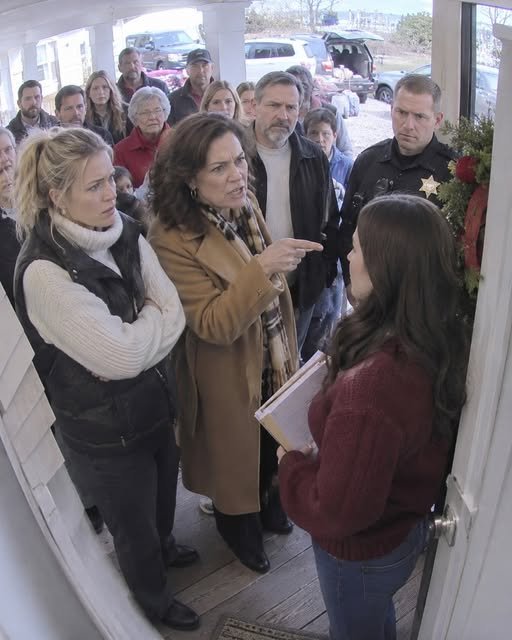
“Margaret can come in,” I said. “So can anyone who wants to sit down and talk without lying. Everyone else is welcome to leave, and I’ll hold no grudge against anyone who does.”
I stepped aside.
Margaret climbed the porch steps slowly and squeezed my arm as she passed. “Eleanor would be proud of you,” she murmured. “She was always afraid you’d take after your mother’s side. You took after hers.”
One by one, six relatives followed her inside. Two cousins. An elderly uncle. A pair of teenagers who looked mortified. Hannah hesitated at the foot of the steps, her eyes shining.
“Layla, I don’t know what to say.”
“You don’t have to say anything yet.”
“Can I come in?”
I looked at her for a long moment. She had my grandmother’s chin and my father’s way of tilting her head when she was unsure. We had shared a mother and almost nothing else.
“Yes,” I said. “But not to take sides. Just to sit.”
She nodded and came in.
Rebecca stayed in the driveway. For almost ten minutes, she did not move. Thomas loaded the presents back into the trunk of the BMW. Deputy Brooks, who had said nothing since the roof comment, stood at a respectful distance with his hands folded.
Finally my mother walked to the porch. The camel coat looked wrinkled. The confidence had gone out of her shoulders.
“Layla,” she said. It was the first time she had said my name without sharpness. “May I speak with you? Alone?”
I glanced at Brooks, who gave a small nod. I stepped out and shut the door behind me.
We stood on the porch where Grandma and I had once sat together, with the gray winter ocean spread out ahead of us, rolling and indifferent.
“I took the money,” Rebecca said. She did not look at me. “I told myself I’d put it back. Gregory’s business was failing and I thought if I just bought us six months, everything would work out. It didn’t. And then you found out, and Eleanor looked at me the way she did, and I couldn’t stand it.”
“The way she did?”
“Like she’d always known what I’d do.” Her mouth trembled. “You have your father’s eyes. Every time I looked at you, I saw him asking me what I’d done with his daughter’s future. It was easier to be angry at you than at myself.”
I had waited fifteen years to hear a version of this. I had imagined it in a hundred different ways, some with tears, some with shouting, some with a grand dramatic reconciliation. In the end, it was just my mother, small and tired, telling me the truth in a voice she had never used.
It did not heal me. I want to be honest about that. Some wounds do not close because someone finally names them. But something that had been clenched in my chest since I was seventeen, ready for a fight, loosened a little.
“Thank you for saying it,” I said. “I mean that.”
“Will you ever forgive me?”
“I don’t know.” I let the answer sit between us. “I’m not going to pretend I do, and I’m not going to promise something I can’t deliver. But I’ll tell you what I can do.”
She waited.
“The house is mine, and I’m keeping it. Thomas and Hannah are going to be repaid for the roof and the renovations. I’ll handle that myself. Not because I owe them, but because it’s the right thing.” I took a breath. “You can visit. Not on holidays, not with a key, not with an audience. You can call first and come for lunch. If it goes well, we’ll try again. If it doesn’t, we’ll know.”
Her eyes filled. “That’s more than I deserve.”
“Maybe,” I said. “But Grandma would have wanted me to offer it.”
She nodded once and walked down the steps without another word. Thomas helped her into the SUV. As they pulled out of the driveway, Hannah watched from the window, one hand pressed to the glass.
Inside, the living room smelled like cinnamon and wood smoke. I had spent the morning baking, half-expecting to eat alone. Instead, eight people sat around a table meant for twelve, passing plates, nobody quite sure what to say.
Margaret raised her cup of tea. “To Eleanor,” she said.
“To Eleanor,” we echoed.
That evening, after everyone had gone, I found a last envelope in the drawer of the old writing desk, the one Jonathan had told me to open only when I felt ready. The handwriting was Grandma’s, shakier than ever.
My dearest Layla,
If you are reading this, you have done the hardest thing, which is to stand in your own home and refuse to be small. I am sorry I could not fix this while I lived. I was a coward in my own way. I thought time would soften your mother. Time only hardens people who do not look at themselves.
The house is not a weapon. Please do not use it as one. It is a door. Decide who gets to walk through it, and let it be someone who comes because they want to, not because of what they might inherit.
I paid you back the money, but I could never repay you for the years. This house is my attempt. The waves will tell you the rest.
All my love, Grandma.
I read it three times, then sat on the back porch in the dark, listening to the ocean.
The following Christmas, I opened the house to anyone who wanted to come. Hannah arrived early with her husband and a tray of cookies, and she stayed to help me hang the stockings. Margaret returned with her cane and her sharp opinions. Even Rebecca came, for two hours, with a store-bought pie and an awkward, honest hug.
It was not a perfect Christmas. Nothing is. But for the first time in fifteen years, I stood in that living room beside a sparkling tree, in a house that smelled like pine and salt, and nobody had to ask whether I belonged.
I was already home.