The truck smelled like coffee and old vinyl. On the passenger seat sat a manila folder and Del’s reading glasses, folded on top like he’d meant for someone to find them.
I opened the folder. I’m not proud of that, either.
Inside were forty-one pages of handwritten notes in Del’s blocky carpenter print. Dates, times, and short lines like Tues. Ida in good spirits. Ate half a sandwich. Thurs. Bad night. Asked for Ruthie twice. At the back was a stack of receipts, all stamped Desert Willow Memory Care.
I read the name three times.
Then I walked into the low tan building with my coat over my nightgown, and a nurse looked up from the desk and said, “You must be Ruthie.”
Her name was Pam. She poured me a coffee and told me to sit.
“Your husband has been coming here three mornings a week for six years,” she said. “Tuesday, Thursday, Saturday. He brings donuts for the night shift.”
“Here? Why would he come here?”
Pam studied me. “Mrs. Barlow, who do you think he’s been visiting?”
I didn’t answer. I couldn’t.
“Your mother was admitted to our assisted wing six years ago,” Pam said gently. “Then she moved to memory care, three years back. Early Alzheimer’s, diagnosed right after you left for Tucson. She made your husband promise he wouldn’t tell you.”
The room tilted.
“Mama died in her bed. In her stucco house.”
“No, honey.” Pam’s eyes filled. “She died here, Wednesday before last, at 4:10 in the morning. Your husband was holding her hand. He arranged for her to be moved to the house afterward, and he had the doctor sign the papers. She wanted to be found at home. She said you’d handle it better that way.”
I put my hand over my mouth.
Del came out of a room at the end of the hall, carrying the empty pink donut box. He saw me and stopped like a man who’s walked into a wall.
“Ruthie.”
“Del Barlow,” I said, and my voice cracked in the middle of his name. “You’ve been lying to me for six years.”
“Yes, ma’am.”
“Mama’s bridge games. The cat. The bruise.”
“The bruise was a fall,” he said quietly. “She got lost walking to the mailbox. The neighbor found her. That was the first time.”
“And you let me think…”
“She asked me to.” He set the box down on a chair. His hands were shaking. “Ruthie, the day you left for Tucson, your mother called me at the shop. She said, ‘Del, I’m losing my mind, and I know it. Don’t you dare tell Ruthie. She’s got a sick baby to look after.’ And then she said…” He stopped.
“Said what?”
“She said, ‘You’re the only one I can trust to do it right. You’re the only one who ever told me no.'”
I stared at him.
“We’d hated each other for so long, it was safe,” Del said, with a small, wretched laugh. “She figured I’d never go soft on her. She was right. First week, I made her take her pills, and she called me a jailer. Second week, I found her crying in the yard because she couldn’t remember our address, and I sat down in the dirt beside her.”
I sat down in the chair next to the donuts, because my knees wouldn’t hold me.
“The money,” I said. “The checkbook. I balanced it every month.”
“Your mother did that with a ruler and a magnifying glass until she couldn’t read numbers anymore. After that, I paid her bills from our savings, and I brought you the statements she’d already marked up, so you wouldn’t see anything wrong.”
“The Social Security…”
“Went into her account on the third, like always. It paid for this place. We covered the difference.”
“We?”
He looked at his boots. “I took on weekend jobs. The Hendersons’ deck. Mrs. Pruitt’s fence. Anything cash. Six years of Saturdays, Ruthie, and I told you I was at the Home Depot.”
I thought of the mileage book. The truck that never carried a single bag of screws.
“And the paper in her casket?” I whispered. “What did it say? What did you promise her?”
Del took a long breath. From his shirt pocket he drew a second sheet, folded in thirds and soft as cloth, and handed it to me.
It was a carbon copy. The original, he said, lay under Mama’s hands in the ground.
It was in Mama’s own shaky, slanting writing, the last she’d managed, dated a week before she passed:
Del. I know what happened in 1986. Ruthie told me herself, the night before she left for Tucson. She cried and cried. I said I forgave her, and I forgot, because that’s the thing about this sickness. But I remembered it again last night, clear as a bell. I let you carry the blame for forty years because you were stubborn enough to take it. Tell Ruthie she was never in trouble. Tell her I was proud of her every single day. And tell her I’m sorry I called you a thief. You were the best son-in-law a difficult woman could have. — Ida
My vision swam.
“She remembered,” I said. “She knew.”
“For one night.” Del’s voice was thick. “I wrote it down while she dictated it to me. She said I should put it with her when she went, and I should never let you read it unless you asked. She said you’d carry that old lie like a stone until the day you died, and she wanted you to be able to set it down.” He swallowed. “But I couldn’t stand to give it to you while you were grieving. So I put it in the casket. And I told her, ‘Nobody’ll ever know. I promise.’ Because that was her secret to tell, not mine.”
“Nobody was supposed to know about the memory care,” I realized.
“Nobody was supposed to know she’d been sick at all. She was too proud, Ruthie.”
I cried then, a way I hadn’t cried at the funeral, loud and ugly, with a nurse patting my shoulder and a janitor politely pretending to mop somewhere else. Del knelt in front of my chair, a big, tired man with sawdust in his knuckles, and I put both arms around his neck.
“I’m so sorry,” I said into his collar. “Forty years you let her hate you for my lie.”
“I’d have let her hate me forty more.”
“Why?”
He smiled, wet-eyed. “Because it made her happy to have somebody to be mad at. And because I loved you. That’s all it ever was.”
Pam led us down the hall to Mama’s old room, which had not yet been cleared. On the windowsill sat a chipped bridge-score pad, her reading glasses, and a Polaroid of the three of us at some long-ago Thanksgiving. Mama and Del stood at opposite ends of the frame, glaring, and I stood in the middle holding a basket of rolls.
On the back, in Del’s print, was one line: Our best day.
“She kept it by her bed,” Pam said. “She told me, ‘That Okie’s the only man who ever argued with me and meant it kindly.'”
I laughed, and then I was crying again.
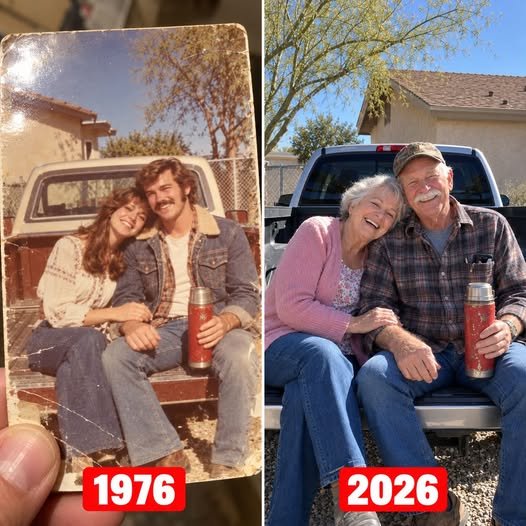
We scattered a little of Mama’s garden dirt over her grave that spring, and Del planted her favorite yellow roses at the foot of the stone. He still goes out Tuesday, Thursday and Saturday mornings, but now I ride along with a thermos of coffee, and we sit on the bench beside her, and I tell her about my route and my grandson and the new neighbors.
Sometimes, Del argues with her about politics, out loud.
I let him.
I still sell Avon, though most of my ladies are gone now. When someone calls me Ding-Dong Ruthie, I smile and answer to it, because I finally understand that the people we spend our lives bickering with are often the ones who love us in ways too awkward to say.
Mama called him “that Okie.” Del called her “the Colonel.”
They were, I think, the two best friends I ever had, and neither would have admitted it for all the tea in China.
The End.