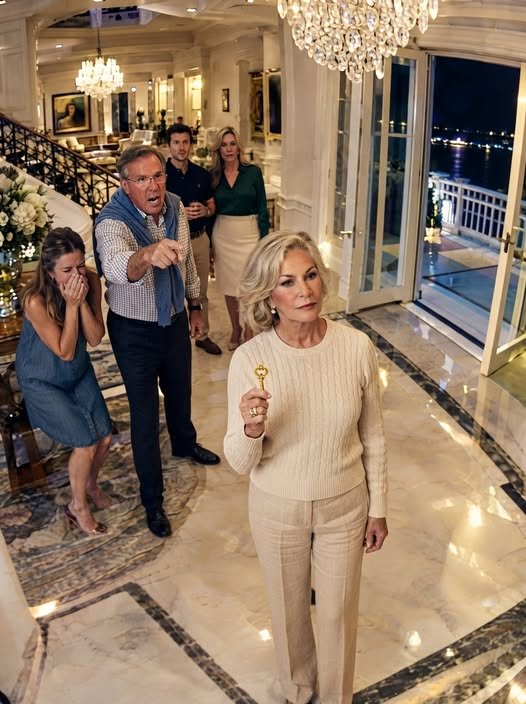
By the morning of December 23rd, I was in Palm Beach.
I had never told Harrison about the estate. Not out of spite, but out of a lesson learned the hard way. Eight months earlier, my late husband’s brother, a quiet real estate investor named Walter, had died childless and left me everything. The beachfront house, a portfolio of commercial properties, and a letter in his shaky handwriting: Clara, you gave up too much for everyone else. Spend some of this on yourself.
I kept my apartment and my coupons. I wanted to know, just once, how my family would treat me when they believed I had nothing.
Now I knew.
I spent two days in that enormous house, barefoot on cool marble, listening to the Atlantic. I cried the first night. Not for the money, but for the boy who used to fall asleep on my shoulder reading Charlotte’s Web, and for the man who had grown into someone who could say “You’d ruin the vibe” to his mother without flinching.
On the second night, I made a decision. I would not punish them. But I would no longer pretend.
I called a caterer, a florist, and a string quartet. Then I called Harrison’s father-in-law, Gerald Whitmore.
I had met Gerald twice. He was a retired bank executive who loved hearing himself talk, and he had always been polite to me in the distracted way of a man who hadn’t really looked. When he answered, I said, “Gerald, this is Clara, Harrison’s mother. I’m hosting Christmas Eve at my home in Palm Beach, and I’d be honored if you and Margaret came. Please bring Eleanor and Harrison and Mason too.”
There was a long pause. “Your… home?”
“Yes. I’ll text the address. Dinner is at seven. It’s formal, of course.”
I ended the call before he could ask anything else.
Eleanor called me eleven times that afternoon.
I let them ring. At 5:40, I finally answered once.
“Clara, what is this about a Palm Beach address?” Her voice was thin and tight. “My father says it’s a fifteen-million-dollar property. Is this some kind of joke?”
“Not at all.”
“Whose house is it?”
“Mine.”
“That’s impossible. You live in…”
“An apartment I like very much. And a house I inherited. Both are mine. Dinner is at seven, Eleanor. Do wear something elegant. I’d hate for you to feel out of step.”
I hung up. I stood in my kitchen, with its wide windows, its marble island, and its gleaming brass fixtures, and I realized my hands were steady.
They arrived at 6:55, in two cars, looking like people who had been told the ground beneath them had shifted.
I met them at the front door in a deep emerald gown, my silver hair pinned up, Walter’s pearls at my throat. Behind me, the great room blazed with candlelight. A twelve-foot tree glittered in the corner, and the quartet played softly near the windows.
Gerald’s mouth fell open. Margaret clutched her purse. Harrison stared at me as though I’d been replaced by a stranger, and Eleanor, in her cream cashmere, couldn’t seem to blink.
“Welcome,” I said warmly. “Please, come in.”
Mason broke free from his mother’s hand and ran across the marble. “Grandma!” He crashed into my legs. I knelt, ignoring the gown, and held him.
“I missed you so much,” he whispered.
“I missed you more, sweetheart.”
Dinner was exquisite. The chef served lobster bisque, rack of lamb, and a pear tart. Gerald praised everything loudly and kept glancing around the room at the art on the walls, the vaulted ceiling, and the ocean beyond the glass. Margaret asked three times whether I’d had the house long.
“A few months,” I said. “Walter left it to me.”
“Walter?” Eleanor said faintly.
“My brother-in-law. You met him once, Harrison. At the funeral.” I smiled. “He owned quite a bit of property, it turns out. Commercial buildings in four states. I’m still sorting through it.”
Silence settled over the table like a dropped fork.
Harrison set down his glass. His face was gray. “Mom,” he said. “Why didn’t you tell me?”
“Because I wanted to see something,” I said, quite gently. “I wanted to know whether I was welcome at your table as your mother, or only as someone with something to offer.”
No one spoke for a long while. Even the quartet seemed to hush.
Then Mason, seven years old and blind to every adult subtlety, said into the quiet, “Grandma, why couldn’t you come to our house for Christmas?”
Eleanor’s face went white. Harrison looked at his plate.
“Because some grown-ups made a mistake, sweetheart,” I told him. “It happens. People forget what matters.”
Harrison stood. His chair scraped. He walked around the table and, in front of his in-laws, his wife, and his son, dropped to his knees beside me.
“Mom, I’m so sorry.” His voice broke. “I was ashamed of the wrong thing. I let Eleanor decide who deserved a seat at our table, and I let her decide it was you, because it was easier than telling her no. You never asked for anything. You raised me alone after Dad passed, and I treated you like an inconvenience.” Tears ran down his face. “I don’t care about the house. I don’t care about any of it. I just want my mother back.”
I looked at him for a long moment. I saw the boy and the man, and I knew they were both still in there.
“I don’t need your apology because of this house, Harrison,” I said. “I need it because I’m your mother. If you’d said those words in my little apartment, they’d have meant exactly the same.”
“I know,” he whispered. “I know that now.”
Eleanor sat very still. When she spoke at last, her voice was small.
“Clara. I was cruel to you. I told myself it was about my parents, about manners, about… style. It wasn’t. I was embarrassed by you because I was embarrassed by myself. My family has always cared too much about appearances.” She swallowed. “I’m sorry. I don’t expect you to forgive me tonight.”
Gerald cleared his throat and, for the first time since I’d known him, looked humbled. “Clara, I owe you an apology as well. I knew about the arrangement. I should have said something.”
I looked down the long, candlelit table, at faces that were finally unguarded.
“Thank you,” I said. “All of you. Apologies matter to me more than any estate. But I want to be clear about something. I won’t be a guest in my own family’s life. Not anymore. If I’m at your table, I’m there as your equal, and so is every person I love.”
“Of course,” said Eleanor quickly. “Always.”
It took time. Forgiveness isn’t an event, it’s a practice. Harrison and I had dinner every Sunday that spring, just the two of us, until the awkwardness thinned into something warmer. Eleanor sent me a handwritten note every month, small and unpolished, and eventually I started answering them. Mason spent every school vacation at the beach house, building sandcastles with me and learning to identify shorebirds.
The next Christmas, I hosted again in Palm Beach, and this time, the invitation list was different. Harrison and Eleanor brought Mason and a casserole dish of Eleanor’s own, slightly burned, which Mason declared the best thing he’d ever eaten. Gerald and Margaret came too, and Gerald, to my astonishment, volunteered to wash the dishes.
I wore my old moss-green dress.
Eleanor noticed. She caught my eye across the room, and instead of flinching, she smiled and said, “It’s beautiful on you, Clara.”
I think she meant it.
Before the guests left that night, I stood alone on the terrace, listening to the surf. I thought about the woman standing in that galley kitchen with a gold key and a chipped mug, hearing her son tell her not to come.
I wanted to tell her that she hadn’t needed the house to matter. That her dignity was never in the marble or the pool or the thousand small luxuries. It lived in her patience, her restraint, and her stubborn heart that still believed in second chances.
The house had only revealed what was already true.
Mason found me there, tugging my sleeve. “Grandma, will you tell me the story about Charlotte again?”
“Of course, my darling.”
I took his hand, and we went inside together.
The End.