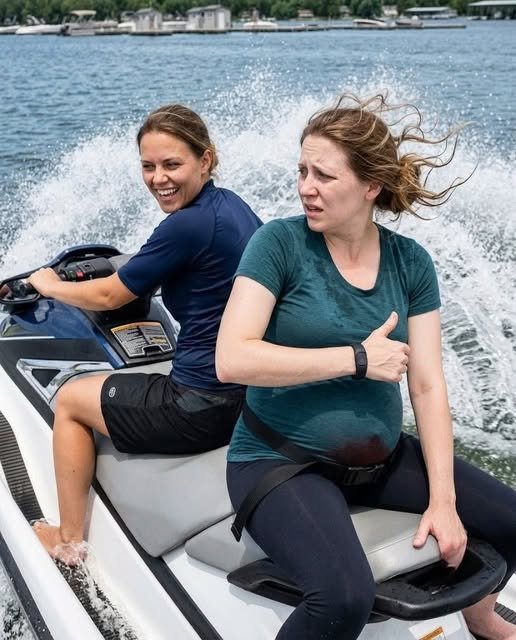
Victoria’s hand slammed the brake, but it was too late for her. The cutter’s bow wave rolled across the bay, and two Coast Guard rescue swimmers hit the water before her engine had even died.
“Ma’am, we’ve got you,” a voice said close to my ear. A blade sliced through the zip ties. Hands lifted me off the jet ski as if I weighed nothing. “Stay with me. How far along are you?”
“Nine months,” I gasped. “I’m bleeding. Please, my baby…”
“Medics are aboard. You’re going to be okay.”
Over the swimmer’s shoulder, I saw Victoria raise both hands in the air, her icy smile gone. A Navy helicopter hovered above her, its downdraft whipping the water into spray.
On the dock, Julian’s scotch glass slipped from his fingers.
I don’t remember the flight to the hospital in Cabo, only pieces of it. A paramedic pressing a mask to my face. The pounding of rotors. My father’s voice on the watch, steady as a ship’s keel, saying, “I’m landing in forty minutes, Genevieve. Do not you dare leave me.”
My daughter was born at 3:12 that afternoon, by emergency cesarean, four weeks of my fear compressed into twelve minutes. They told me later that her heart rate had dropped twice. They told me that the placenta had partially detached. They told me that if the Coast Guard had arrived twenty minutes later, they might have been telling me something else.
When I woke up, my mother was sitting beside the bed with her pearl earrings in and mascara streaked to her jaw.
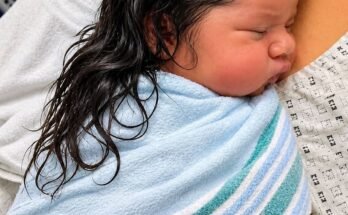
“She’s in the NICU,” she said, before I could ask. “Five pounds, one ounce. She’s breathing on her own. She has your father’s stubborn chin.”
I cried so hard the nurse came running.
My father stood at the foot of the bed in civilian clothes, but nobody in that hospital mistook him for a civilian. Two officers from the Mexican Navy waited in the hallway, and a pair of federal agents from the U.S. consulate flanked the door.
“Tell me everything,” Dad said quietly. “Start from the capsules.”
I did. The white pills. The water bottle. Julian’s kiss on my forehead.
A toxicologist later confirmed what I’d suspected: a heavy sedative, far past anything in a prenatal vitamin, mixed with a second compound that slows the body’s ability to resist. Enough to put a healthy adult under for hours. Enough, in a woman at the end of a high-risk pregnancy, to be lethal.
“He meant for me to drown,” I said. “He meant for it to look like an accident.”
“A pregnant woman, sedated, on a jet ski she insisted on riding,” Dad said. “Twenty witnesses who’d heard him say ‘get on.’ It would have been tragic. It would have been convenient.”
I understood then what the whole retreat had been for.
The investigation took six weeks, and it was thorough, because my father had friends who did not do anything halfway.
Julian’s company, Vance Logistics, had been losing money for two years. What I hadn’t known was how much he’d hidden. He’d borrowed against inflated contracts, forged revenue reports, and quietly drained the accounts of two investors. The “quiet” money I’d put in over the years, funneled through a holding company I thought was protecting him from embarrassment, had been spent on Victoria. Her condo. Her car. A six-month lease on an apartment in Houston where they met.
He’d also taken out a life insurance policy on me, for eight million dollars, eleven weeks before the retreat.
The beneficiary was Julian.
The signature on the application was not mine.
“He didn’t need my family’s money after all,” I said, when the agent laid the paperwork in front of me. “He just needed me gone.”
“He thought he’d get both,” the agent said. “He had no idea who your father was. Or what your mother’s trust documents say about spousal claims.”
Victoria broke first.
She was held in a Mexican detention facility for four days before being transferred to U.S. custody, and by the second morning she had asked for a deal. In her statement, she described the plan in flat, clinical detail. The sedatives came from Julian. The jet skis had been rented under a false name. The binoculars were so he could confirm the “incident” from a distance and appear shocked.
She also said something that made my mother put her hand over her mouth.
“Julian told me you’d lose the baby either way,” Victoria said on the recording. “He said it would be a blessing, because a child would make it harder to leave you.”
Victoria was convicted of conspiracy to commit murder, attempted murder, and fraud. She was sentenced to twenty-two years. At sentencing, she looked across the courtroom at me with an expression I’d expected to be rage and found instead to be fear. I felt almost nothing. That surprised me.
Julian’s trial lasted eleven days.
He appeared in a navy suit that hung loosely on him, a man who had gone, in a matter of weeks, from boardrooms to a cell. His lawyer tried to argue that Victoria had acted alone, that the sedatives were an “unfortunate mix-up,” that a husband could hardly be blamed for a mistress’s cruelty.
Then the prosecutor played the recording.
It was from the dock. A bystander’s phone had caught the moment Julian raised his binoculars and, in his own voice, muttered to a colleague standing next to him: “Come on, come on. Just a few more minutes.”
The courtroom went silent.
When the jury returned, it took them less than four hours. Guilty of attempted murder, conspiracy, insurance fraud, forgery, and financial crimes. The judge sentenced him to thirty years, without parole eligibility for twenty.
As the bailiffs led him away, he turned his head toward me for the first time in two months.
“Genevieve,” he said hoarsely. “Our daughter…”
“Doesn’t have a father,” I said evenly. “She has a family.”
We named her Eleanor Grace, after my grandmother and for the grace that had held on when I couldn’t. She came home from the NICU after nineteen days, so small that my father, a man who had commanded warships, held her as though she might break.
“Four stars,” my mother teased him. “And this is the one that scares you.”
“Don’t tell anyone,” he said, without taking his eyes off her.
I filed for divorce from my hospital bed, and it was granted before Julian’s sentencing. The court terminated his parental rights. My trust attorney and the federal prosecutors recovered what they could of the stolen investor funds, and the rest I paid back myself, from the trust Julian had never known existed. Two investors who had lost everything received their money, with interest, and a handwritten apology from me for having been married to the man who took it.
I sold the house I’d shared with Julian. I moved with Eleanor to a quiet property near my parents, on a hill above the water, where the nearest jet ski is nine miles away.
On Eleanor’s first birthday, my father brought me a small box.
Inside was the watch, the same one, with its hidden button. A new band, a new battery, and an engraving on the back.
For the day you needed us. We came.
I turned it over in my hands.
For ten years, I had hidden who I was, trying to find a man who would love me without knowing what I had. I’d been so afraid of being valued for my family’s name that I’d missed the person standing in front of me.
I would not make that mistake again, with anyone, and I would teach my daughter never to make it either.
I fastened the watch around my wrist and carried Eleanor out onto the porch. The sea below was calm and silver and nothing like the water that day.
“Hold on tight, sweetheart,” I whispered to her, and she gripped my finger in her small fist.
This time, nobody laughed.