I let him in. I still don’t know why, except that the face in that photograph was Claire’s, and no one could have faked the way she was laughing.
His name was Nathan Brooks, and he sat on my worn living room sofa with his knees almost touching the coffee table, glancing at the peeling paint without a trace of judgment. He held the envelope in both hands like it might break.
“Mrs. Hale, my sister didn’t die the way you were told,” he said. “I mean, the accident was real. But the reason she was on that road wasn’t what you think.”
My throat went dry. “Go on.”
“Our family is old money, the kind that keeps its secrets in leather folders. My grandmother, Margaret, was the head of it. When Claire was twenty-three, she fell in love with your son, a carpenter’s boy who taught shop class. My grandmother forbade it.”
“Daniel never told me,” I whispered.
“Claire never told him everything either. My grandmother threatened to cut her off. Claire chose Daniel anyway, and she left with one suitcase. She changed her last name, she cut contact, and she never asked for a cent.” Nathan smiled sadly. “She was the bravest person I ever knew, and I was too much of a coward to follow her.”
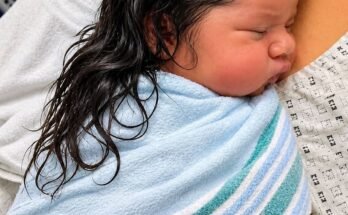
He slid out a second photograph. Claire, younger, was standing on a porch with a sleeping baby in her arms. Ellie.
“I found that in her old room last month. She’d mailed it to my grandmother right after Ellie was born, with no note. My grandmother kept it under her pillow for four years.”
“The night of the accident,” Nathan continued, “Claire and Daniel were driving to my grandmother’s estate. Margaret had suffered a stroke that week, and she’d asked for Claire. Just once. Claire had decided to forgive her, and Daniel agreed to go. Ellie was at your house that night, remember?”
I did. They had kissed her goodnight on my doorstep. Claire had held her an extra long time.
“They never made it,” Nathan said, his voice cracking. “A truck ran a red light on Route 9. It wasn’t anyone’s plot. It was only terrible luck. But my grandmother didn’t learn about it for two weeks. The rest of the family hid it, because her heart was failing. By the time she found out, she didn’t know where to look. The only name she had was Claire’s married name, and nobody knew the town.”
“You searched for three years.”
“We hired investigators. Every Daniel Hale in four states.” He laughed weakly. “Turns out your son went by ‘Danny’ on every document.”
I almost laughed too. He had been Danny since he was two.
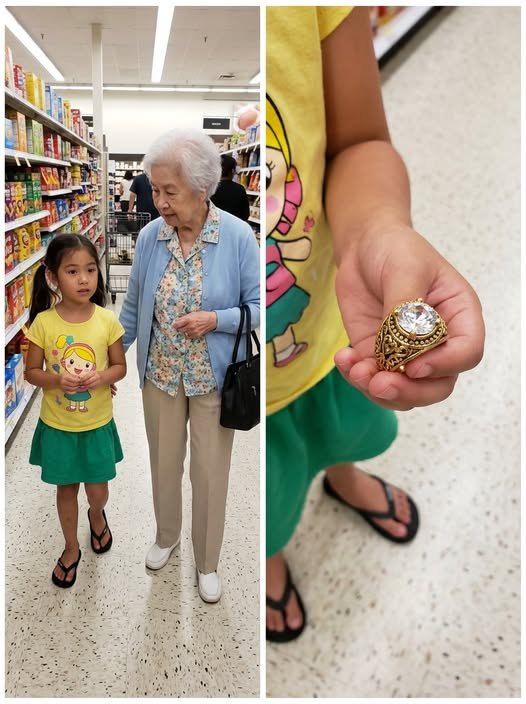
“And the ring?” I asked. “That woman in Walmart…”
“My cousin Vivian.” Nathan’s expression darkened. “Margaret’s will left the ring to Claire’s firstborn. She wrote it herself, in her own hand, before she died eight months ago. She also set up a trust. Not millions of dollars, Mrs. Hale. Tens of millions.”
I gripped the arm of my chair.
“Vivian is the executor’s assistant. She was supposed to take the ring to a vault. She told us she’d lost track of Ellie’s whereabouts, which was a lie. She’d found you weeks ago through a private investigator, and she was keeping it quiet. If Ellie was never found, the trust would revert to the rest of the family, and Vivian’s father would receive most of it.”
“The phone call,” I breathed. “She turned white when she answered it.”
“That was her father, Raymond. He’d been tracking her phone. When Ellie found the ring in that store, Vivian had dropped it on purpose, trying to slip away from him. She’d been having second thoughts.” Nathan shook his head. “She couldn’t go through with it. Your granddaughter handed it back, looked her in the eye, and shamed her more deeply than anything I could have said.”
“Ellie didn’t know…”
“No,” he agreed. “That’s what made it work.”
Vivian had called Nathan from her car that night, sobbing. She confessed everything: the lies, the investigator, the plan. “A seven-year-old girl returned a diamond worth a hundred thousand dollars,” she’d said, “and then asked if I was okay.”
Nathan had driven through the night.
“Raymond has been dealt with,” he said quietly. “Our attorney filed this morning. Vivian gave a full statement, and she’s cooperating. She wants to apologize to you and Ellie in person, if you’ll let her. But I’ll understand if you don’t.”
I stared at my hands for a long while.
“What does Ellie get?” I finally asked. “I’m not asking about the money. I’m asking what she gets that’s real.”
Nathan’s eyes grew wet. “A family. Two cousins her age. An aunt who’s a pediatrician. A grandfather’s grave to visit, and a great-grandmother’s letter.” He opened the envelope one last time and pulled out an ivory page, folded in thirds. “And this.”
The letter was in an old woman’s careful script. I read it aloud later, at the kitchen table, with Ellie in my lap eating cereal.
To my great-granddaughter, whose name I do not know,
I was wrong, and I am ashamed. I loved my family’s name more than I loved my own granddaughter, and I lost both of them. Your mother was braver than I ever was. If you are reading this, someone kind has found you. Whatever I leave you, it is not enough to repay what I took from you. Be like her. Choose love over everything.
— Your great-grandmother, Margaret
Ellie listened without a sound. When I finished, she looked up at me with serious eyes.
“Grandma? Was she the lady in the picture?”
“Yes, baby.”
“Was she sad?”
“I think so. For a long time.”
Ellie considered this. “I’m glad we gave the ring back,” she said. “Then she could send us the letter.”
I kissed the top of her head and could not speak.
The legal part took months. The trust was real. It was held in Ellie’s name, with me as her guardian until she turned eighteen. I was careful, and I hired my own attorney. I wasn’t going to hand my granddaughter’s future to people because they wore good suits.
The first thing I paid for was the roof. The second was my medication, a full year’s supply, which I cried over in the pharmacy parking lot. The third was a pair of pink sneakers for Ellie, which she wore until they fell apart.
We stayed in our house. The paint is fresh now, and the heater runs quietly. Ellie asked to keep her bedroom exactly as it is, with its crooked shelves and its window that looks over the maple tree.
Vivian came in the spring, shaking, holding a bouquet of daisies. She knelt in front of Ellie, as she had in Walmart.
“I’m so sorry,” she said. “You were kinder to me than I deserved.”
Ellie studied her. “Did you get in trouble?”
“Yes.”
“Are you going to be better?”
“I’m trying very hard.”
Ellie nodded and hugged her. I let her.
On Ellie’s eighteenth birthday, the ring will be hers. For now it sits in a vault, and a photograph of it sits on our mantel, next to a picture of Daniel and Claire laughing at some long-ago picnic.
Sometimes at night, Ellie asks me whether her parents would be proud of her.
“They already are,” I tell her. “They were proud of you the moment you were born. And somewhere, I think they were proud of you in aisle seven.”
She smiles at that, sleepy and satisfied.
I’m seventy-one now, and I used to wonder what I’d done to deserve being left behind. I know better today. Kindness isn’t a transaction. A seven-year-old girl didn’t know that a ring could change our lives. She only knew that somebody was crying.
That was all it took.
The End.