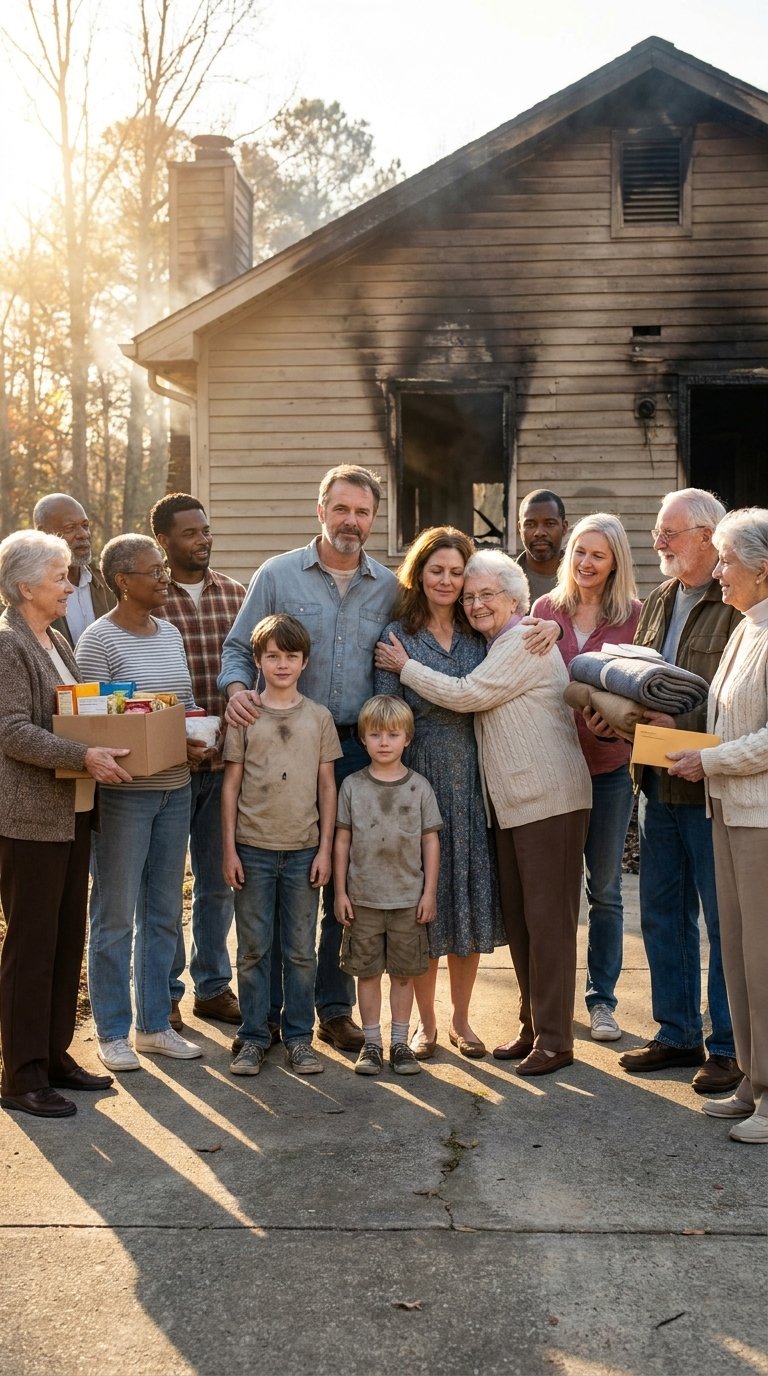
Diane Whitfield opened the leather folder on the hood of her car, and the whole yard went quiet around her.
“Mr. Abernathy didn’t just call me last night,” she said. “He called me eleven years too late, by his own account. He told me that he had a small trust, that nobody knew about, built from forty years of mail route pension savings and a house he’d sold after his wife passed. He’d planned to leave it to a charity someday. But last night, he said, he’d found the right one.”
Tom turned to look at the old man. Mr. Abernathy shifted on his cane and said, gruffly, “I’m eighty-three. I don’t have time to wait for someday.”
“How much?” Ruth whispered.
Diane slid a single page across the hood.
“Sixty-two thousand dollars,” she said. “In a fund for the Wilson family. And that’s before the community fund started this morning.”
Tom took a step back. “Sir, I can’t…”
“You will,” said Mr. Abernathy, “because I’m too old to argue, and because Marlene Pruitt over there says she’ll chase you down if you refuse.” There was a stir of laughter through the crowd, and Marlene, red-faced, raised a hand in surrender.
It turned out the old friends from the Sunday route had not simply shown up.
Mrs. Delacroix, who had once chaired a church committee for thirty years, had called everyone she’d ever known. The Okonkwo sisters had phoned their nephews, who owned a small contracting company two towns over. Walter had called his veterans’ post, and eleven men and women had driven in at dawn, with their own tools.
By ten in the morning, a donation account at Diane’s bank had received $14,000 from strangers. By noon, it had passed $31,000. A local radio station had picked up the story and read the Wilsons’ address on air, and cars began arriving from other towns with groceries, blankets, and checks.
A man in a Carhartt jacket walked up to Tom with a toolbox. “I’m a framer,” he said. “My mother ate your wife’s chicken for a year. I’d like to start on your roof.”
“We don’t have a house yet,” Tom said, almost laughing.
“Then I’ll start on the walls.”
The rebuild took four months.
The crew that came was bigger than anything Tom had imagined. Retired carpenters. Teenagers working off community service hours. Veterans from Walter’s post. Women from church hauled lunches in on Saturdays, and the Okonkwo sisters ran a rotating schedule of casseroles, which Hannah noticed with quiet delight was the exact reverse of the old Sunday route.
Caleb worked every weekend, hammering alongside men three times his age. Hannah organized the donation sorting, and Pip, who couldn’t hammer anything, was appointed Official Inspector and walked every corner of the frame with a toy flashlight.
Marlene Pruitt came every Saturday. The first week, she didn’t say much. She swept sawdust, hauled boards, and kept her eyes down. In the second week, she came up to Ruth with a thermos of coffee and a folded piece of paper.
“I left a bag of clothes on your porch two winters ago,” she said, not meeting her eyes. “With a note. It was me.”
Ruth took the coffee. “I know.”
“You knew?”
“Marlene, I read the handwriting. I’ve been signing the church newsletter beside it for ten years.”
Marlene stared at her, then put her face in her hands. “I was so ashamed of my own life that I made yours smaller. I’m sorry, Ruth. I don’t have a good reason.”
“You don’t need one.” Ruth set the thermos down and put her arms around her. “You showed up. That’s the reason that counts.”
The house was finished on the first warm Saturday of April.
It wasn’t a mansion. It had three bedrooms, a wide porch, and a kitchen with new cabinets and a window over the sink that faced east. But on the wall inside the front door, someone had hung a large wooden board, and on it, burned in by hand, were the names of every person who had helped.
There were three hundred and eleven.
At the bottom, in smaller letters, was a single line.
Built by the neighbors the Wilsons fed.
Ruth stood in front of it for a long time. Tom came up behind her and rested his chin on her shoulder.
“We never asked,” she said softly.
“That’s why they came,” said Tom.
That Sunday, the Wilsons loaded a new pickup, a gift from a dealership owner in the next county, with containers of soup and bread and baked chicken. They drove the old route. Mr. Abernathy was waiting on his porch. So was Walter. So were Mrs. Delacroix and the Okonkwo sisters.
But when they stopped at the first house, the old man did something he had never done in six years.
He climbed into the passenger seat.
“I’m riding along today,” he said. “I’ve got a bad hip and a worse heater, but I’ve got two good hands, and these people need dinner.”
Behind them, a second car pulled up. Then a third. By the end of the afternoon, there were nineteen volunteers on the route, and the seven households had become twenty-three.
Marlene Pruitt drove the last stretch herself, with her twins in the back seat, carrying a pot of beef stew.
“It’s not your recipe,” she told Ruth at the final stop. “It’s burned a little.”
“It’s perfect,” said Ruth.
Years later, when Hannah was grown and working as a nurse, someone asked her what it was like to be the poor family on Maple Hollow Road.
She thought for a long moment.
“People think we were poor because we didn’t have much,” she said. “But the truth is, we were the richest people in town. We just didn’t know how rich until the winter the house burned.”
She smiled.
“My mother taught me that you don’t give so people will thank you. You give because someone is hungry. And if you do it long enough, quietly enough, one day the whole town shows up at your door, carrying exactly what you gave them.”
On the wall by the front door, the wooden board with the three hundred and eleven names is still there. Every Sunday, Pip, now a grown man with a toolbox of his own, adds a new one.
The End.