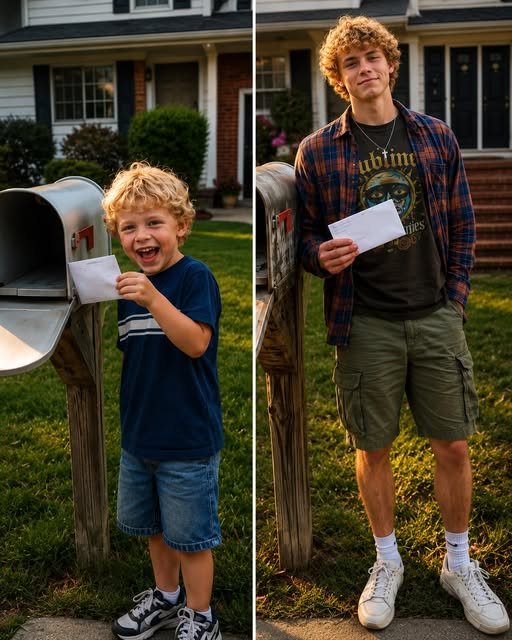
He read the final line aloud, and his voice cracked halfway through.
“‘I am your grandmother. My name is Ruth Callahan.'”
I felt my knees go weak. I knew that last name. It was Daniel’s, Adrian’s father’s.
“Mom,” Adrian said, “read it. Please.”
He slid the letter across the table, and I sat down because I didn’t trust my legs.
Dear Adrian,
If you are reading this, you are eighteen, and I have finally run out of excuses to stay hidden.
I have wanted to write this letter for a very long time. I have started it more times than I can count. But I made a promise, and for eighteen years I let that promise decide for me.
I am your father’s mother. When your mother told Daniel she was pregnant, he told me about it at my kitchen table, laughing like it was a nuisance. I asked him what he planned to do. He said nothing. He said it was her problem. I have never been so ashamed of anyone in my life, and he was my own son.
I begged him to do the right thing. He told me that if I contacted your mother or you, he would never speak to me again. I told myself he would grow up and change his mind. He didn’t.
I looked up. Adrian was watching me, his eyes wet.
“Keep reading,” he whispered.
I didn’t know where you were for the first two years. Then a distant cousin mentioned your mother’s new address at a funeral, and I wrote it on the back of my hand so I wouldn’t forget it. I sent the first card the week you turned three. I was terrified your mother would recognize my name, so I left it off. I thought she had every right to want nothing to do with our family. After what Daniel did, I wouldn’t have blamed her.
So I did the only thing I could. I sent a card every year, with whatever money I could spare. Some years it was five dollars, because it was a bad year. The year I sent twenty, I had sold my late husband’s watch. I never told anyone.
My throat tightened. I remembered that year. Adrian had waved the twenty-dollar bill around the house for a week.
I know a card and a few dollars can’t make up for a grandmother who wasn’t there. I should have been at your birthday parties. I should have been at your games. I should have been brave enough to knock on your door. I was a coward, and I’m sorry.
But I want you to know that you were never forgotten. Every year, on the day you were born, I lit a candle and said your name.
Adrian made a small sound and pressed the back of his hand to his mouth.
I read on.
I am writing this letter now because I am not well. The doctors say I have months, maybe less. I don’t want to leave this world without you knowing that someone loved you from the very beginning.
I have spent eighteen years setting money aside. It isn’t a fortune. It’s what was left from selling my house, and the small savings I never touched. My lawyer, Mr. Harold Pierce, has the paperwork. It is yours, for college, or a first apartment, or whatever you choose. There are no conditions, and your father has no claim on it. I made sure of that.
One more thing, and then I’ll let you go.
Your mother did nothing wrong. She raised you alone and raised you well. I know because I have watched from a distance, and I’m sorry for that too. Last spring I sat in a parked car outside your school’s football field and watched you play. You were number twenty-two. You laughed when you fumbled the ball, and you helped the other boy up. I knew then that you had turned out to be everything your father never was.
If you ever want to meet me, I would give anything for that. If you don’t, I will understand.
Happy birthday, my sweet boy.
With all the love I never got to say out loud,
Grandma Ruth
P.S. The address is below. The porch light is always on.
I set the letter down. The kitchen was quiet except for the refrigerator humming.
“She was at my game,” Adrian said finally. “Mom, she was there. I was twenty feet away from her, and I never knew.”
“I didn’t either,” I said, and my voice broke. “Adrian, I swear, I never knew.”
“I know.” He wiped his face with his sleeve. “Mom, was she right? About Dad?”
I had spent eighteen years softening that story, and I decided he was old enough now to hear all of it.
“Your father told me he wasn’t ready,” I said. “Then he blocked my number. I never told you the rest because I didn’t want you to feel unwanted. But you were never unwanted, Adrian. Not by me, and apparently not by her.”
He nodded slowly, staring at the envelope. “She said she’s sick. How long ago did she write this?”
I checked the postmark, and my stomach dropped. “Four days ago.”
Adrian was already standing, grabbing his keys. “The address is two towns over. That’s forty minutes.”
“I’ll drive,” I said, and I meant it. “You’ve been through enough this morning.”
He shook his head. “No. I want you to come with me.”
We were in the car in under five minutes. Adrian held the letter in both hands the whole drive, reading the last line again and again.
The house was small and white, with chipped blue shutters and a flower box that someone had clearly tended with care. And just like she’d promised, the porch light was on, glowing faintly in the morning sun.
Adrian stood on the walkway for a long moment, and I put my hand on his shoulder.
“Whatever happens in there,” I told him, “I’m right behind you.”
He took a deep breath and knocked.
Footsteps shuffled slowly toward the door. It opened, and a frail woman with silver hair and Adrian’s exact eyes stood there gripping the doorframe. Her hand flew to her mouth.
“Adrian,” she whispered. “You came.”
He didn’t say a word. He stepped forward and wrapped his arms around her, and she held on to him like she had been waiting eighteen years to do exactly that.
Over his shoulder, she met my eyes and mouthed, Thank you.
I was crying too hard to answer.
Later, over tea at her kitchen table, Ruth showed us a shoebox. Inside were photos she had taken from afar over the years: Adrian at the bus stop, Adrian at the football field, Adrian carrying groceries for a neighbor. Underneath them sat a stack of unsent letters, one for every year, each beginning with the same words: Dear Adrian, I wish I could tell you who I am.
“I wrote them all,” she said softly. “I just never had the courage to mail any but the cards.”
Adrian picked up the one from the year he turned thirteen, the year he asked me if it was his dad.
“This one says you almost came that day,” he said.
“I got as far as your street,” Ruth admitted. “Then I lost my nerve.”
Adrian reached across the table and took her hand. “You’re not losing it today.”
She smiled, and for the first time, I understood the envelope was never really about the money. It was a promise, kept every year for eighteen years, that someone was out there thinking of him.
And now that promise finally had a face.