I stared at him. “You wondered?”
“Come inside, Jessie-bean. It’s cold, and my knees aren’t what they used to be.” He turned and shuffled back into the kitchen. Marcus and I followed.
The kitchen looked the same as it had when I was nine. Yellow curtains, scratched table, Mom’s ceramic rooster still sitting on the windowsill. Dad lowered himself into his chair slowly, and I noticed he had to stop and catch his breath.
“I’m angry with you,” I said, and my voice broke on the last word. “You lied to me for months, Dad.”
“I did.” He didn’t argue. “And you have every right to be angry. But I need you to listen before you decide what to do about that, because there’s something I never told you. Not even Marcus knows this part.”
Marcus frowned. “Dad?”
“Marcus, go in the hall closet. Top shelf, behind the Christmas lights. There’s a green metal box.”
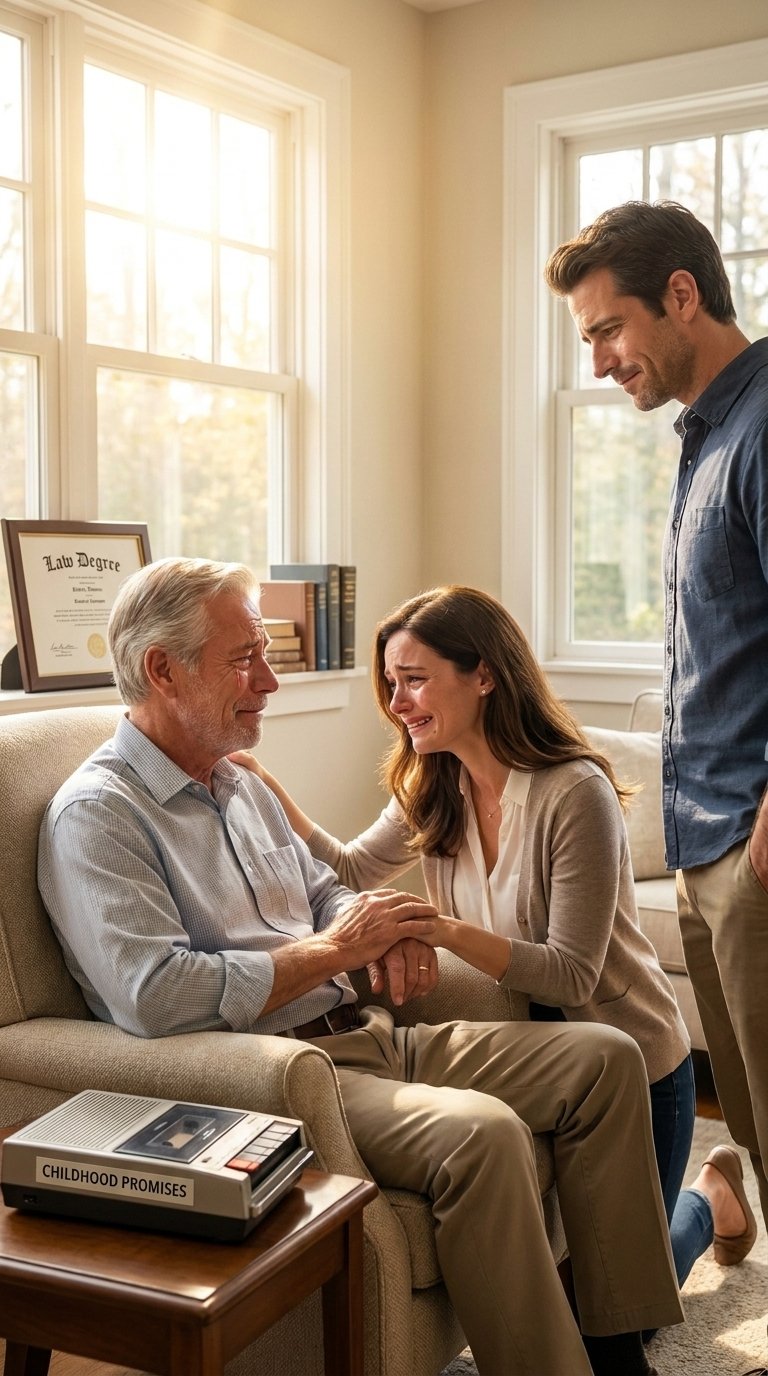
Marcus left and came back with a dented box, the kind you’d keep important papers in. My father opened it with careful hands. Inside were cassette tapes. A dozen of them, maybe more, each labeled in his blocky handwriting. Jessie, age 7. Jessie, age 9. Jessie, age 10.
I felt cold all over. “What is this?”
“After your mother died,” he said quietly, “you stopped talking for almost two weeks. You were nine. Do you remember?”
I did, vaguely. A gray, silent stretch of my childhood.
“I didn’t know how to reach you. I bought a cheap tape recorder at a yard sale, thinking maybe you’d talk to it if you wouldn’t talk to me. And one night, you did.”
He pressed the button on an old player he must have kept for this exact purpose.
A tiny voice crackled out of the speaker, thick with tears. My own voice.
“Daddy, I’m scared you’re going to go away too. I promise I’ll never leave you. Even when I’m big. I’ll come home. I’ll always come home. I promise, I promise.”
I put my hand over my mouth.
“I recorded more after that,” Dad said, clicking the machine off. “Not because I wanted to trap you, sweetheart. I swear on your mother’s grave, I never wanted that. It was just that your promises got me through the worst years of my life. When the garage almost went under, I played them. When Marcus and I fought, I played them. When the loneliness got bad, I played them.”
I was crying openly now. Marcus had turned away, wiping his eyes.
“There’s one more,” Dad said, and slid a different tape from the bottom of the box. “You were twelve. You said this one when you won the school debate.”
The tape hissed, and then my twelve-year-old voice, proud and bright: “When I’m a lawyer, I’m going to help everybody like you, Daddy. People who work hard and get cheated. And I’ll never forget where I came from.”
“I did forget,” I whispered. “For years. I got so busy.”
“No.” My father shook his head firmly. “You didn’t forget. You were doing exactly what I hoped you’d do. Every success you had, every case you won, I sat in this kitchen and felt like the luckiest man alive. I never needed you to come home, Jess. I needed you to fly.“
“Then why did you say you wondered how long it would take me?”
He smiled, and it was tired and gentle and a little mischievous. “Because I know my daughter. I hid this illness because I couldn’t stand the thought of being the reason you gave up your dreams. But a part of me, a selfish part, always knew that the second you found out, you’d come. That’s who you are. You made a promise at nine years old, and you’ve never broken one in your life.”
“That’s not fair,” I said, laughing and crying at once. “You hid it because you knew I’d come?”
“I hid it because I wanted you to have your life. I’m proud of you for coming anyway.” He reached across the table, and his hand was shaking, but his grip was strong. “Both things are true, Jessie-bean.”
My phone buzzed again on the table. The firm. The partners’ meeting. Everything I had worked for since I was twelve years old.
Marcus looked at me. “Jess, you don’t have to decide right now.”
But I already had.
I picked up the phone and stepped onto the porch. The managing partner answered on the second ring, and I told him the truth: my father was ill, and I needed to withdraw from consideration for partnership. I told him I would stay on through the transition of my cases, remotely, and then resign.
He was quiet for a long moment. Then he said, “Jessica, in thirty years, I’ve never had anyone walk away from this.”
“I’m not walking away,” I said. “I’m walking toward something.”
When I came back inside, Dad was staring at me with tears running down his face.
“You didn’t have to do that.”
“I know,” I said. “That’s what makes it a promise.”
I stayed.
I moved into my old bedroom with its faded stars on the ceiling. I drove Dad to Dr. Patel’s appointments and learned his medications by heart. Marcus and I took turns on the night shifts, and for the first time in years, we were a family again, arguing over whose turn it was to do the dishes.
Six months later, I hung a small sign beside the garage, a little crooked on purpose. JESSICA CALLAHAN, ATTORNEY AT LAW. I handled wills for the neighbors, disputes between farmers, and the kind of cases that never made headlines but mattered more than any merger. Half my clients paid me in casseroles. I had never been happier.
My father lived another fourteen months, far longer than the doctors expected. He spent most of that time in a lawn chair outside the garage, telling every customer who walked by, “That’s my daughter, the lawyer. She came home.”
He died on a quiet October morning with my hand in one of his and Marcus’s in the other. The last thing he said to me was, “Play the tapes sometimes.”
I do. On the anniversary of Mom’s death, and on his, Marcus and I sit at the old kitchen table and listen to a little girl making promises with all her heart. And every time, I’m grateful to know that she kept every one.