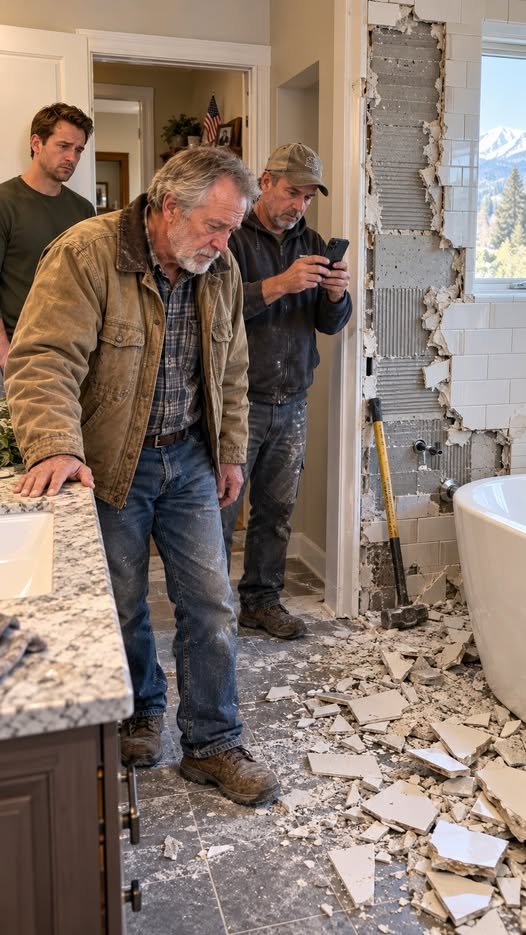
I wiped my hands on a shop rag and asked Doyle to show me.
He held out his phone. The post had been up since seven that morning, forty-three comments already. My mother is threatening to put my family out on the street over a misunderstanding. My seven-year-old daughter doesn’t understand why Grandma is doing this. Please pray for us.
There was no mention of the taxes, the furnace, or the fence. There was no mention of four years and seven months.
“People are taking sides,” Doyle said quietly. “Most of them don’t know the whole story.”
“No,” I said. “They don’t.”
I handed back the phone. My first instinct, the old one, was to fix it before anyone had to feel uncomfortable. I could call Reuben, withdraw the lease, apologize for a misunderstanding I hadn’t caused. I had done that my whole life.
Instead, I picked up a pen and wrote my son a short message.
I’m not putting anyone out. I’d like to meet tonight, you and Brooke and me, at the kitchen table on Clearwater Road. I’ll bring everything. If you still want to talk about it online afterward, that’s your choice.
He answered in four minutes. Fine. 7.
I arrived at seven sharp with a folder, a coffee can of receipts, and no groceries. Piper was at a friend’s house; Reuben had arranged that, which told me he understood this was not a conversation for a child.
Brooke opened the door before I could knock. I realized it was the first time in months she had done so. She looked tired, and her arms were folded tight.
“Come in,” she said. “Since you’ve been invited.”
I let that pass.
We sat at the table I had bought for that kitchen eight years earlier, back when the house still held my husband’s laughter and Reuben’s boyhood. Reuben stared at his hands.
“I’ll go first,” I said, “and then I’ll listen to every word you have. I promise that.”
I opened the folder and slid out the legal pad, then the coffee can. I did not make a speech. I read it out, item by item, the way I would have read an inventory in my workshop. Property taxes, four Decembers, with the bills attached. Homeowner’s insurance, every year. The furnace in the January it hit eighteen below. The fence after the storm. Two phone lines. The groceries, which I had kept receipts for only because I keep receipts for everything.
When I reached the total, I set the pen down. “Fifty-eight thousand, four hundred and twelve dollars.”
Nobody spoke. The refrigerator hummed.
“I’m not asking for it back,” I said. “I want that to be very clear. I’m telling you because on Tuesday I was told this was your home and that I should not come unless invited. And the person telling me that did not seem to know what it had cost to make it a home.”
Brooke’s jaw tightened. “I didn’t know it was that much.”
“You didn’t ask.”
“Reuben never said…”
“Reuben never said because he was embarrassed,” I said, and my son flinched. “And I never said because I thought love meant not keeping score. I was wrong about that. Not about love. About silence.”
Reuben finally looked up. His eyes were wet. “Mom, I should have told her. I should have told everyone. I let it get comfortable. It was easier not to look at it.”
“I know.”
“And the post…” He closed his eyes. “I wrote it at six in the morning after we fought half the night. I wanted somebody to be on my side. I didn’t think about what it would do to you.”
“What did you want it to do?”
He took a long time to answer. “Make it go away without having to be the one to fix it.”
It was the most honest thing he’d said to me in years.
Then Brooke spoke, and I kept my promise and listened.
“I’m not going to pretend I handled it well,” she said, her voice rough. “But I want you to hear what it’s been like. Every time you come, you bring groceries. You fix something. You ask what we need. And every time, I feel like a guest in my own kitchen. Like we failed and you’re patient about it.”
I sat very still.
“You never criticized us,” she went on. “That almost made it worse. I couldn’t even be angry at you. So I got angry about the small things, and that text was one of them. I’m sorry. I mean that.”
I looked at this woman I had half-resented for years and saw, for the first time, someone drowning in gratitude she had no way to repay.
“Brooke,” I said gently, “I never wanted you to feel like a guest. I wanted you to feel safe. I confused the two.”
“Maybe we both did,” she said, and almost smiled.
We talked until after ten. The lease was never the point, and by the end we all knew it. Reuben had been out of steady work for two of those four years and had taken a contracting job he hadn’t mentioned because it paid badly. Brooke had been working nights remotely and hiding how little it brought in. They had been terrified to tell me they still couldn’t afford to leave.
So we made a plan, written down, on that same legal pad.
They would pay rent, but not $2,400. I had used that number to start a conversation, and I told them so plainly. We settled on a figure they could actually meet, $900 to begin, rising each time Reuben’s income did. Every dollar would go toward a down payment fund, held in an account in their names, which I would match for the first two years. The house would be theirs to buy at a fair price once they were ready, and I would not hold it over them.
“You’d sell it to us?” Reuben whispered.
“I’d rather sell it to my son than to a stranger. But you’ll earn it, and you’ll know you earned it. That’s a gift too.”
Brooke wiped her eyes. “And the post?”
“That’s yours to fix,” I said. “I won’t tell you how.”
Reuben took it down that night. The next morning he wrote a new one, shorter and plainer. He said he had spoken publicly before understanding the full picture. He said his mother had supported his family for nearly five years and he had never properly thanked her. He apologized to her and to anyone he had misled.
Doyle read it aloud to me in the workshop, grinning. “Forty-one hearts and a bunch of people saying they never doubted you.”
“Half of them did,” I said.
“Sure. But now they’re embarrassed, and that’s almost as good.”
It took thirty-one months. Reuben landed a steady job at a Bozeman design firm. Brooke started a small consulting practice from the spare room. They paid rent on the first of every month, sometimes with a handwritten note from Piper tucked in the envelope, usually a drawing of the house with a very large sun.
On the day the deed transferred, we all sat at that same kitchen table. I signed first. Reuben signed second. Brooke signed last, and her hand shook.
“Thank you,” she said. It was quiet and unadorned, and it was enough.
I handed the keys to Piper, who had insisted. She held them in both palms like something alive.
“Is this our home now?” she asked.
“It always was, sweetheart,” I said. “Now it’s just on paper too.”
That Sunday, I came for dinner. I rang the bell, and Brooke opened the door, and I held up a pie instead of groceries.
“Am I invited?” I asked.
She laughed, and stepped aside. “Always.”