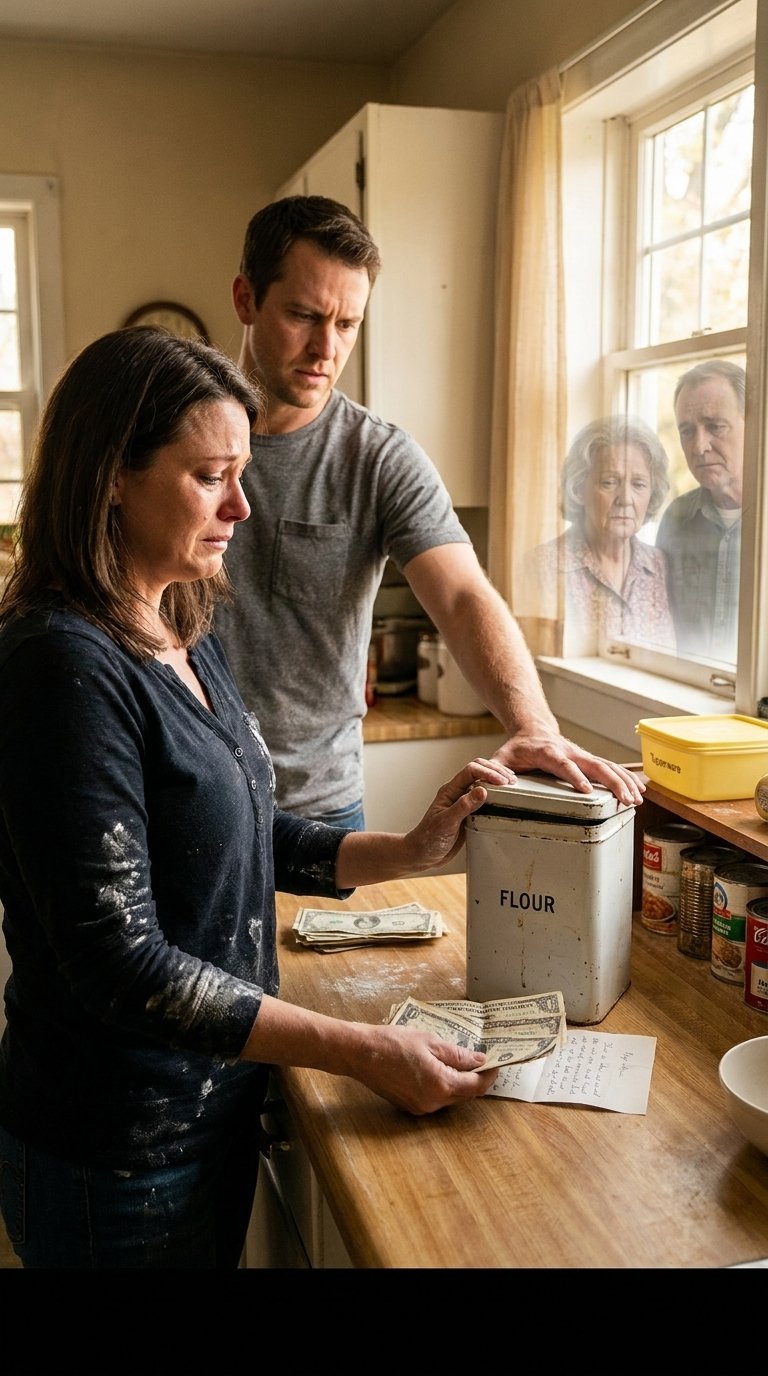
The branch manager was a gray-haired man named Mr. Aldridge, and he did not ask what I wanted. He looked at the flour on my sleeves, the tin under my arm, and said, “Mrs. Linda Pruitt. Your mother told us you’d come. Please, come back to my office.”
Russell had followed me in the car. He pushed through the glass doors a minute later, red-faced. “Linda, don’t sign anything. She wasn’t in her right mind at the end.”
“She was in her right mind enough to leave a note,” I said. “Sit down or wait outside, Russell.”
He sat. He did not look at me.
Mr. Aldridge closed the office door and opened a folder. “Your mother came in eleven months ago. She opened an account in your name and asked me to hold a sealed letter and some documents until she passed. She said you would bring the third page.”
I broke the old brown tape with my thumbnail. The page was written in Mama’s shaky, slanted hand, the same hand that had signed every permission slip of my childhood.
Linda,
If you are reading this at the bank, then you did what I asked, and I am prouder of you than I ever said.
I am going to tell you what I should have told you forty-one years ago.
When that truck hit you, the trucking company settled for sixty-two thousand dollars. It was put in a trust for you until you turned twenty-one, with Wayne as the trustee because you were a minor. I signed the papers. I did not read them closely. I trusted him.
Wayne told us the money went to your hospital bills. That was a lie. The hospital had already been paid by the company’s insurance. Wayne took the money. He used it to pay off the gambling debts he had hidden from me, and to buy into the hardware store with his brother. By the time I found the bank statements, it was gone.
I confronted him. He cried, and he promised he would pay it back. I believed him. God forgive me, I was afraid to be alone with two children, and I let him stay.
I told myself I would fix it quietly. So I started saving. Every grocery trip, I kept a little back. Every birthday check from my sister. Every egg-money dollar. Forty-one years, Linda. It was never enough to feel right, but it grew.
The tin was never about flour. I slapped your hand that day because I was terrified you would find it before I was ready to tell you. I was a coward. I am so sorry.
Your brother knows. He found the statements after Wayne died and asked me to keep it from you. He wanted the hardware store money, what little was left of it. I told him no. He has not forgiven me, and I do not blame him for being angry, but he was wrong to ask.
The account at this bank is yours. It holds what I saved, plus every cent of interest. There is also one more thing, in the safe deposit box. Mr. Aldridge has the key.
I love you. I always did. I just did not know how to be brave.
Mama
I read it twice. Then I set it down on the desk and looked at my brother.
Russell stared at the carpet. “She told me not to say anything,” he said finally. “Wayne was already dead. I figured, why hurt you?”
“Why hurt me?” My voice came out quiet. “I limped for a year, Russell. I put off college. I worked at the Piggly Wiggly where I got hit, and I thought we were poor because of bad luck.”
“I was nineteen. I didn’t know what to do.”
“You were forty-six when Wayne died. You knew exactly what to do. You wanted the money.”
He did not argue. That was the worst of it.
Mr. Aldridge cleared his throat gently. “Mrs. Pruitt, if I may. The account holds twenty-three thousand, four hundred dollars, in addition to the cash you brought. Your mother added to it every month for the last eleven months from her pension, once she knew she was ill.”
I put my hand over my mouth.
“And there is the safe deposit box,” he said. “She asked that you open it today.”
The box was in a quiet vault downstairs. Mr. Aldridge left me alone with it, and Russell stayed upstairs, which I took as a small mercy.
Inside was a manila envelope and a small velvet pouch.
The envelope held the original trust documents, stamped and signed, along with a set of copied bank statements in Wayne’s handwriting, circled in red ink by Mama. At the bottom was a letter from an attorney dated eight months earlier. Mama had gone to see him. She had asked whether anything could be recovered from Wayne’s estate.
He had told her no. The statute of limitations had run out decades ago, and Wayne had died with nothing.
But clipped to the letter was a handwritten note in Mama’s hand: I could not get your money back, Linda. So I decided to give it to you myself.
I opened the velvet pouch. Inside was her wedding ring, the thin gold one from her first marriage, to my father. I had never known she kept it. Beneath it lay a photograph of me at six years old, gap-toothed, standing on a kitchen stool, my hands white to the elbows.
On the back, in her writing: Biscuits with Linda. Best day of the year.
I sat down on the cold floor of that vault and cried until I had nothing left.
When I came upstairs, Russell was standing by the window with his hands in his pockets. He looked smaller than I remembered.
“I’m not going to ask you for anything,” he said. “I want you to know that. I was ashamed. Not just of the money. Of staying quiet.”
“Why did you?”
He rubbed his face. “Because Wayne raised me too. And I couldn’t stand the idea that the man who taught me to fish was also the man who did that to you. It was easier to pretend it never happened.”
I did not forgive him that day. I want to be honest about that. Forgiveness, I have learned, does not arrive on the schedule of a funeral.
But I did say, “Come help me carry the tin to the car.”
He did.
I used the money the way Mama would have wanted. Part of it paid off the small mortgage I had carried for years, which finally let me sleep. Part of it went to my daughter’s last two semesters of nursing school, which I had been quietly dreading for months. And a third part I put aside in an account in Mama’s name, for a scholarship at the community college for girls who had to put off school because of an accident or an illness or a hard year.
Russell called in the spring. He was not asking for anything. He had sold the camper. He wanted to put a thousand dollars into the scholarship, and he wanted me to know he was seeing a counselor about the rest.
I said yes to the thousand. I said we could talk about the rest over biscuits.
We made them in Mama’s kitchen, the week before the house sold. I stood on a stool, because the shelf was still too high, and took down the flour tin. This time it held actual flour, a fresh bag I had bought that morning.
Russell watched me work the dough. He said, “Mama used to slap my hand too, you know.”
“I know,” I said. “I remember.”
“I think she slapped hers harder.”
I looked at the tin, white enamel chipped with blue, and for the first time, it was only a tin.
“Hand me the rolling pin,” I said. “And wash your hands. We’re using all of it.”
THE END 💛