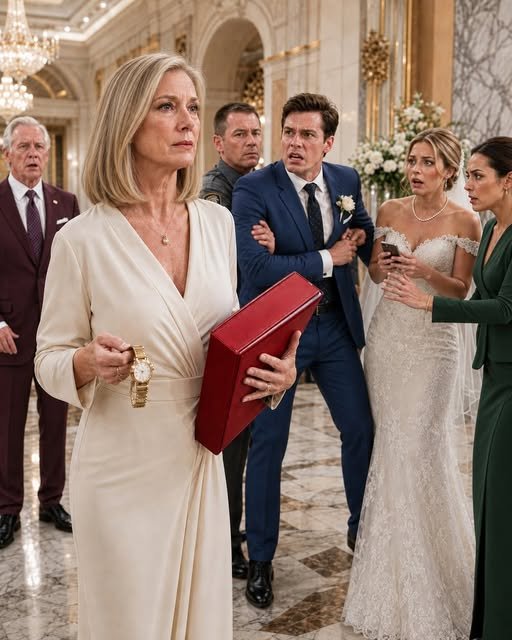
I sat in the back of Claire’s sedan and watched the church doors through the tinted glass. The wedding march drifted down the steps, thin and far away, as if it belonged to somebody else’s life.
“You’re sure about this?” Claire asked. “Once the resolution takes effect, there’s no taking it back.”
“I gave him eleven years of chances,” I said. “I won’t spend the twelfth.”
She handed me the red folder, and I read it once more, though I knew every line. The forged signature was a decent copy of mine. Daniel had always been good at imitating people. The loan against the Grand Hale was the part that made my hands go cold, because that hotel was where I had started, a single rented kitchen in its basement, thirty-one years ago, with Daniel asleep in a laundry basket beside the stove.
At 11:40, my phone buzzed. Not Daniel. The board chair.
Quorum confirmed. Eight votes to nothing. Effective at noon.
I closed my eyes. “Send it.”
At noon exactly, three things happened at once. Daniel’s company email was suspended. His corporate cards were frozen. And the notice went out to the lender, informing them that the loan against the Grand Hale had been executed fraudulently and would be contested.
Then I did what I had promised: I told Claire to take me to the reception hall.
The Whitmore Estate sat on a hill outside town, white columns and a tented lawn, with a string quartet and a champagne tower that must have cost more than most cars. I did not go in through the front. Claire had arranged for me to wait in the catering corridor, where I had once stood in a hundred venues with a clipboard and a clean apron.
Through the swinging door, I watched the receiving line break up and the toasts begin. Daniel looked handsome, which hurt more than anything. He had his father’s jaw. He laughed at something Vanessa whispered, and he lifted his glass like a man who believed nothing could touch him.
At 12:20, his phone began to vibrate.
I watched him glance at it, frown, and silence it. A minute later it buzzed again. Then Vanessa’s phone lit up. Then the Senator’s chief of staff came hurrying across the lawn, whispering urgently in his ear.
Daniel’s face changed in stages. First confusion. Then irritation. Then, as he read, the color left him entirely.
He scanned the crowd. His eyes found the catering door.
I stepped through it.
The guests nearest me fell silent, and the silence spread outward across the lawn like ripples. Daniel crossed the grass toward me, fast, then slower, his wedding boutonniere trembling.
“Mom.” His voice dropped to a hiss. “What did you do?”
“Exactly what I said I would. I checked in on you, sweetheart.”
“My accounts are frozen. My email is dead. They’re saying I’m suspended.”
“You were relieved of your position at noon, by unanimous vote of the board.” I kept my tone mild. “I’m sorry. I know the timing is unfortunate.”
Vanessa swept up beside him, lace trailing. “This is sabotage. You’re trying to humiliate us on our wedding day!”
“Humiliate you?” I looked at her. “You had me blocked from a church.”
“You were an embarrassment!”
“I was the woman who paid for the dress you’re standing in,” I said quietly. “Along with the church, the quartet, the champagne, and a honeymoon in Santorini, all of it from a company account Daniel emptied without my knowledge.”
A murmur rose from the nearest tables. Senator Whitmore had come up behind his daughter, his smile gone stiff.
“Ms. Hale,” he said, “this is hardly the place.”
“I agree, Senator. I didn’t choose the place. Your daughter’s husband did, when he told me in front of two hundred people that I wasn’t invited.” I turned to Daniel. “I have a few things to say, and then I’ll leave.”
I took the red folder out of my bag and held it, unopened.
“One point eight million dollars,” I said, loud enough now for the tables to hear. “Over fourteen months. Transferred through a vendor account that doesn’t exist, authorized by a signature that looks like mine. And a mortgage against the Grand Hale Hotel, which I built with my own hands before you were old enough to read.”
Daniel stared at the folder. “Mom, I can explain.”
“I know you can. You’re very good at explaining.” My voice cracked, just once. “I wanted you to come to me. All year, I waited. I left the door open. I would have found a way to forgive nearly anything, if you’d only walked in and said, ‘Mom, I made a terrible mistake.'”
“I was going to pay it back…”
“With what? Vanessa’s boutique has never turned a profit. I checked.”
Vanessa’s face went red. “You had no right to look!”
“It was my money, dear. I had every right.”
The Senator was now looking at Daniel with an expression I knew well. It was the look of a man calculating how quickly he could put distance between himself and a liability. “Is this accurate, young man?”
Daniel opened his mouth and closed it again.
“Forgery,” I said gently, “is a felony. So is fraud against a lender. Claire has prepared the paperwork. But I haven’t signed the complaint yet, and I want you to understand why.”
He looked at me then, truly looked, for the first time in a year.
“Because I’m still your mother,” I said. “And because your father would have wanted me to give you one last chance to do the right thing. So here it is.”
I reached into my purse and took out the watch.
It was a plain steel Omega, scratched along the band, the face a little yellowed. Robert had worn it every day for twenty-two years. He had given it to me in the hospital, three days before he died, and said, “Give it to Danny when he’s ready to be a man.”
“I brought this to the church to give you,” I said. “I thought you were ready. I was wrong.”
Daniel’s eyes filled. “Mom…”
“Here is what happens now. You will sign a full confession of the transfers and the forged authorization. You will cooperate with the lender and the auditors. You will repay every dollar, from your own earnings, over as many years as it takes, starting with whatever job you can find. If you do all of it, I will not file the complaint.” I held the watch a little higher. “And if you do it honestly, you can have this back. Not today. Not next month. When you’ve earned it.”
Vanessa gripped his arm. “Daniel, don’t you dare agree to anything. My father’s attorneys…”
The Senator raised a hand. “Vanessa, be quiet.”
Everyone froze. He was looking at Daniel.
“Son, in my experience, a woman who builds eleven hotels and is willing to forgive a theft of this size is offering you more than you deserve. I’d take it.”
For a long moment, Daniel stood there in his tuxedo with the champagne tower glittering behind him and two hundred people watching. Then he pulled his arm free of Vanessa’s, took off his boutonniere, and dropped it on the grass.
“I’ll sign,” he said hoarsely. “Everything. I’m so sorry, Mom. I’m so sorry.”
“I know you are.” I put the watch back in my purse, because the day had not come yet. “Call Claire on Monday.”
Vanessa stared at him. “You’re choosing her over me?”
“I’m choosing the truth,” Daniel said. “For the first time in a long while.”
I turned and walked back across the lawn. Behind me, I heard Vanessa’s voice rising and the Senator’s voice, low and firm, answering her. I did not look back.
Daniel signed on Monday. He lost the title, the corporate card, and the apartment I’d helped him lease. Vanessa’s family quietly arranged an annulment within two months, and the boutique closed by spring.
He took a job as a line cook at one of my own properties, under a manager who had no idea who his mother was until the second week. He started at five every morning. He scrubbed the same basement kitchen where he had once slept in a laundry basket. He paid back the money in monthly installments, small at first, then larger, and he never missed one.
For eight months, we spoke only about business. Then one night in November, he knocked on my kitchen door in his stained apron and said, “Can I come in?”
“It’s your house too,” I said.
We sat up until two, drinking tea and talking about his father, about pride, about all the ways a person can mistake a title for a self. He cried, and I did too.
On the second anniversary of the wedding, I mailed him a small box with no note. Inside was Robert’s watch.
An hour later, my phone rang.
“Mom,” Daniel said, and his voice was thick. “I thought I had to be someone important for you to want me at the table.”
“All I ever wanted,” I told him, “was for you to be someone worth sitting beside.”
He came to dinner that night. He wore the watch. And when I looked across the table at my son, I saw his father’s face at last, and none of the stranger who had stood in a church doorway.
Some doors are blocked by pride. The ones worth keeping are the ones that open again from the inside.