In small print at the top was a line I had not expected: Gratuity pre-authorized by Courtney Marsh. Card on file declined 7:42 PM.
I read it twice. Then I closed the folder, set it gently on the table, and looked up at my sister.
“Your card was declined,” I said.
Courtney’s smile flickered. “That’s a mistake. The bank flagged it. It happens.”
“Does it?” I turned toward the doorway. “Mr. Sullivan, would you come in, please?”
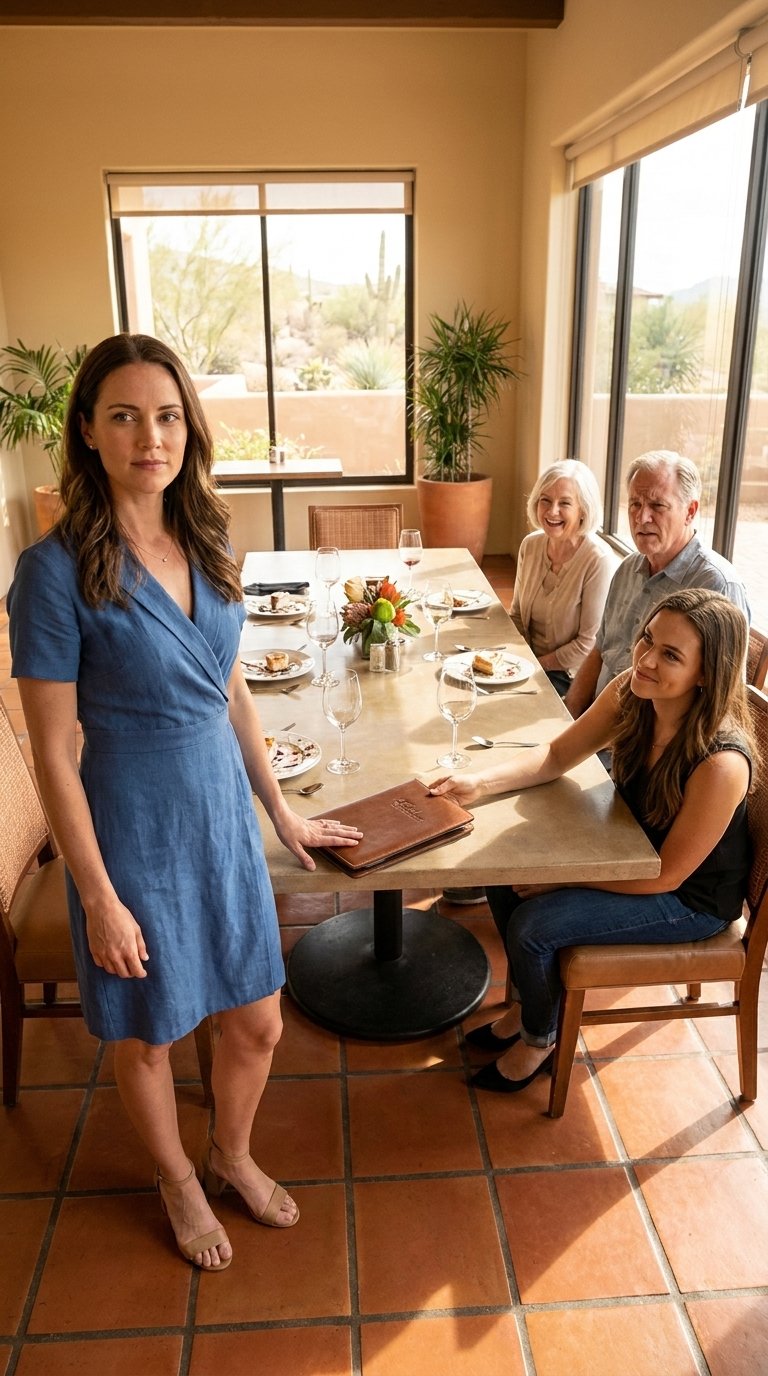
Nate Sullivan had been standing just outside the terrace door, exactly as we’d agreed. He stepped in with a tablet in his hand and a face that was very carefully neutral. The room went quiet, and Dad put down his water glass.
“Ms. Collier,” Nate said. “How can I help?”
“Remember what I requested earlier?”
He nodded.
“Please tell my family what instructions the host desk received for tonight.”
Courtney half rose from her chair. “This is ridiculous. Rosie, you’re making a scene.”
“I’m asking a question,” I said. “Mr. Sullivan?”
Nate cleared his throat. “The reservation was made by Courtney Marsh for eight guests at seven o’clock. She left written instructions that a ninth guest, Ms. Rosemary Collier, would arrive at nine, that she should not be seated for dinner service, and that the entire check was to be presented to her. Ms. Marsh also provided a photograph so my staff could identify her.”
He held up the tablet. On the screen was a scanned instruction sheet in Courtney’s looping handwriting, and clipped beside it, a printed photo of me from my school’s staff page.
Nobody breathed.
Dad turned slowly toward my mother. “Linda? What is he saying?”
“It was a joke, Tom,” Mom said quickly. “Courtney was being playful. Rosie knows how we tease.”
“Nine o’clock,” Dad said. He looked at me. “Rosie, you told me you couldn’t come to dinner.”
“I never said that, Dad. Mom told me nine. I have the text.” I took out my phone and set it on the table beside the check. Dinner starts at 9:00. Terrace room. Don’t be late. With a little red heart.
Dad read it. Then he picked up the phone and read it again, his thick fingers shaking.
“They told me you declined,” he said quietly. “Courtney said you had a school thing.”
“I know.”
Preston, Courtney’s husband, had been staring into his wine glass all evening. Now he spoke for the first time. “Courtney, you said your parents’ friends were covering it.”
“Preston, not now.”
“You told me the Colliers’ friends had put in for the dinner. You said I didn’t need to bring cards.” His voice cracked. “My card didn’t decline. I didn’t bring one. You told me not to.”
Courtney’s face went pale beneath her bronzer. “Stop talking.”
“Did you plan to make your sister pay for your parents’ anniversary?”
“She can afford it!” Courtney snapped, and the words hung in the air like a dropped plate. “She’s a teacher with no kids and no mortgage. She’s been paying for things for years and never complained. Why is it suddenly a crime?”
“Because nobody asked,” I said. “You told Dad you paid the water heater. You didn’t.”
Dad flinched as if struck.
“You paid it?” he whispered.
“Eleven hundred dollars,” I said. “It came out of the monthly money I sent through Courtney. Four hundred a month, for six years, Dad. I never wanted credit. I only wanted you to know it came from someone who loved you.”
Dad sat very still. Then he reached into his jacket pocket and took out the little spiral notebook. He flipped to a page, found a line, and drew a hard stroke through Courtney’s name beside the water heater.
“Thomas,” Mom said sharply.
“Don’t,” said Dad. It was the voice he had used when I was twelve and had fallen off the bleachers, and he had walked into the clinic and picked me up himself. “Linda, you’ve known.”
Mom’s hands fluttered to her pearls. “Your sister has pressures…”
“That’s what you said to Rosie, isn’t it?” Dad’s eyes were wet. “She told me. I’d forgotten. I thought it was just a passing remark. I didn’t ask.”
“Dad, it isn’t your fault,” I said.
“It is,” he said. “Because I wrote everything down but I never wrote down what she did.”
I picked up the brown-paper package I had carried in under my arm and set it in front of him.
“I almost didn’t bring this,” I said. “But I think I should.”
He tore the paper carefully. The frame was simple, and the photograph inside was whole, clean, bright. Mom at twenty-four outside the church, laughing so hard her eyes were shut.
Dad touched the glass. “That was the water stain.”
“I had it restored. I wanted you to have the day back.”
Mom was crying now, but I couldn’t tell for whom. She had gone very small in her chair. “Rosie, I didn’t want it to be like this.”
“What did you want, Mom?”
She looked at the photograph, then at me. “I wanted to feel like we were all right,” she whispered. “Courtney always seemed to need more. And you never did. You were so strong. It was easier to lean on you.”
“I wasn’t strong,” I said gently. “I was quiet. Those aren’t the same.”
She had no answer.
I reached for the check folder and slid it back across the table, not to Courtney, but to Dad.
“I won’t pay this,” I said. “Not because I can’t. Because it isn’t right. But I won’t leave Dad stuck with it either.” I looked at Nate. “Mr. Sullivan, I believe a manager’s discretion applies. May I settle the cost of the meal for the two honorees, and only them?”
“Of course,” Nate said. “Two entrées and a glass of wine each. Ninety-four dollars.”
I handed him my card. It was a small act, and it felt like closing a window against a draft.
“The remaining balance,” I said, “belongs to the host who made the reservation.”
Courtney stared at the folder as if it might bite. “I don’t have the money.”
“I know,” said Preston, very quietly. “I’ll take it up with you at home.”
I did not stay for coffee. I kissed Dad’s cheek, and he held onto my hand a moment too long.
“Rosie girl,” he said. “Thank you for the picture. I’m so sorry.”
“I know, Dad.”
“Come Sunday. Just you and me. I’ll cook.”
“Okay,” I said, and I meant it.
Outside, the Tucson night was warm and enormous, the stars sharp over the foothills. I stood by my Corolla for a long minute with the keys in my hand.
Behind me, I heard footsteps on the gravel. It was Mom, alone, her heels in one hand.
“I don’t know how to fix this,” she said.
“You don’t have to fix it tonight.”
“Will you let me try?”
I looked at her, small and mascara-streaked in the parking lot light. “You can start by asking me to dinner,” I said. “At the right time.”
She laughed, and cried, and nodded.
Dad and I had Sunday dinner every week after that. He burned the chili the first time, and we ate it anyway. Mom came to the third one and brought a pie. She sat quietly and listened. She did not speak much, but she asked about my students, and for the first time in years she waited for the answer.
Courtney called in the fall. She did not apologize well, but she apologized, and it was a beginning. Preston had taken over their finances and they were selling the Scottsdale house.
I never restarted the recurring transfer. But on Dad’s birthday, I took him to lunch and picked up the check myself, because I chose to, and because he wrote it in his notebook with a note beside it.
Rosie. Lunch. Paid out of love.
The photograph hangs in their hallway now, just inside the front door, where everyone sees it as they come in. A young woman laughing under a clean blue sky.
And at every family dinner since, a ninth chair has been set. Nobody has to ask who it’s for.