Seconds later, I heard a voice. It was barely a breath, so thin that I pressed my ear against the cold metal door to catch it.
“…Mom?”
Every year of my career, every instinct, every rule about waiting for backup fell away in that one word.
“Rachel!” I whispered, pounding my palm against the door. “Baby, it’s me. I’m here. I’m right here.”
“Mom…” A cough racked her. “Can’t… get out. He took my phone. The door…”
“Stay with me. Keep talking. I’m calling for help.”
My hands were steady, a skill I had learned in courtrooms and never lost. I dialed 911 and kept my voice flat and exact.
“This is Elaine Harper. I’m a retired prosecutor. I’m at 418 Willow Lane, behind the residence. My daughter is locked inside a detached garage and is weakly responsive. I need police and an ambulance now. The man inside the house is her husband, Nolan Pierce. I believe he is holding her against her will.”
“Officers are on the way, ma’am. Stay on the line.”
I did, but I did not stay still. The padlock was heavy and new, but the hinges were old. On the ground beside the wall lay a rusted tire iron half buried in leaves. I wedged it behind the hasp and threw my whole weight against it. The screws groaned and held.
“Elaine!”
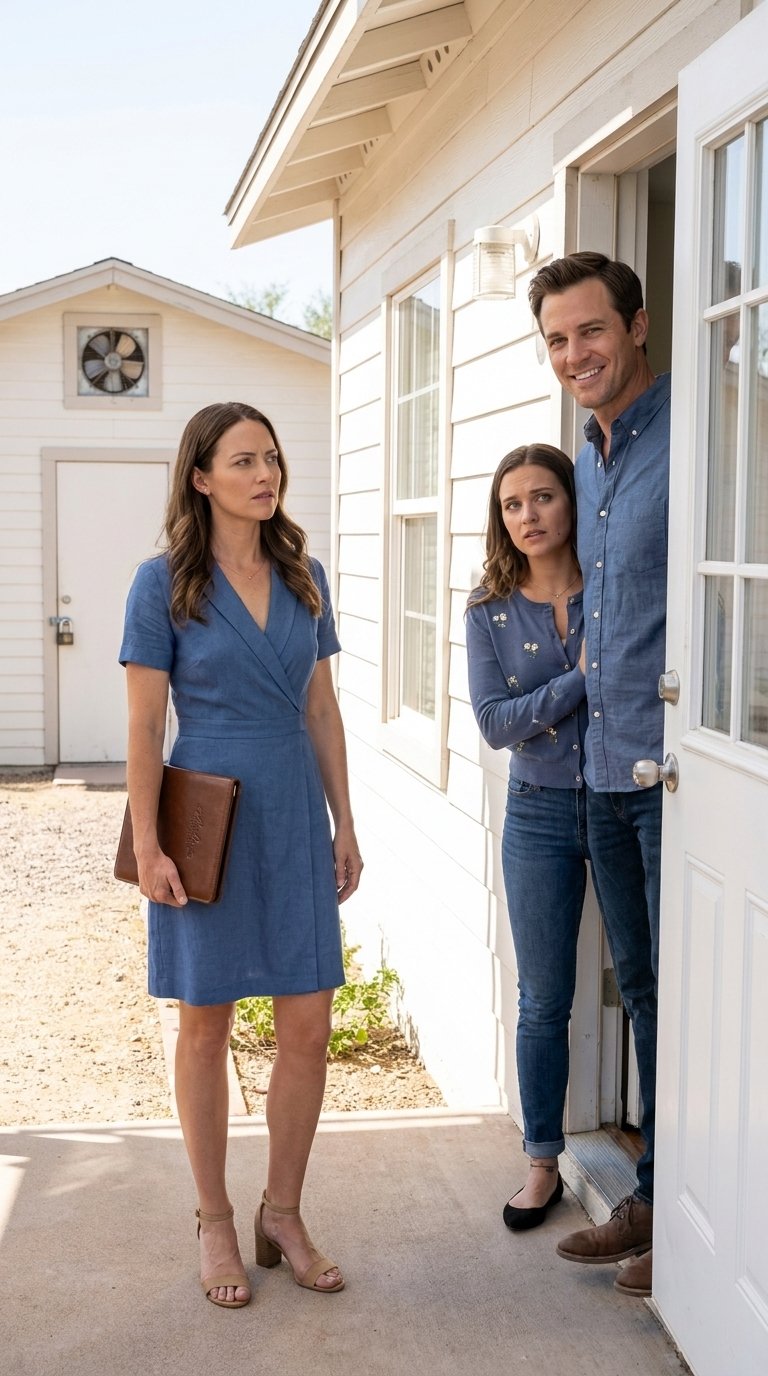
The back door of the house had opened. Nolan stood on the porch, no longer smiling, his phone in his hand. Tessa hovered behind him, her face drained of color.
“Get away from there,” he called. “That’s private property.”
“Unlock this door, Nolan.”
“You’re trespassing. I’ll have you arrested.”
“Please do,” I said. “I’ll wait.”
He came down the steps fast, and I saw the key in his fist. For one second I thought he meant to run. Instead he started toward me, jaw tight, and I raised the tire iron.
“One more step,” I said, “and every word of this is going on a recorded line. I’ve been narrating since I called.”
He stopped. Tessa grabbed his sleeve. “Nolan, stop. Please. It’s gone too far.”
“Shut up, Tessa.”
“She’s been in there six days!” Her voice cracked. “You said it was one night. You said she just needed to calm down.”
Sirens rose in the distance, thin and then thick. Nolan’s eyes flicked toward the street, and I watched the calculation cross his face and fail.
He threw the key into the dark yard.
Two officers came through the side gate with flashlights and drawn weapons, and I stepped back with my hands visible and the tire iron on the ground.
“Ma’am, step away from the door.”
“My daughter is inside. The key is somewhere in that grass. The man on the porch is the husband.”
One officer cuffed Nolan while the other swept his light across the lawn. Tessa, sobbing, dropped to her knees and found the key within a minute. Her hands shook so badly that the officer had to take it from her.
The lock opened. The door swung out on a wave of stale, warm air.
Rachel lay on a thin camping mat in the far corner, a blanket pulled to her chin, a water bottle empty beside her. She was pale and so much thinner, her hair matted, her lips cracked. When the flashlight touched her face, she squinted and lifted one hand.
“Mom.”
I crossed that garage without feeling my legs. I knelt and gathered her into my arms, and she felt like a bundle of sticks wrapped in cloth.
“I’ve got you,” I said. “I’ve got you. Nobody’s going to hurt you anymore.”
“I knew you’d come,” she whispered. “I told myself you’d come.”
The paramedics arrived within minutes. They found dehydration, a sprained wrist, and bruises along her upper arm in the shape of fingers. At the hospital, a doctor told me that another day or two might have been serious. I held her hand through every question.
By morning, the story came out in pieces.
Rachel had found out that Nolan had been moving money from her retirement account into an account only he controlled. Nearly ninety thousand dollars, over two years. When she confronted him a week earlier, he grabbed her phone and locked her in the garage, telling her she was “unwell” and needed to “reflect.” He brought food twice a day, then once, then forgot. He told Tessa that Rachel was resting. He told everyone else about the retreat.
“He said no one would look for me,” Rachel said from the hospital bed, her voice steadier now. “He said I was confused. That I’d embarrass myself if I told anyone.”
“He was wrong about that,” I said. “He was wrong about me.”
Detective Alvarez took Rachel’s statement that afternoon. Tessa gave hers separately, and it matched. She had seen the padlock go on, and she had been too frightened of her brother to question it. She had worn the cardigan because she had found it in the hallway, and she wanted, in some small way, to be near the sister-in-law she suspected was in trouble. She wept as she told it, and the detective let her finish.
“I should have called someone,” Tessa said to me in the corridor, afterward. “I’ll say so in court. Every word.”
“Thank you,” I said. And I meant it, though I did not yet know what else I felt.
The financial records took two weeks to unwind. The transfers were clean and traceable, and they matched Rachel’s account line for line. The county prosecutor, who had once been my second chair, called me personally.
“Elaine, I’m not going to tell you how to feel,” she said. “But this is a strong case. Unlawful imprisonment. Theft. Domestic assault. He will not walk.”
“Good,” I said. “Not for me. For her.”
Nolan pleaded guilty in January. He received eight years. In the courtroom, he did not look at Rachel, but she looked at him, steady and unblinking, until the judge finished reading.
Afterward, on the courthouse steps, she turned to me.
“I’m going to be okay, Mom.”
“I know you are.”
“I mean it. I’m not saying it to make you feel better.” She took a breath of cold air. “I spent six days in the dark listening to the rain, thinking about everything I’d let him tell me about myself. And the whole time, I kept thinking, my mother’s going to notice. She’s going to notice, because she always does.”
I could not answer. I held her face in my hands.
“Every night, you ended our calls with ‘love you,'” she said. “Do you know what that does to a person? It tells her someone’s keeping watch.”
Rachel moved into my guest room for six months. We ate dinner at the kitchen table, burned one pie, ruined two casseroles, and slowly she began to laugh again. She went back to work in the spring. She rented a small apartment with a window that faced the sunrise, and she painted the walls herself, a soft yellow.
Tessa wrote her letters from a distance and never asked for forgiveness. Rachel answered the third one. That was her choice, and I did not interfere.
On the first anniversary of that night, Rachel came to dinner with a small wrapped box. Inside was the blue cardigan, washed and folded, the white flowers still bright at the cuffs.
“I want you to wear it,” she said.
“It’s yours, sweetheart.”
“I know. That’s why I want you to have it. So you’ll remember what you did.”
I put it on over my shoulders, and I did not take it off all evening.
When she left that night, she stood in the doorway, rain tapping softly on the porch roof.
“Love you, Mom,” she said.
“Love you more,” I said, and I watched her taillights until they disappeared. Then I turned on the porch light, because somebody should always be watching, and went back inside to wait for her next call.