The first year was the hardest of Mark’s life, and the happiest he would later admit, though he never said so to anyone but Helen.
They moved into a two-bedroom rental with a leaky faucet and a front yard the size of a tablecloth. Mark took a job driving for a regional carrier, the same trucks he had once owned a fleet of. He started at five every morning. Helen, who had spent twenty years doing the books for the business, picked up bookkeeping clients on the side: dentists, a bakery, a landscaper, a church. She worked at the kitchen table with a calculator and a cup of tea.
The bankruptcy was finalized in October. It was humiliating, and it was also, strangely, a relief. Mark sat in the courtroom with Helen’s hand in his, and when the judge signed the final order, he felt a weight lift that he hadn’t known he’d been carrying.
“We’re not done,” Helen whispered on the courthouse steps. “We’re just starting over.”
The idea came from Walt, of all people.
Mark ran into the old driver at a gas station one winter morning, and they stood talking in the cold. Walt had been working for a competitor, a big outfit that treated drivers like numbers.
“Folks around here don’t want a giant company, boss,” he said. “Small manufacturers, local farms. They want somebody who knows their name and shows up on time. Nobody does that anymore.”
Mark carried the thought home like a coal in his pocket. That night, he laid it out for Helen over dinner.
“A small regional delivery company. Ten trucks, maybe fewer at first. We’d focus on local businesses. Fair prices. Real service.”
Helen was already reaching for her legal pad. “What would it cost to start?”
“More than we have.”
“Then we do it small.” She tapped the pen against the paper. “I’ve been keeping books for nine clients. Four of them ship goods. I’ll ask if they’d hire us if we could guarantee their deliveries.”
Within a month, she had signed three of them. Within two, they had borrowed a used box truck from a retired farmer who believed in them. Mark drove it. Helen ran the schedule, the invoicing, and the phone, all from the kitchen table. Walt joined them in the spring, then two more drivers who had once worked for Mark. The first week of every month, Helen paid every employee before she paid herself.
They called the company Second Mile Delivery. It had been Helen’s idea.
“Because when everyone else stops at the first mile,” she said, “you keep going.”
The years that followed were not easy, but they had a rhythm. They added a truck, then another. They moved into a small warehouse, rented, then bought. Mark learned to listen where he had once simply directed. Helen learned to negotiate in rooms where nobody expected her to speak. Some banks still would not return their calls, and others, once they heard the story, sat forward in their chairs.
Daniel visited only once in those early years, awkward and uncomfortable, and left a check Mark refused to cash. Neither brother mentioned the divorce. It sat between them like a stone in a shoe.
By year six, Second Mile had thirty trucks. By year eight, a hundred employees and a contract with a regional grocery chain. By year ten, it was the largest independent delivery company in the state.
None of it came from luck. It came from a woman at a kitchen table who never let a bill go unpaid, and a man who finally learned that the people beside him were the real inventory.
Mark had made a decision five years earlier, in secret.
It was a quiet Tuesday afternoon. Helen was out meeting a client, and Mark sat in the office of their attorney, Ms. Okafor, looking at a stack of corporate documents.
“You’re sure?” she asked. “You’d be giving up control of half the company.”
“I’m sure.”
“Mrs. Reynolds will have to sign for the transfer to be complete.”
“She’ll sign,” Mark said. “Eventually. I just want it done. If anything happens to me, I want her protected. And I want it in writing that she earned it.”
Ms. Okafor slid the paper across the desk. He signed his name at the bottom, and it was the most certain signature he had ever written.
He did not tell Helen. He had a plan for that. He had been saving it for five years.
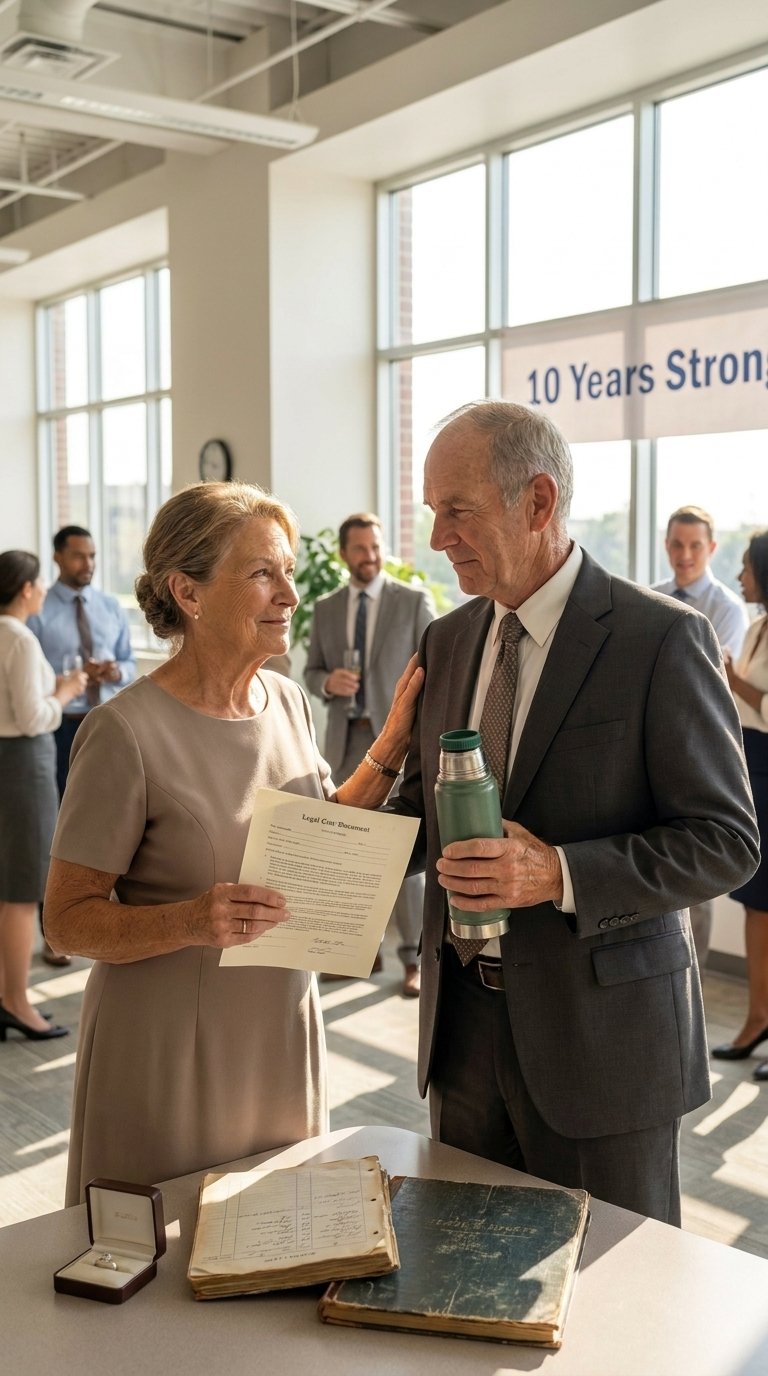
The tenth-anniversary celebration was held in the new warehouse on a warm June evening, under strings of white lights. More than two hundred people came: employees, clients, drivers’ families, the mayor, a few reporters from the local paper. A long banner read, TEN YEARS OF SECOND MILE.
Mark, in a navy suit Helen had picked out, stood at the microphone with his notes trembling in his hand. Helen sat at the front table, wearing a green dress, her hair silver and swept back. Walt, retired now, sat beside her in his best jacket. Daniel sat at the edge of the room, quiet.
“I’m not a good speaker,” Mark began, “so I’ll keep it short.”
The room laughed.
“Ten years ago, I lost everything. My company, my savings, my reputation. I lost almost every friend I had. People I’d trusted for twenty years wouldn’t answer my calls.” He looked at the crowd. “And someone close to me, someone who loved me, told me the kind thing to do was to let my wife go before I dragged her down.”
Daniel’s face went still.
“I was ready to do it. I came very close.” Mark’s voice thickened. “And then my wife looked at me at two in the morning and said, ‘I wasn’t married to the warehouse.'”
A low murmur moved through the room. Helen pressed her hand to her mouth.
“She sold her mother’s emerald ring to pay my bankruptcy lawyer. She sold her pearls to keep us in groceries. She did the books at the kitchen table for two years without a paycheck. She kept this company alive when I could barely get out of bed.” He took a breath. “She never once asked me for anything in return.”
He reached into his jacket and drew out a folded document.
“Five years ago, I went to our attorney and signed over half of this company to Helen. Half the shares, half the votes, effective immediately. I never told her, because I wanted to wait for a night like this. Because I wanted every person who ever doubted her to hear it.”
He walked to her table and held out the paper.
“Helen, you never abandoned me. So I’m making sure that nothing, not law, not luck, not anyone, can ever say this isn’t yours. You aren’t my wife who helped build it. You’re my partner who built it.”
Helen took the page with shaking hands. She read it once, then looked up, tears running openly down her face.
“You foolish man,” she whispered. “I already knew.”
“You knew?”
“Ms. Okafor called me the week after you signed. She said an ethical obligation required her to tell me.” A watery smile broke over her face. “I’ve been waiting five years to see how long you’d keep it a secret.”
The room erupted in laughter and applause. Mark laughed too, helplessly, and pulled her to her feet and held her in front of two hundred people.
Across the room, Daniel stood, wiping his eyes with the back of his hand. When Helen caught his gaze, he nodded slowly, a silent apology ten years in the making. She nodded back, a silent acceptance.
Walt called out from the table, “To Helen!”
Two hundred glasses rose.
“To Helen!”
Late that night, after the last guest left, Mark and Helen walked through the dark warehouse together, past the rows of trucks with their painted logo.
“Do you ever think about the emerald ring?” Mark asked.
“Sometimes.” She took his arm. “Then I think about what it bought.”
“What did it buy?”
She smiled up at him in the half-light, silver-haired and steady.
“This,” she said. “All of it. And you.”