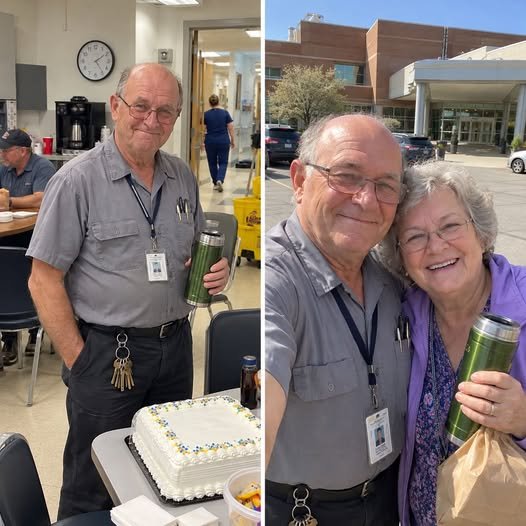
I stood in my doorway with the alarm squealing behind me and my hand locked around the IV pole. The whole floor seemed to hold its breath. Then Neely came out of the supply room, saw me upright and barefoot, and said, “Mrs. Overstreet, bed. Right now, hon. Please.”
“Where is he?”
“Who?”
“My husband. His coffee is still steaming on your counter, and his thermos is under that chair.”
Neely looked at the thermos. Then she looked at me, and I watched twenty-nine years of nursing school and bedside manner drain right out of her face.
“Mrs. Overstreet,” she said quietly, “will you sit down with me first? Five minutes. If you still want to go find him after that, I’ll walk you there myself.”
I should have said no. But my legs were shaking, and there was something in her voice that wasn’t guilt. It was closer to fear. So I let her ease me back onto the bed, and she pulled the plastic chair up close and shut my door.
“He made me promise not to tell you,” she said. “But I’m done keeping it. It’s not right, and I don’t think it ever was.”
“Tell me what?”
She took a breath. “The morning you came in, Conrad was in the ER hallway before the ambulance doors finished opening. They’d paged him to the loading dock to fix a gurney lift, and he saw them roll you in. He didn’t know it was you until he saw your housecoat.” She swallowed. “He went down on the floor, Mrs. Overstreet. A grown man. The security guard had to help him up.”
My throat closed.
“He stayed in the surgical waiting room for nine hours. He didn’t eat. When Dr. Amin came out and said you’d made it through, he asked her one question. He asked, ‘Did she say anything before they put her under?'”
“I didn’t,” I whispered. “I don’t remember.”
“That’s what she told him. And he said, ‘Then the last thing she said to me was that she was sick of my face.'” Neely’s eyes filled. “He thought if you woke up and saw him, it would make you worse. That the sight of him would put you back in that kitchen, with that fight. The cardiologist had told him stress was dangerous, and he took it to mean himself.”
I put both hands over my mouth.
“So he couldn’t come in the room. He’s been on this floor every night since you moved up here. Midnight to six, in that plastic chair by the monitors, watching your heartbeat on the screen. I told him I’d never seen anybody watch a green line like that. He said it was the only part of you he was allowed to look at.”
“The keys,” I said. “The jingling.”
“He’d walk past your door every hour. He kept his keys loud on purpose so he could tell himself he was making a sound you’d know.” She wiped her face on her sleeve. “And the pizza was for the night staff. He bought it so they’d keep an eye on you and call him the second anything changed. He’s paid for it with his own cash. Forty dollars a night.”
I thought of that bank statement, and I nearly laughed, and then I nearly screamed, and what came out was something in between.
“And the hand on his shoulder?”
“Mrs. Overstreet, my father had a heart attack when I was nineteen. I sat in a plastic chair in a hallway for three days. Your husband reminded me of him.” Her braid had come loose, and she pushed it back. “He laughed because I told him your potassium was normal and your color was better. It was the first good news he’d heard in a month.”
I looked at the open door and the empty hall.
“I accused him of something terrible,” I said. “I called my cousin about a divorce lawyer.”
“You didn’t know.”
“I should have.”
“You were scared and you were sick, and nobody told you the truth.” She stood and took my hand. “Come on. I know where he goes.”
She wheeled me down in a chair, IV pole and all, past the dark corridors and through a steel door marked MECHANICAL. A narrow stairwell led down into the basement, warm and loud, smelling of oil and old pipe. The boilers hummed like sleeping animals.
He was sitting on an overturned bucket in front of the biggest one, with his back to the door. His shoulders were bowed. The bald spot gleamed under the single work light.
Neely stopped the chair twenty feet away. “I’ll wait at the top,” she whispered, and she was gone.
I sat there for a long time.
“Conrad,” I said.
He didn’t turn right away. His whole body went rigid, the way a man goes when he’s heard a gunshot. Then he stood, slowly, and wiped his hands on a rag as if he could clean off the last month.
“Darlis.” His voice was a rasp. “You shouldn’t be down here. You ought to be in your bed.”
“I ought to be a lot of things.”
He still wouldn’t look at me. He stared at the rag. “I didn’t mean to scare you. I wasn’t going to bother you. I just needed…” He stopped. “I needed to know you were still breathing.”
“I know. Neely told me.”
He closed his eyes. “She wasn’t supposed to.”
“Conrad, look at me.”
He did, finally. His eyes were red, and his face was gray with exhaustion, and he looked about ninety years old. He looked like the boy I married in a borrowed church in 1980, afraid he’d said the wrong thing at the altar.
“I said I was sick of your face,” I said. “I’ve thought about it every day. It was a lie. I was lonely, and I was angry, and I said the cruelest thing I could find. I’d give my other artery to take it back.”
“You weren’t wrong,” he said hoarsely. “I wasn’t there. I took every shift because I was scared, Darlis. Scared we’d have nothing. Scared of two more years that never came. I thought if I worked hard enough, I could fix it.”
“You can’t fix a marriage with a boiler wrench.”
“I can’t fix much else.”
“Come here.”
He crossed the concrete floor in three steps and knelt beside my chair, and put his forehead on my knee. This tall, quiet man who had never once cried in front of me, who’d buried both his parents and not shed a tear, shook against my leg while the boilers hummed.
I stroked what hair he had left. “You fool,” I said. “You sat in a plastic chair for nineteen nights, watching a green line. You could have just walked in my door.”
“I was afraid you’d tell me to leave.”
“I might have,” I said. “And then I’d have told you to stay. You know that. You’ve known me forty-four years.”
He laughed, wet and broken. “Yeah. I guess I do.”
They sent me home the next afternoon. Conrad drove, both hands on the wheel at ten and two, the way he drives when he’s nervous. When we pulled into our driveway, he came around and opened my door, and then he stopped.
“I have something for you,” he said, and handed me the green thermos.
Inside, instead of coffee, there was a folded paper. It was a retirement form, filled out in his careful block print, signed and dated that morning.
“Two more years never comes,” he said. “You were right. I turned it in at six a.m.”
I read it twice. “And the camper?”
“There’s a lot in Hastings. They’ve got one with a little kitchen.” He ducked his head. “I thought we could look Saturday. If you’re up to it.”
“I’m up to it,” I said.
We went inside. The house smelled of dust and old coffee. On the kitchen counter, where he had left it before every early shift for forty-four years, sat my cup, turned upside down on a folded paper towel.
I hadn’t seen it since September.
I picked it up, and I turned it right side up, and he filled it. We drank our coffee at the kitchen table, the two of us, with nothing between us but the sugar bowl.
Neely sent a card the next week, with a drawing of a green heartbeat line and the words Keep watching. We stuck it on the refrigerator.
And every morning since, before he gets up to feed the cat, my husband sets my cup out on its folded towel, and I find it waiting.
It’s still all the roses I need.