I had never seen Opal cry. In all the years I’d known her, she was the one who handed out tissues at funerals and told everyone else to straighten their backs.
I stood in the doorway, afraid to move.
Finally she spoke, her voice barely louder than the wind in the broken screen door. “I was born in this room.”
“In the kitchen?” I asked.
“On that table, right there, where the table used to be. February of 1937. A snowstorm kept the doctor away, so my mother and the neighbor lady did it by lamplight.” She pressed her palm against the pantry frame again. “My maiden name was Miller, honey. This was my father’s house.”
The floor seemed to tilt beneath me. In six years of marriage, I had never once connected Opal with Miller. Everyone in town simply called her Granny Opal.
“My brother Earl got the farm when Papa passed,” she went on. “He never married, never fixed a thing, and never let me set foot on it after our fight in 1974. When he died, I was told the house would go to the state. I begged Ronald to find out what could be done. To bid on it. To save it for the family.”
She looked at me, and her eyes were clear and sharp.
“Do you know what my son said? He said, ‘Mom, that place is a money pit. Let it go.'”
My stomach dropped.
“I don’t drive anymore. I don’t use the computer. I didn’t know when the auction was.” She gave a thin, tired smile. “And then, two springs ago, I opened the paper and read the legal notices. Purchased by Nathan and Claire Hargrove. I sat in my kitchen and cried for an hour. I thought, the Lord sent someone who’d love it.”
I covered my mouth. I had no words.
“That’s why I made you promise not to tell Ronald,” she said. “He’d have told me I was being sentimental. Or worse, he’d have ruined the surprise.”
“What surprise?”
She walked to the pantry, knelt with a grunt, and pried up the third floorboard with her fingernails. Beneath it sat a rusted coffee tin. Inside were a gold wedding band, a stack of yellowed recipe cards, and a thick envelope held shut with a rubber band.
“The ring was my mother’s. The recipes are the best thing a Miller woman ever wrote. And that,” she said, tapping the envelope, “is for you.”
The envelope held nineteen thousand four hundred dollars in cash, wrapped in a note.
Egg money and quilt money, saved over sixty-three years. I put some of it here when I was a young woman, and the rest I’ve been saving ever since. I’d planned to leave it to whoever kept this house.
“Opal, I can’t,” I whispered.
“Oh, you can,” she said. “Because I intend to rent that front bedroom from you. This is my first year’s payment. I’d like to die where I was born, if it’s all the same to you.”
I laughed and cried at the same time. I put my arms around her, and she patted my back like I was a child.
“I know about the bluebird card,” she said into my shoulder. “Judy bragged about it at church. Said it was so thoughtful. It made me sick.”
Nate came home that night to find his grandmother and me at the kitchen table, laughing over her mother’s biscuit recipe by lantern light. When he heard the whole story, he sat down on the floor and put his head in his hands.
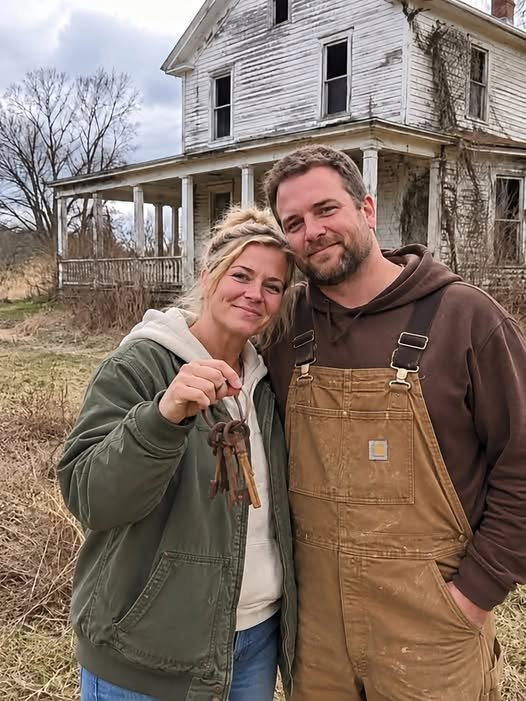
Three weeks later, we fixed up the front bedroom. Opal moved in with her rocking chair, her quilts, and a small wooden bluebird house, which she set on the porch rail the first morning.
Word got out, as it always does in a small town. And the following Sunday, Ron and Judy’s truck came crunching up the gravel drive.
They stood in the yard, staring at the freshly painted porch and the glowing windows. Opal sat on the porch swing like a queen, a quilt across her lap.
“Mother?” Ron said. “What are you doing here?”
“Living,” said Opal.
“But this house…” He looked at Nate. “You bought the Miller place? With what money?”
“Our own,” Nate said evenly. “Nine hundred hours of overtime and a fishing boat.”
Judy’s face crumpled. “We never knew you wanted…”
“You never asked,” I said. It came out gentler than I expected, but it was true. “We didn’t need the twenty thousand, Judy. We managed. We always do. But a card telling us we were so independent that you never had to worry about us? That one hurt.”
Opal rose from the swing, slow and steady, and walked down the steps to face her son.
“Ronald,” she said, “I raised you to be fair. Somewhere along the way, you decided that the child who doesn’t beg is the child who doesn’t need. That’s not independence. That’s loneliness wearing a brave face.”
Ron’s jaw trembled. He looked at his mother, then at the house he had called a money pit, then at his son.
“I confused not asking for help with not wanting it,” he said hoarsely. “I was wrong. Nate, I’m so sorry, son.”
Judy was crying openly now, clutching a tissue. “We thought we were complimenting you,” she whispered. “We truly did. I’m ashamed.”
Nate stepped forward and took his father’s hand. “Dad, we don’t want a check. We never did. We wanted you to look at us and ask what we needed.”
Ron wiped his eyes with the back of his wrist. “All right then. What do you need?”
I almost laughed. “A porch that doesn’t sag, for one.”
“Done,” he said immediately.
The next Saturday, Ron arrived before sunrise with a truckload of lumber and spent the whole day rebuilding the porch with Nate. Judy came behind him carrying a casserole and apologized to me again, quietly, in the kitchen. Kim, Jeff, and Stacy showed up by afternoon, embarrassed and ready to help, and by sunset the whole family was eating supper at the Miller table.
It was the first Sunday dinner we’d had at our own house.
The Ending
Opal lived in that front bedroom for two more years.
She taught me every one of her mother’s recipes, and she spent her afternoons on the porch swing, watching a pair of bluebirds nest in the little wooden house she’d set on the rail. When she died in her sleep at ninety, the whole county came to the funeral. The family stayed late that evening, sharing stories at the old kitchen table.
In her will, she left Nate and me the land, the ring, the recipes, and one small note, written in her tidy cursive:
Bluebirds don’t build in new houses. They find the abandoned ones and make them home. That’s the best kind of independence there is.
I framed that note and hung it in the kitchen, right next to the greeting card with the bluebird on the front, the one Judy had once handed us at Easter. She’d asked if she could have it back, to throw away. I told her no. I wanted to keep it.
Because that little card had been right about one thing after all. We could manage on our own. We just never had to again.
The lesson: Don’t mistake the quiet ones for the ones who need nothing. Strength isn’t the absence of need. It is the habit of not asking. Ask anyway, and offer before you’re asked.