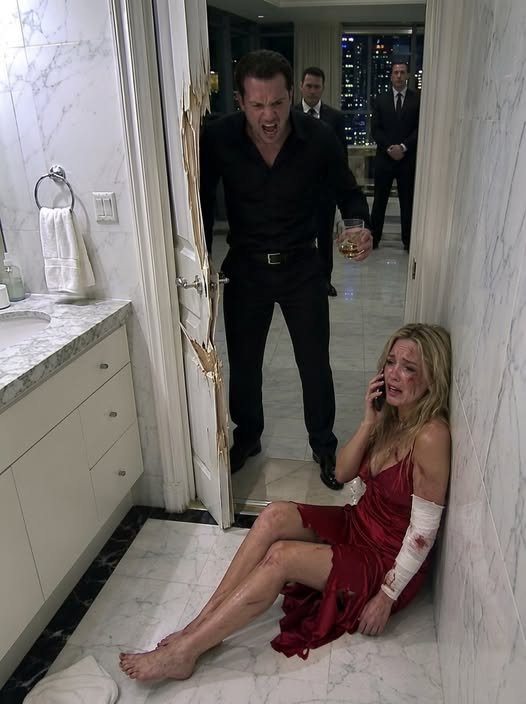
The bathroom door exploded inward, and for one heartbeat, all I could see was my husband’s silhouette against the hallway light.
Derek filled the doorway, swaying, his tie loose, the smell of whiskey rolling off him in waves. He looked down at me crumpled on the cold tile, cradling my broken arm, and he smiled the same way he had smiled when he broke it.
“Look at you,” he slurred. “Hiding in the bathroom like a little mouse. Who did you call, Lena? Your mother? She’s three states away.” He crouched and snatched the phone from my hand. He glanced at the screen, still glowing with an active call, and laughed. “Nobody’s on the line, sweetheart. Nobody’s ever on the line for you.”
He threw the phone against the wall.
He didn’t know that Vincent had already heard everything.
Derek grabbed a fistful of my hair and began dragging me toward the living room. I screamed, and somewhere in the back of my mind I counted the seconds, the way you count between lightning and thunder. Six minutes. Five. Four.
Then the front door of our apartment came off its hinges.
It didn’t open. It fell, flat on the hallway floor, and four men in dark coats stepped over it as calmly as if they were entering a church. Derek froze, his hand still tangled in my hair.
Behind the four men came a fifth.
Vincent Moretti didn’t hurry. He walked into the apartment slowly, buttoning his charcoal jacket, his eyes sweeping the room: the overturned chair, the broken glass, the blood on my sleeve. His gaze landed on my twisted arm, and something in his face went very, very still.
“Seven minutes and forty seconds,” he said quietly. “My apologies, Lena. Traffic.”
Derek let go of my hair. His bravado cracked like thin ice. “Who the hell are you? This is my home. That’s my wife.”
Vincent turned his head toward him, slowly.
“I’m the man she called,” he said. “The one you said didn’t exist.”
Two of his men crossed the room in three strides. Derek tried to swing, a clumsy, drunken swing, and found himself pinned face-first against the wall with his arm twisted behind his back. His shouting turned into a high, panicked whine.
Vincent knelt beside me, and for the first time in my life, a man much larger than me lowered himself to my level so that I would not have to look up.
“Lena,” he said. “Look at me. You’re safe now.”
He took off his coat and wrapped it around my shoulders. It smelled like cedar and rain. I broke down completely, sobbing into the collar of a stranger I had met exactly once.
“Is he going to… are you going to…” I couldn’t finish.
Vincent glanced over his shoulder at Derek, who had gone gray. Everyone in that room, including me, expected the next words to be a death sentence.
“No,” Vincent said.
Derek’s knees nearly gave out in relief.
“Death would be too easy for him,” Vincent continued, his voice cold and even. “And it would make me the kind of man I swore I would never be again. Tommy, the phone.”
His lieutenant placed a call. Not to some hidden crew, but to 911.
“There’s a domestic assault in progress at this address,” Tommy said evenly. “Send police and an ambulance. We’ll be waiting.”
I stared at Vincent, confused. The most feared mob boss in New York was waiting for the police.
“The next hour matters more than the last five years,” he told me, softly enough that only I could hear. “You’re going to tell them everything. Tommy filmed the doorway, the room, and your husband’s own words before we came in. Your arm will be photographed. Every bruise will be documented. A man like that doesn’t get to vanish. He gets to stand in a courtroom with the whole world watching.”
The police arrived within minutes, with paramedics close behind. By the time the officers came through the broken doorway, Vincent’s men had stepped quietly to the side with their hands visible, their faces calm. Derek, still pinned against the wall, started to shout that he was the victim.
Nobody listened.
In the ambulance, as the paramedic splinted my arm, Vincent stood outside the open doors in the cold, his hands in his pockets.
“Why?” I asked him. “Why would you come for me? You don’t even know me.”
He was quiet for a long time.
“When you spilled my coffee that night,” he said, “your sleeve rose up. I saw the bruise on your wrist. Four fingers. I knew that mark, Lena. I’d seen it before.”
He looked up at the dark sky.
“My sister Gianna was married to a man like yours. She told me everything was fine every time I asked. I was nineteen, and I believed her. I didn’t look hard enough. By the time I understood, it was a funeral.” His jaw tightened. “Nobody came for her. Nobody even knew to knock on the door. So I made a promise. Whenever I see that mark on someone, I leave a card. A way out. And I wait to see if they’ll use it.”
“Most never call,” he added quietly. “You did. That took more courage than anything I have ever done.”
The Ending
Derek Hollis was charged with aggravated assault and domestic abuse. Once the investigation began, the hospital records surfaced: seven emergency room visits over five years, each with a story I had been forced to tell. Two former girlfriends came forward, one after nine years of silence. The video Tommy had filmed, Derek’s own voice mocking me through a broken door, was played in court. The jury needed less than three hours.
He was sentenced to twelve years in prison.
I sat in the courtroom with a cast on my arm, and when the judge read the sentence, I felt something I hadn’t felt in half a decade. I felt light.
Vincent never asked for anything in return. He didn’t visit. He didn’t call. I heard from him only once, through a lawyer, who handed me an envelope. Inside was a lease for a sunny apartment in Brooklyn, paid for a year, in my name only, and a short note: This is not a debt. It is a door. Walk through it.
For months, I did nothing but heal. My arm mended slowly, and so did the rest of me. I learned to sleep through the night. I learned to hear a man’s footsteps in the hall without my heart seizing.
Then one morning, I called Vincent’s lawyer and asked to meet.
When I walked into that office, Vincent was standing by the window. It was the first time I had seen him since the ambulance.
“I don’t want to owe you anything,” I said.
“You don’t.”
“But I want to do something. For the people who never get to make that call.”
He studied me for a long moment. Then, for the first time since I’d known him, Vincent Moretti smiled.
Six months later, we opened Gianna’s Door, a shelter and legal aid center for women escaping violent homes, funded by Vincent’s money and run by me. Every woman who walks through the front door receives a safe bed, a lawyer, and a counselor. Above the entrance hangs a small brass plaque with his sister’s name.
On my desk sits a single black business card in a simple frame. The gold stamp has faded a little. The handwritten words on the back have not.
If you ever need help.
And now, whenever a woman comes into the diner where I still volunteer on Saturday mornings, with a sleeve pulled down too far and a bruise she hopes no one has noticed, I leave my own card beneath her check.
On the back, I write the same four words.
The lesson: Courage is not the absence of fear. It is picking up the phone anyway. And if you ever see someone who needs help, don’t wait to be asked. Leave the door open.