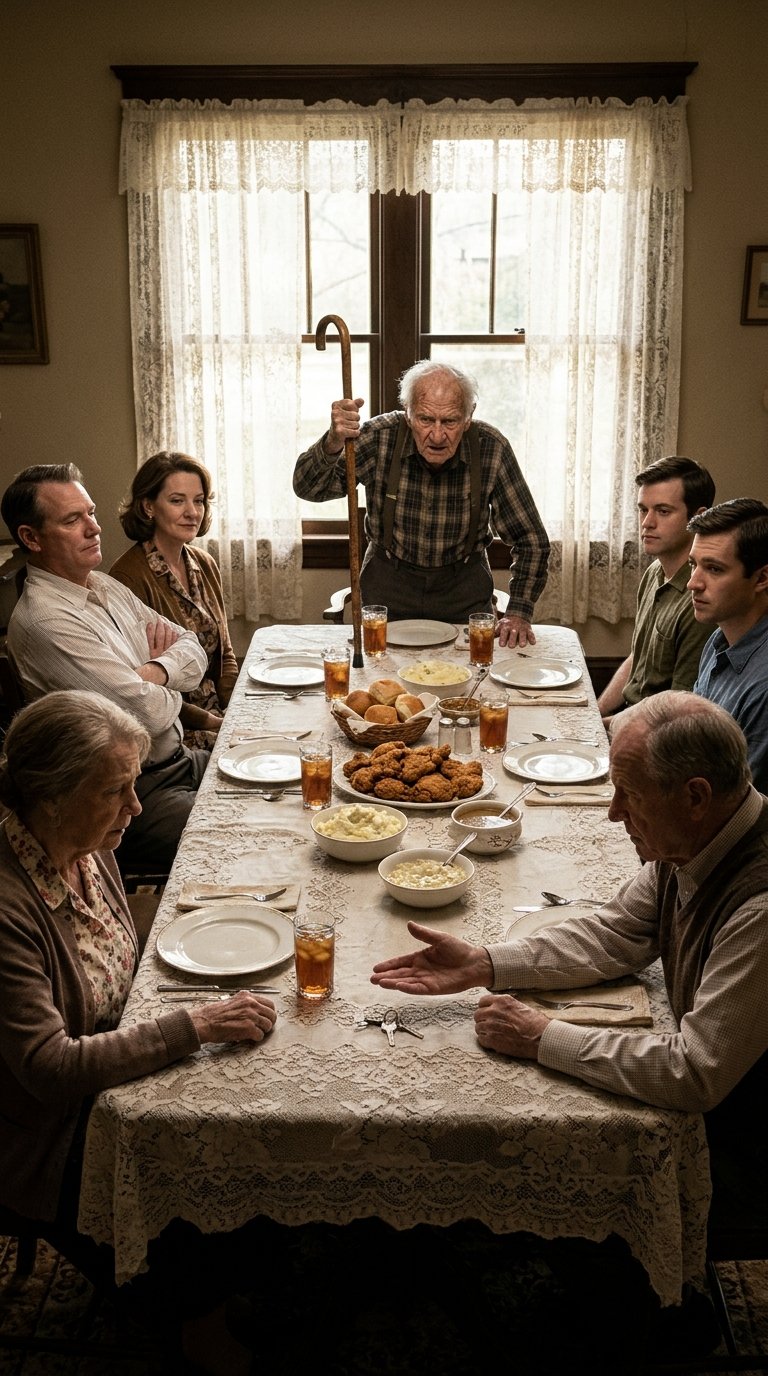
The cane came down on the table so hard that the gravy boat jumped and Lurline’s water glass tipped into her lap.
“Put those keys back in your pocket, Mabel,” Ulysses Kroeker said.
It was the most words he had said to me in one breath in forty years.
Nobody moved. The old man rose from his chair, ninety-two years old and shaking, but standing straighter than I had ever seen him stand. He leaned on the cane with both hands and looked down the table at his son.
“Weston, sit up. You’re going to hear something, and you’re going to hear all of it.”
“Dad, you’re confused,” Weston said. “You’ve been out of sorts since the fall.”
“I’ve never been clearer in my life.”
He reached into his good shirt pocket and drew out a folded, yellowed envelope. His hands trembled as he laid it on the tablecloth beside the green beans.
“Forty years ago, you told this girl I thought she wasn’t good enough for this family,” he said. “I never said that. Not once. Not a word of it.”
The room went still.
“The week before your wedding,” he went on, “you came to me and said Mabel’s people wanted money. That she was marrying you for the land. I told you that was nonsense. I told you I’d watched her at the church picnic, carrying her mama’s pies and not asking anybody for a thing, and I thought you’d done better than you deserved.” His jaw worked. “You told her the opposite. And I was too proud and too stubborn to correct it. I figured if she wanted to know what I thought, she’d ask. I was a fool. I’ve had forty years to be sorry about it.”
I couldn’t breathe. Forty years of shame, and it had been built on a lie told over a rehearsal dinner.
“That’s not…” Weston started.
“I’m not finished.” The cane tapped once. “I watched you drink your way through 1990. I watched this woman take your children and go to her mama’s, and I thought, good for her. When you got sober, I thought maybe there was hope for you. Since then, you’ve used that year against her every chance you got. I’ve heard you do it at my own Christmas table.”
Lurline gave a nervous little laugh. “Daddy, surely this isn’t the time.”
“It’s exactly the time, Lurline.” He turned his pale eyes on her. “You said you couldn’t take me in because your hands were full. Yet you’ve got room for your whole family in a house that isn’t yours. I’ve been in that back bedroom for six weeks. I hear things through walls. You two have been planning this for a month.”
Darwin put down my yeast roll.
“I came to Mabel’s house with nothing but a suitcase,” Ulysses said. “She never once made me feel like a burden. She cooked, she cleaned, she put her own mama’s quilt on my bed. Meanwhile, my own son sat in the next room scheming to push her out of her own home.”
He slid the envelope toward me.
“Open it, Mabel.”
My fingers wouldn’t work. Finally I got the flap loose. Inside was a document with a county seal and a lawyer’s letterhead: a revised will, signed and notarized two weeks earlier, the week he came to stay.
“I’ve changed my estate,” he said quietly. “Eight hundred acres, the equipment, the accounts, and the mineral rights under the east section, which the oil company has been after for years. All of it was going to Weston. Now it goes to the one person at this table who’s earned it.”
He looked at me.
“It goes to you, Mabel. Free and clear. You’ll have it in your own name, and no one can touch it without your signature.”
Weston shot to his feet. “You can’t do that!”
“I can, and I did. Bill Hartzler at the bank witnessed it, and my attorney in Lyons has the original.” The old man’s voice never rose. “You’ll still get your portion, son, if you earn it. Treat your wife like a partner and not a doormat, and Mabel can decide what you deserve. I trust her judgment. It’s more than I can say for yours.”
Lurline’s face had gone gray. “She’s been manipulating you,” she hissed. “She’s been working on you since you got here!”
The old man actually smiled, a small, dry, astonishing thing.
“Lurline, in six weeks that woman never asked me for a single thing. She never mentioned the farm, not once. You’ve been here three hours.”
Then he turned back to me, and his eyes had gone bright and wet.
“I should have told you the truth forty years ago. I’m telling you now. You were always good enough, Mabel. You were better than all of us.”
I’d spent four decades believing I was something to be ashamed of. I put my keys on the table, but not for Lurline. I set them down in front of my own plate.
“Lurline,” I said, and my voice was steady for the first time in my adult life, “you and Darwin and the boys will be leaving tonight. I’ll pack you a plate of chicken for the road. This is my house, and I decide who lives in it.”
“Mabel, you can’t…” Weston began.
“Weston.” I looked at my husband of forty years. “You told me to hand over my keys. Now I’ll tell you what you can do. You can apologize, and mean it. Then you can go to your meetings, find a counselor, and learn what a marriage is. Or you can pack a bag and go stay at Lurline’s. I’ll leave that choice to you.”
He sat down very slowly.
Lurline’s family left within the hour. The boys wouldn’t meet my eyes, and Darwin carried out their suitcases in silence.
Weston did not leave. That night he sat on the edge of our bed with his head in his hands and cried the way I hadn’t seen since 1990. He told me everything: the lie, the jealousy, the years of throwing my past in my face to keep me small, because he was afraid I’d realize I could do better. I didn’t forgive him that night. Forgiveness took longer, and I made him earn every inch.
Ulysses stayed on with us through the winter. We sat on the porch in the afternoons, and for the first time I heard him talk. He told me about his wife, about the drought of 1956, about the day Weston was born. Sometimes we simply sat together in silence, and it was a comfortable silence at last.
He passed in his sleep the following April, in my mama’s quilt, in my old bedroom.
At the funeral, the whole county came. When Weston stood to speak, he told them what his father had been to me, and what he himself had failed to be. I sat in the front pew with my head high.
I run the farm now with a good foreman and a lot of help from the old books. The grain elevator in Lyons sent flowers when I took over, and a note that said, Welcome home, Mabel.
Weston goes to his meetings. He helps around the farm. Some days, he’s even kind.
And every fall, I set the table with my mama’s yeast rolls and an empty chair at the end, in honor of a man who finally told me the truth.