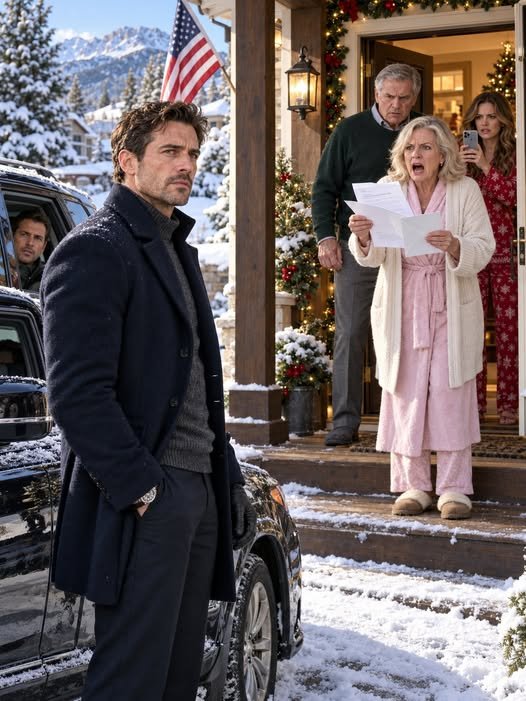
“Richard! Richard, get out here!”
My father came to the door in his reading glasses, holding a coffee mug. Mom shoved the first page into his hand. I stood at the bottom of the porch steps in the snow, and I did not raise my voice.
“It’s a formal notice,” I said. “Read the second paragraph.”
He read it. The mug trembled and a little coffee slopped onto the boards.
“Ninety days,” he said. “You’re giving us ninety days?”
“I’m giving you what the law requires, and a little more. I’m the sole owner of record of this house, Dad. Seven years ago, when the bank was about to foreclose, I bought out the mortgage and put the title in my name. You signed the agreement. You said you’d take care of it, and you never remembered because you never read it. Since then I’ve paid every mortgage installment, every utility bill, and your insurance premiums. The folder behind that notice has all of it.”
“You can’t evict your own parents on Christmas morning,” Mom said, her voice climbing. “People will hear about this.”
“People will hear about a lot of things, Mom. I’m not here to start that. I’m here because last night my sixteen-year-old daughter drove forty minutes through a snowstorm and ate half an orange for Christmas dinner.”
Her mouth opened. Nothing came out.
Sienna’s car skidded into the driveway then, because of course Mom had called her the moment she saw the first line. She jumped out in her robe and boots. “What is he doing? Mom, what is this?”
“Ask her about the seating chart,” I said. “Twenty-eight names. Your clients and neighbors had chairs. My daughter didn’t.”
“It was a business dinner,” Sienna said. “I needed to network. Lennon would have been bored.”
“Then someone could have told her. Someone could have called me. Instead she got a card with two words and no signature.” I took it out of my pocket and held it up. “She still wore the sweater Mom likes.”
Dad had gone gray. He looked at the folder, then at me, and for the first time in my life I saw something in his face that resembled shame.
“Orion,” he said quietly. “I didn’t know she was turned away. Marjorie told me Lennon had other plans.”
Mom’s head snapped toward him. “Richard.”
“Is that true?” he asked her. “Did you tell me that?”
Nobody answered. The silence was an answer.
I said what I had come to say. “The notice isn’t for punishment. It’s so everyone understands where things stand. The house belongs to me, and I’ve been generous because I believed you loved us. Last night proved I was paying for something that wasn’t there.”
Sienna’s anger collapsed into panic. “The catering business runs out of that kitchen. If we lose the house, I lose my clients.”
“Then you’ll find a commercial kitchen. Which I notice you never paid for, because I was covering your utilities.” I handed her the invoice. “I’m done subsidizing it.”
I drove home with Jonah in silence. When I walked in, Lennon was sitting at the kitchen table in her pajamas, and Jonah, bless him, had already texted that he’d bring pancake supplies. We made Christmas together, just the three of us, and for the first time in years the house felt like it belonged to people who wanted each other there.
I told her all of it that afternoon, not to burden her but because she deserved the truth. She listened with her chin on her knees.
“I thought it was something I did,” she said.
“It never was. Not once. I need you to hear that.”
She nodded, and her eyes filled, and I held her until the tears slowed.
The next three weeks were quiet. I didn’t call my parents, and they didn’t call me. Then, on the second Sunday of January, the doorbell rang.
My father stood on the porch alone, in a wool coat, holding an old shoebox.
“May I come in?”
Lennon was upstairs. I stepped outside and closed the door behind me. “Say what you came to say, Dad.”
“I deserved the notice.” He cleared his throat. “I’ve been a poor father, Orion. When your wife died, I should have driven to your house every week. I should have asked how you were instead of criticizing your career. I let your mother’s opinions become mine because it was easier than facing my own failures. And I let Lennon go without a place at my table.” His voice broke. “That I can’t forgive myself for.”
He handed me the shoebox. Inside were cards Lennon had mailed them over the years, birthdays, thank-yous, a drawing she made at seven. Every one had been kept.
“Your mother kept them too,” he said. “She just doesn’t know how to say any of this. That doesn’t excuse her. But I wanted you to see that the love was there. It was buried under a lot of pride.”
I wasn’t ready to forgive, and I told him so. But I told him the door wasn’t permanently shut.
Over the next months, things changed slowly. Dad came to dinner every other Sunday and sat at our small table, eating whatever Lennon cooked, asking about her school and actually listening. The ninety-day notice quietly became a new arrangement: my parents stayed in the house, but under a written lease, with a modest rent I put into a college fund for Lennon. Sienna moved her business into a rented commercial space and, to everyone’s surprise, it did better.
Mom held out the longest. In April, she appeared at our door with a tin of shortbread and a card she had written by hand. It was long, and it wasn’t graceful, and half of it was apology wrapped in justification. But at the bottom she had written, I was wrong, and I’m sorry, Lennon.
My daughter read it twice. Then she looked at her grandmother and said, “Thank you for telling me.”
It wasn’t a full reconciliation. It was a beginning, and it was honest.
The following Christmas, Mom sent an invitation. At the bottom she had written, in her own hand, Reserved: Lennon, head of the table.
We went. Lennon wore the red sweater. There were twelve chairs and twelve guests, and no one had to ask where she should sit.
When dinner ended, Lennon found me in the hallway, her eyes bright.
“Dad,” she said, “thank you for not making a scene.”
“I didn’t need one, sweetheart,” I told her. “I just needed to make sure you’d never be turned away from anywhere again.”